
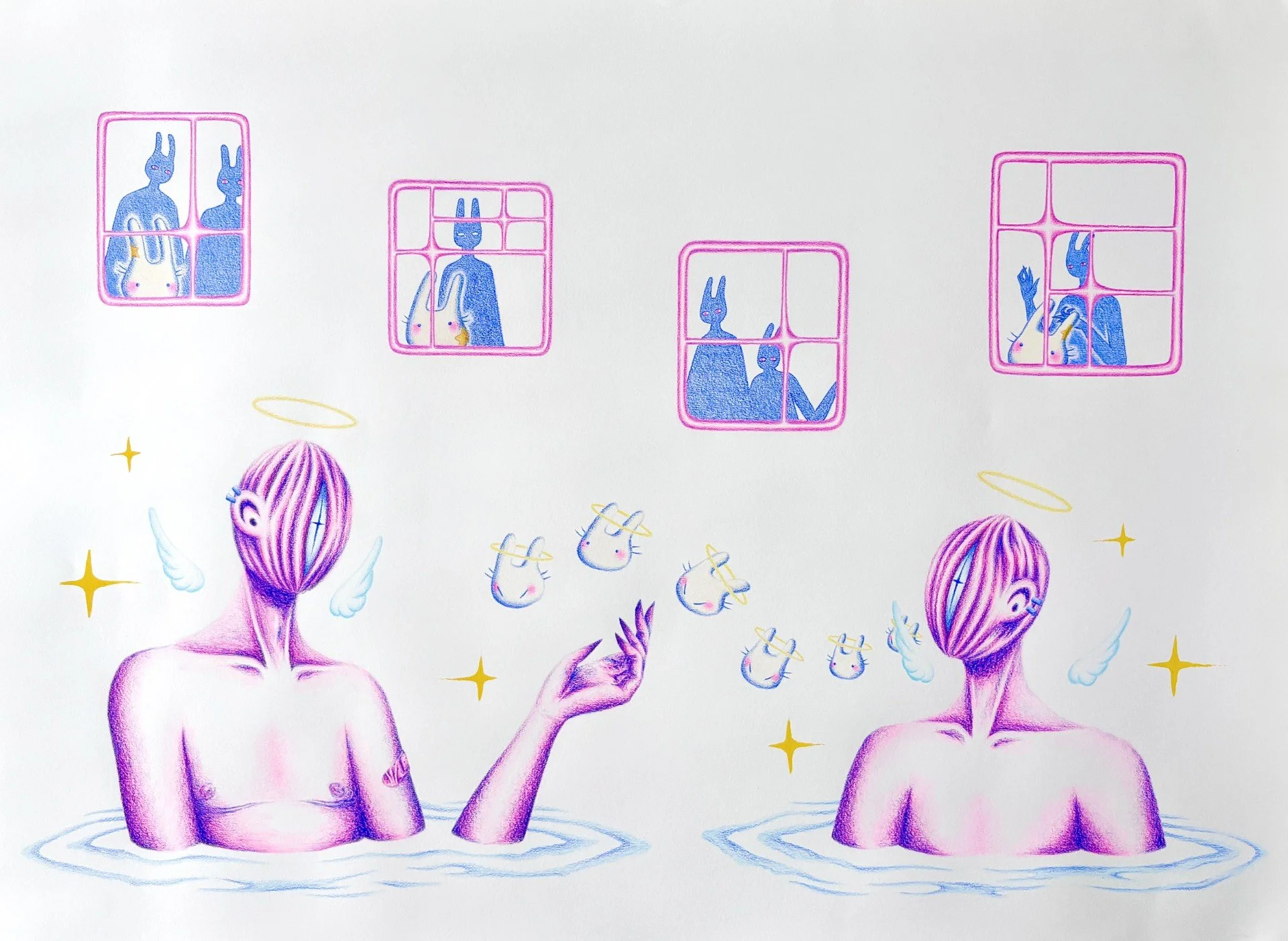
Yuji Szero Lee, Witnessing the Second Rebirth, 2025, pencil crayon and gouache on paper.
This exhibition centres artistic methods from the visual languages of comic and animation arts.
Featuring: Dana Belcourt, Cyril Chen, Simon Fuh, Jordanna George, Rachel Lau, and Yuji Szero Lee.
Panel After Panel gathers artists working in the visual styles of animation and comic arts within a gallery context. The exhibition features artistic interpretations of world-building and cosmologies to create narrative environments that probe at our use of communal spaces like subways, neighbourhoods, and even underscore our collective responsibilities in stewardship. The artists use human, non-human, and post-human perspectives to express joy, fear, and desire in navigating social, cultural, ecological, and inner worlds.
Panel After Panel is part of the 4th annual Regina Comic Arts Festival. The exhibition includes artworks, as well as a reading nook with materials provided by the artists and selections of Regina Public Library's bookshelves.
Essay ↑
Small and Many Wonders – Exhibition Essay by Stacey Fayant
Artists: Dana Belcourt, Cyril Chen, Simon Fuh, Jordanna George, Rachel Lau, Yuji Szero Lee
I initially set out to curate this exhibition with no confidence in my understanding and relationship to comics and animation. My brain does not easily process comics and graphic novels. The panels, word bubbles, and visual activity within a comic book panel tend to overstimulate my mind and I end up feeling confused. Therefore, I came at this exhibition by relating comic books and animation to my background in printmaking. The interesting history of printmaking to me is its connection to “activist art.” Printmaking has a long tradition of exploring political themes or even being used as a tool for propaganda.
In the art world we sometimes find ourselves making art that only other artists see, understand or have access to. And while having a community of like-minded people can feel safe, most artists are aiming to have their work seen, experienced, and understood by as many people as possible.
Printmaking made it possible for many more people to see a piece of art. Similarly -- and relatedly -- comic books and animated media, like the newspaper comics and television cartoons of my childhood, became remarkably accessible forms of art and culture for viewers. Zines have taken accessibility even further and can be made by anyone who has paper, pen, and access to a stapler or even just the ability to fold paper! Zines ushered in a paradigm shift for printed media, wherein folks became empowered to evolve into not just consumers, but active producers of cultural media. This expanded ability to both create and consume allowed artists to reach out far and wide and create bonds of community with people they may never meet.
The artists in Panel After Panel create work that speaks to community in various ways: There are common threads of attention, love, grief and emotional vulnerability. These themes and emotions are often dismissed as private, irrelevant or useless in the wider public, but these feelings are a powerful catalyst for change.
How powerful is it to love and isn’t it even more powerful to ask others to love? As a GenX-er I am continually impressed with my 18-year old’s ability to demand a level of care, acceptance, and understanding from the world around them; a level of love and compassion that my generation would never have imagined we could ask for. I am witness to a movement of kindness that can dismiss aggressive and toxic behaviour as immature. This movement of kindness expects a higher level of maturity and respect from adults and calls upon everyone to take responsibility for their words, actions, and, ultimately, their belief systems.
Just like vulnerable feelings, the mediums used by these artists; graphic novel, comic, zine, animation are also traditionally dismissed as ephemeral, irrelevant, immature, or lightweight. But these genres are powerful infiltrators, using aesthetically appealing drawing techniques and accessible language to draw in an audience. I am reminded of the Looney Tunes cartoons of my childhood and their ability to draw me in with their entertaining comedy, colours and short length while also containing some rather adult themes, subversive satire, wartime propaganda, and questioning authority. Those cartoons taught me about the culture I lived in and what my role would be. Similarly, the artists in this exhibition use these genres to plant ideas in our cultural concrete that will grow, breaking apart and changing what seems unchangeable.
Through panel after panel after panel, the exhibiting artists convey love and vulnerability in their work while they also call for change and challenge norms by touching on environmental issues, queerness, cultural loss and reclamation, and apathy. The work in this exhibition is a call to community: A call to come back to each other in our sameness and difference -- a call to look inward as you look outward and find the relatedness in all our relations to build our bonds and build our future.
Images ↑
Media ↑