Filtering by: 2026
Casey Koyczan: raven: tatsǫ́
Feb
28
to May 27

Casey Koyczan: raven: tatsǫ́

  • Dunlop Art Gallery, Regina Public Library, Sherwood Village Branch (map)
  • Google Calendar ICS

Casey Koyczan - raven: tatsǫ́

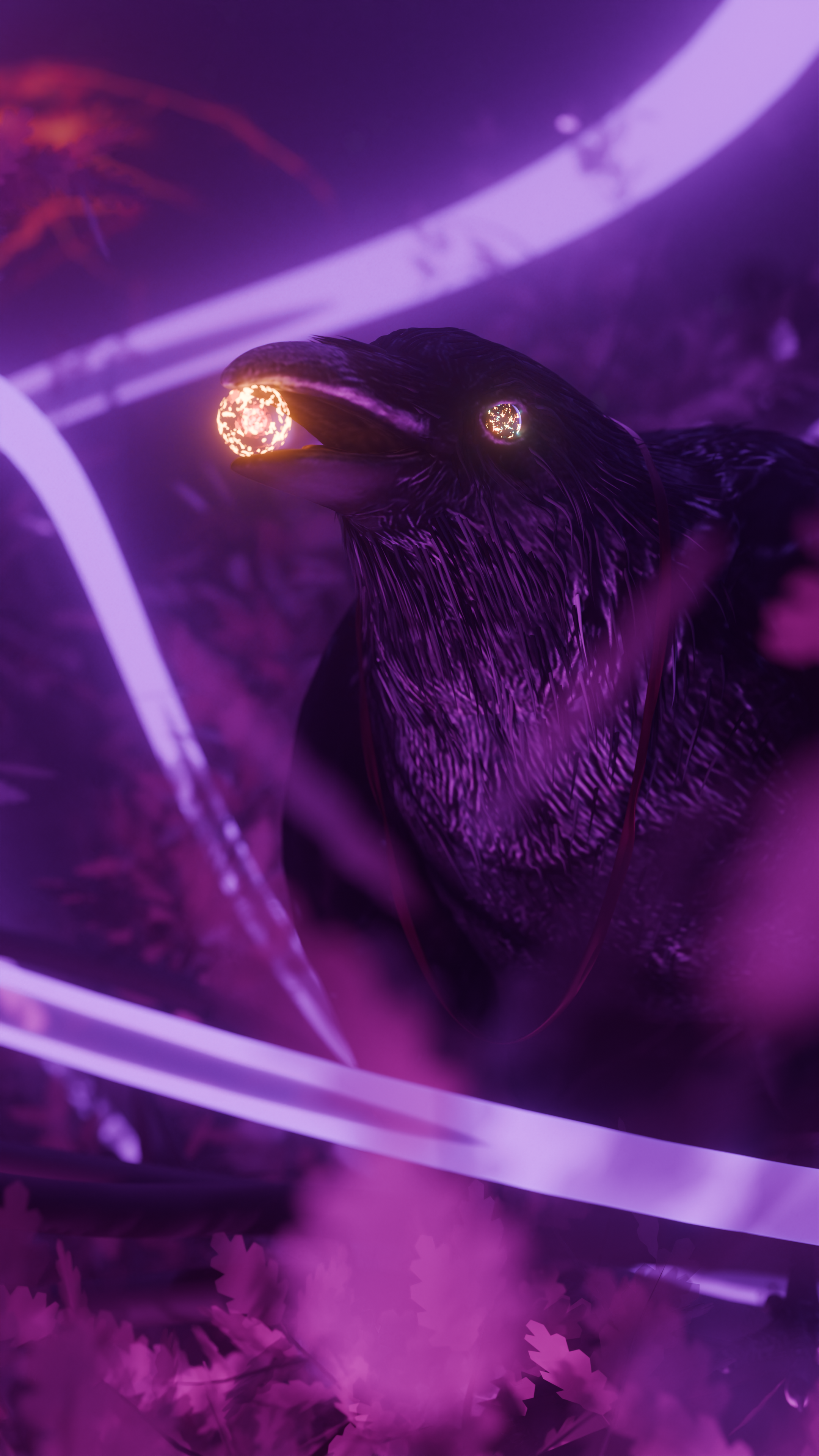
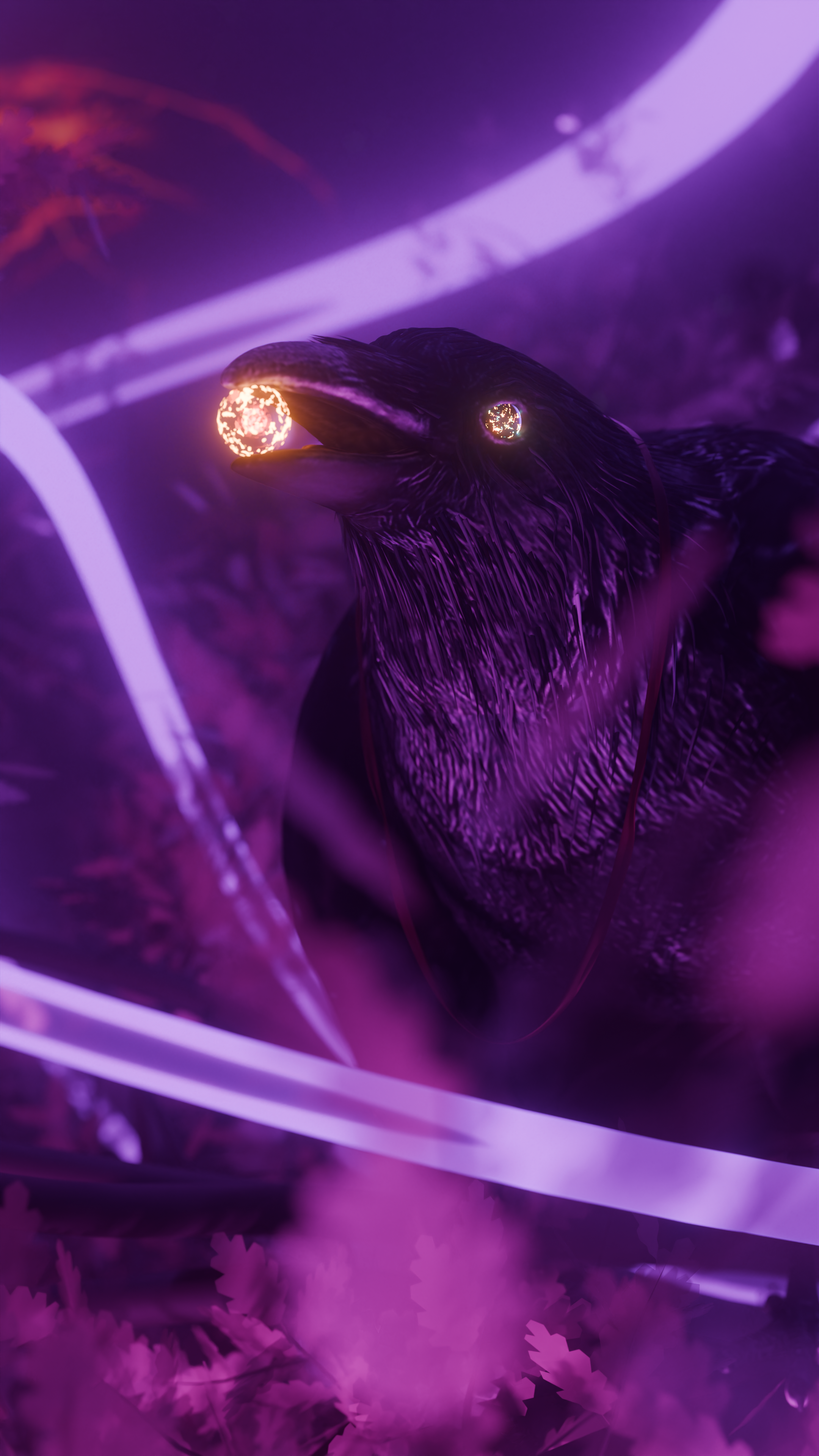
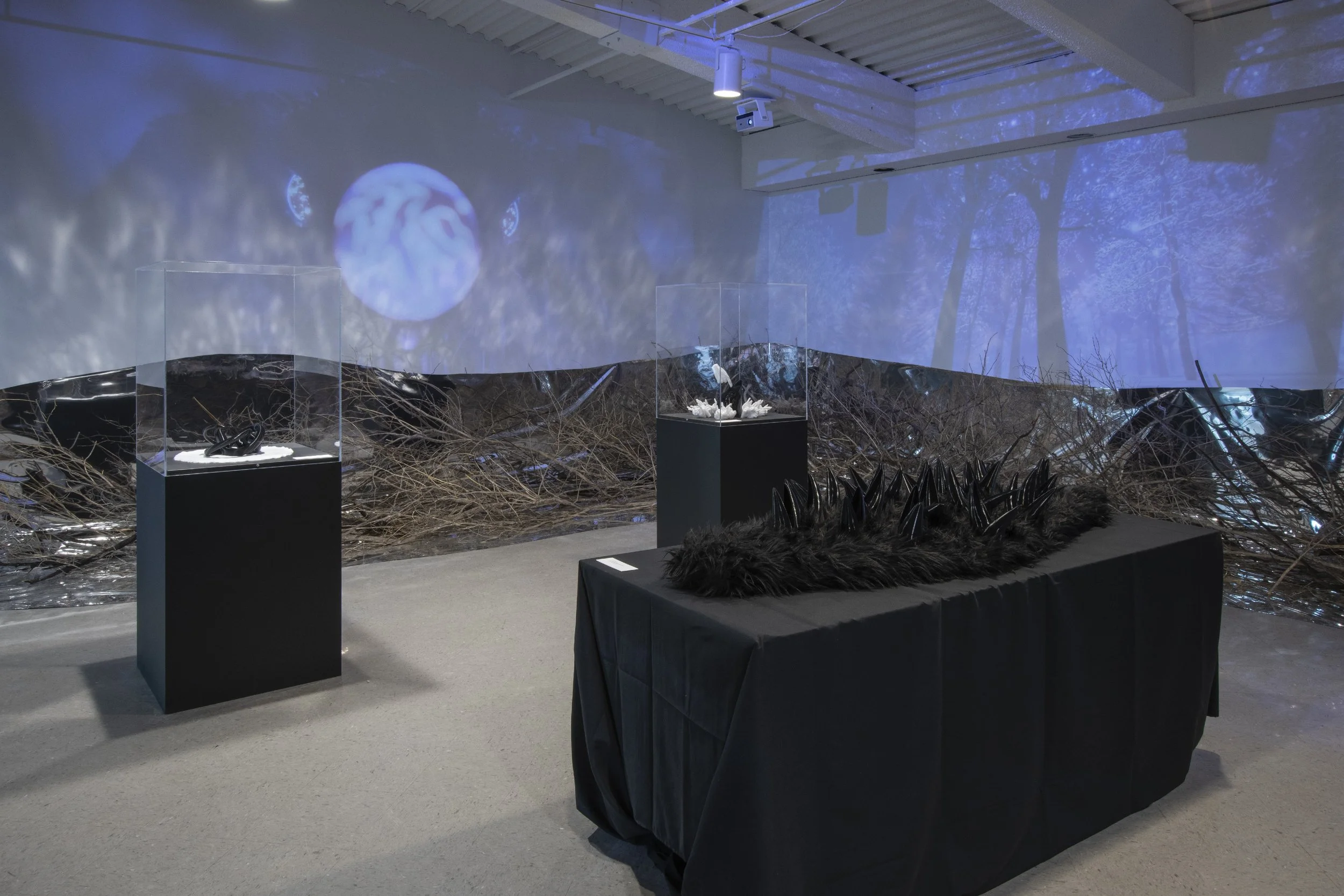
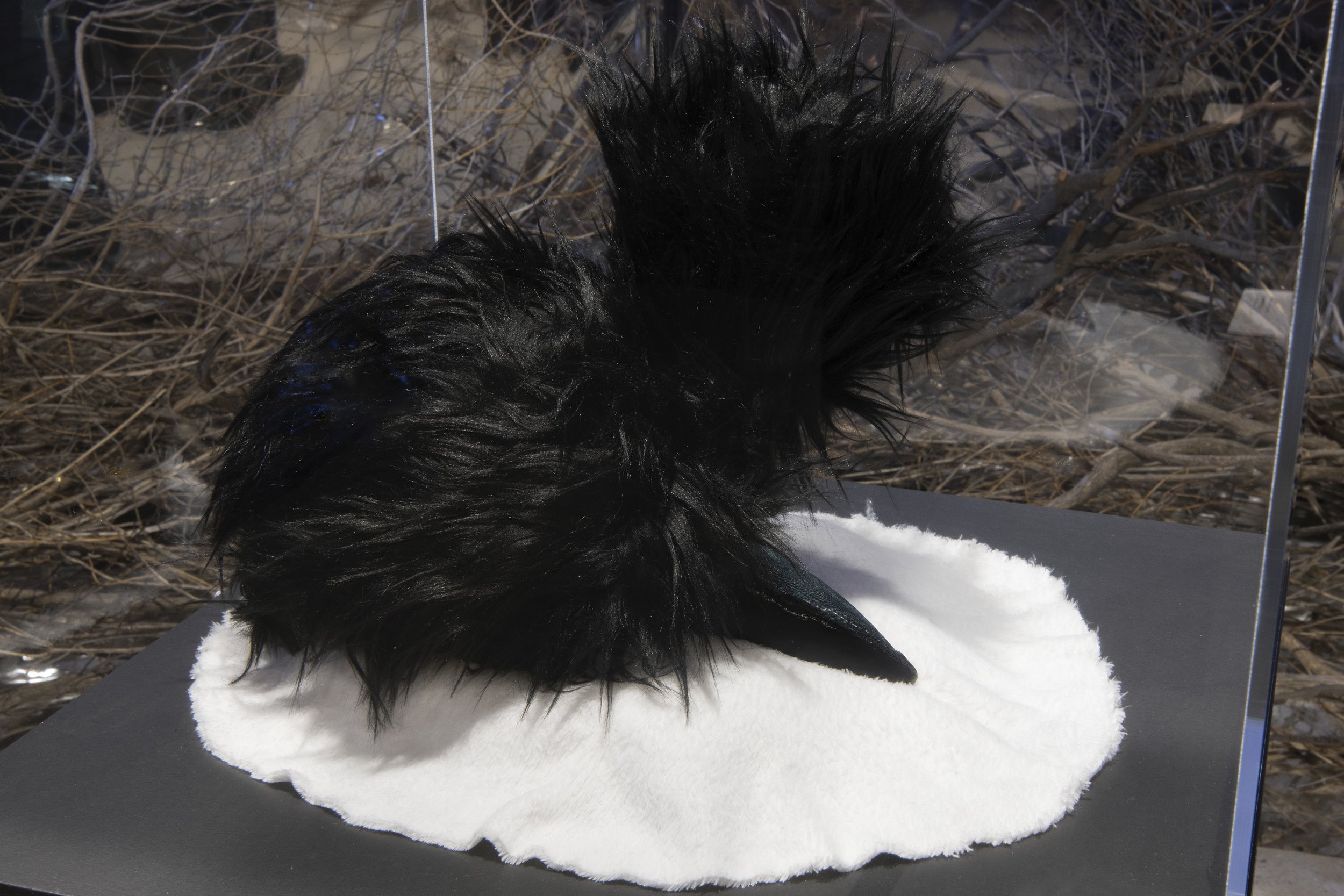
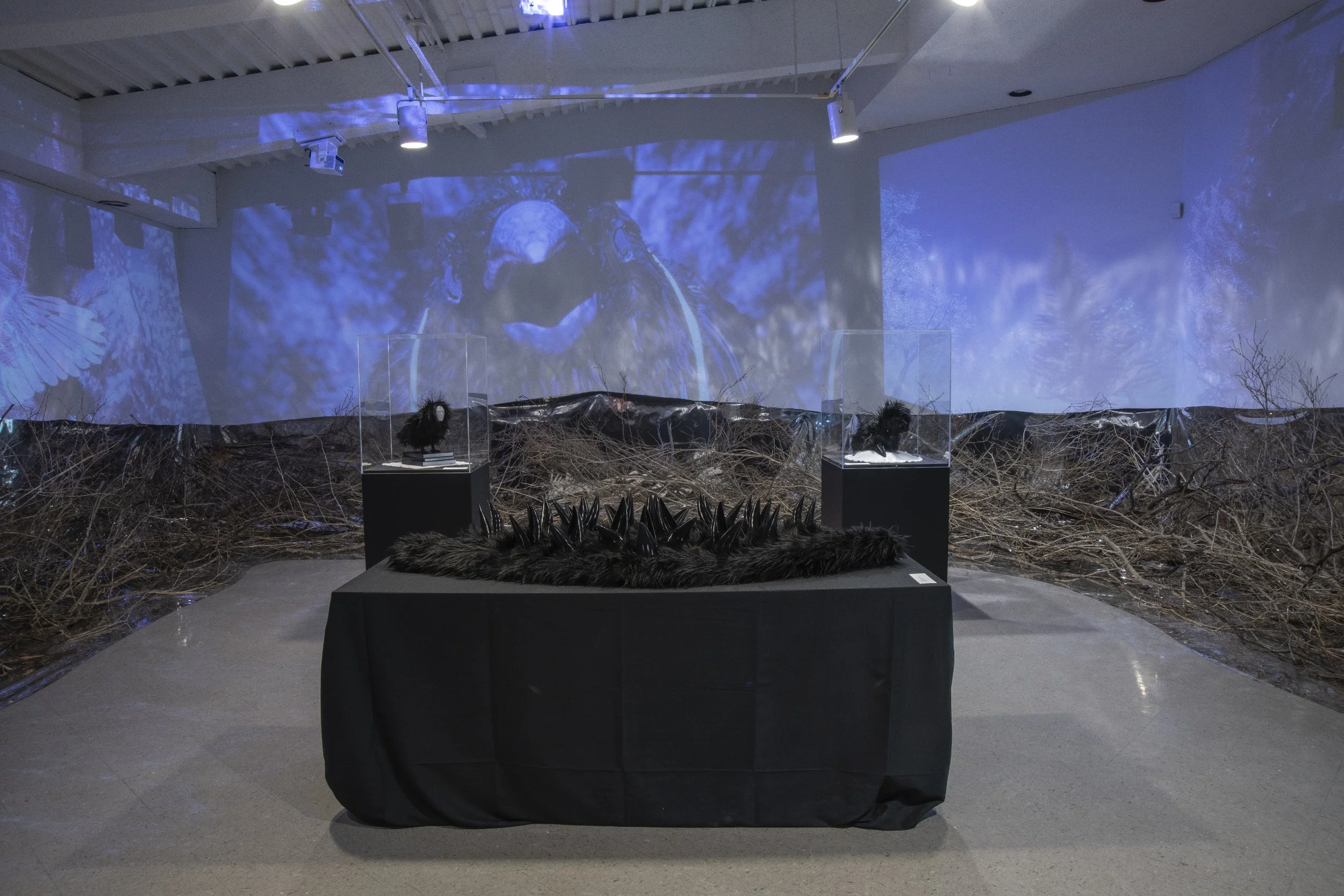
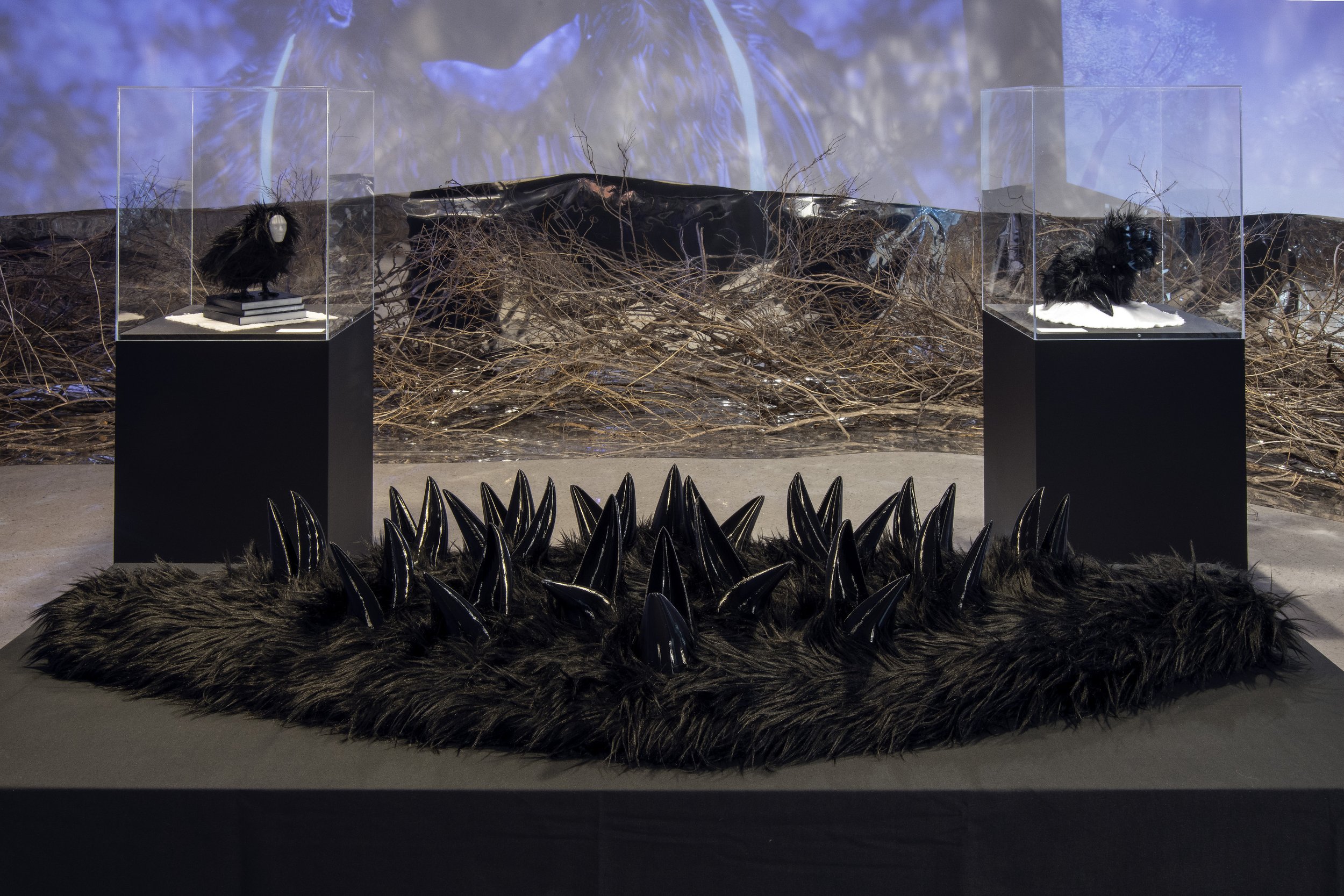
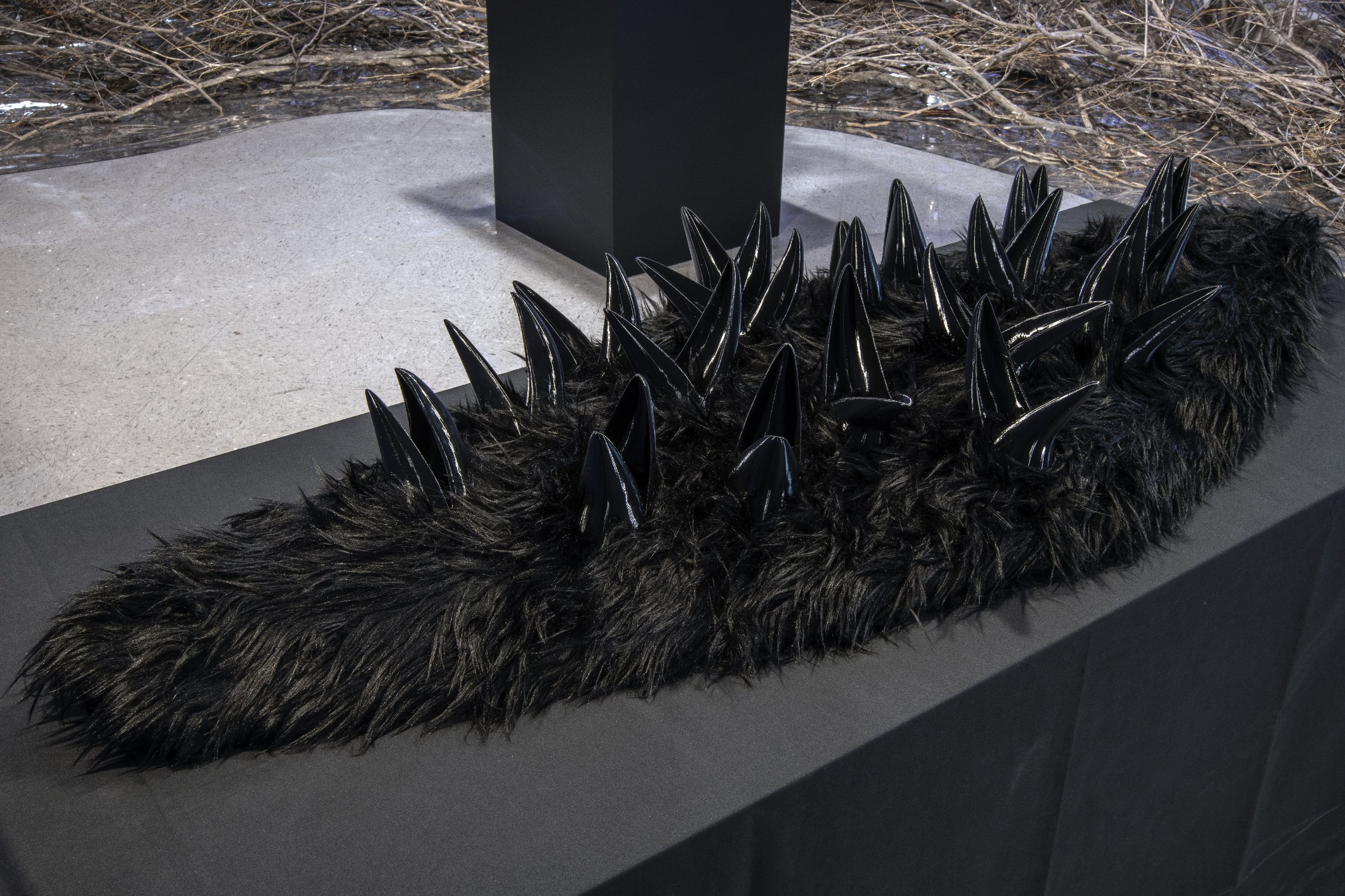
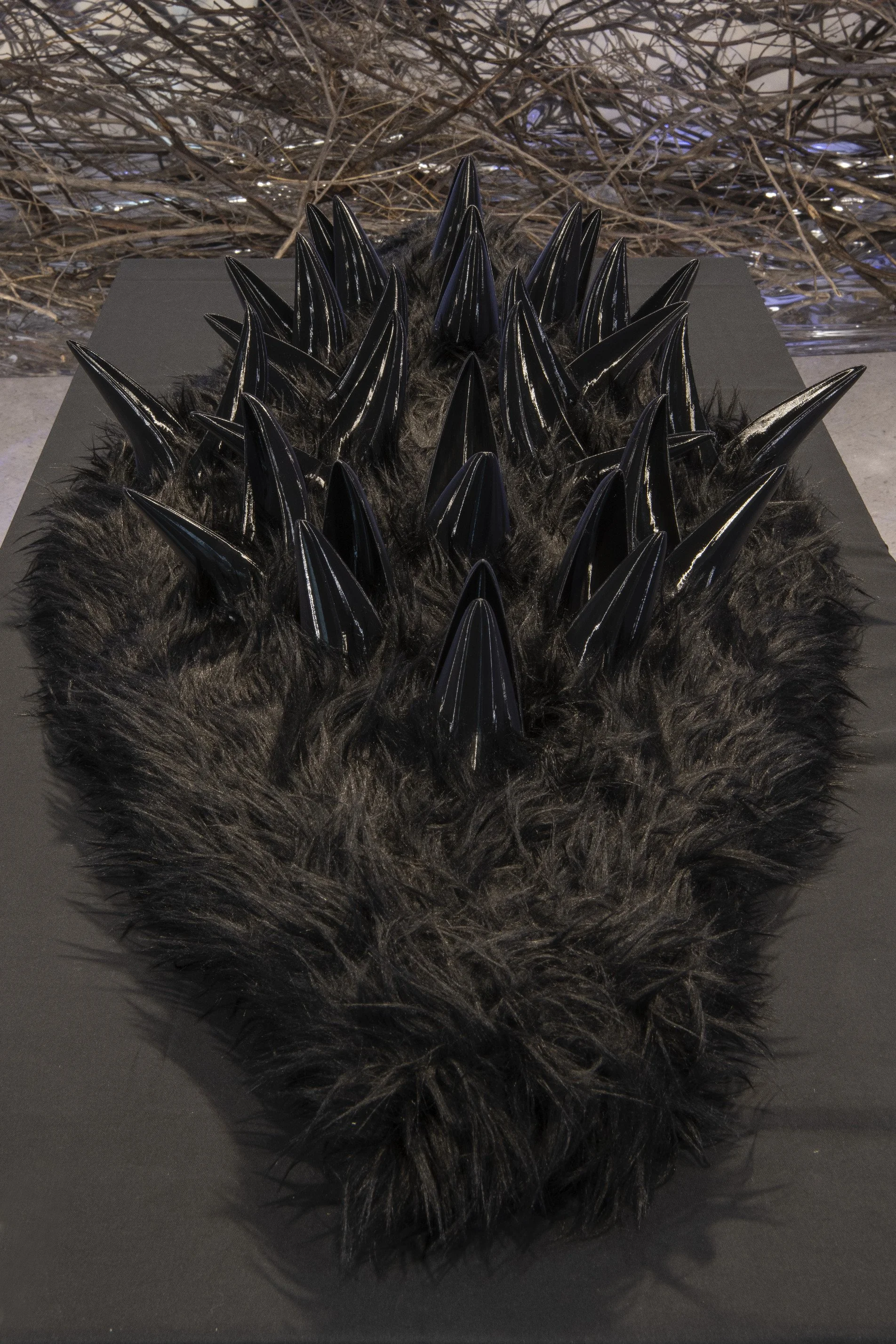
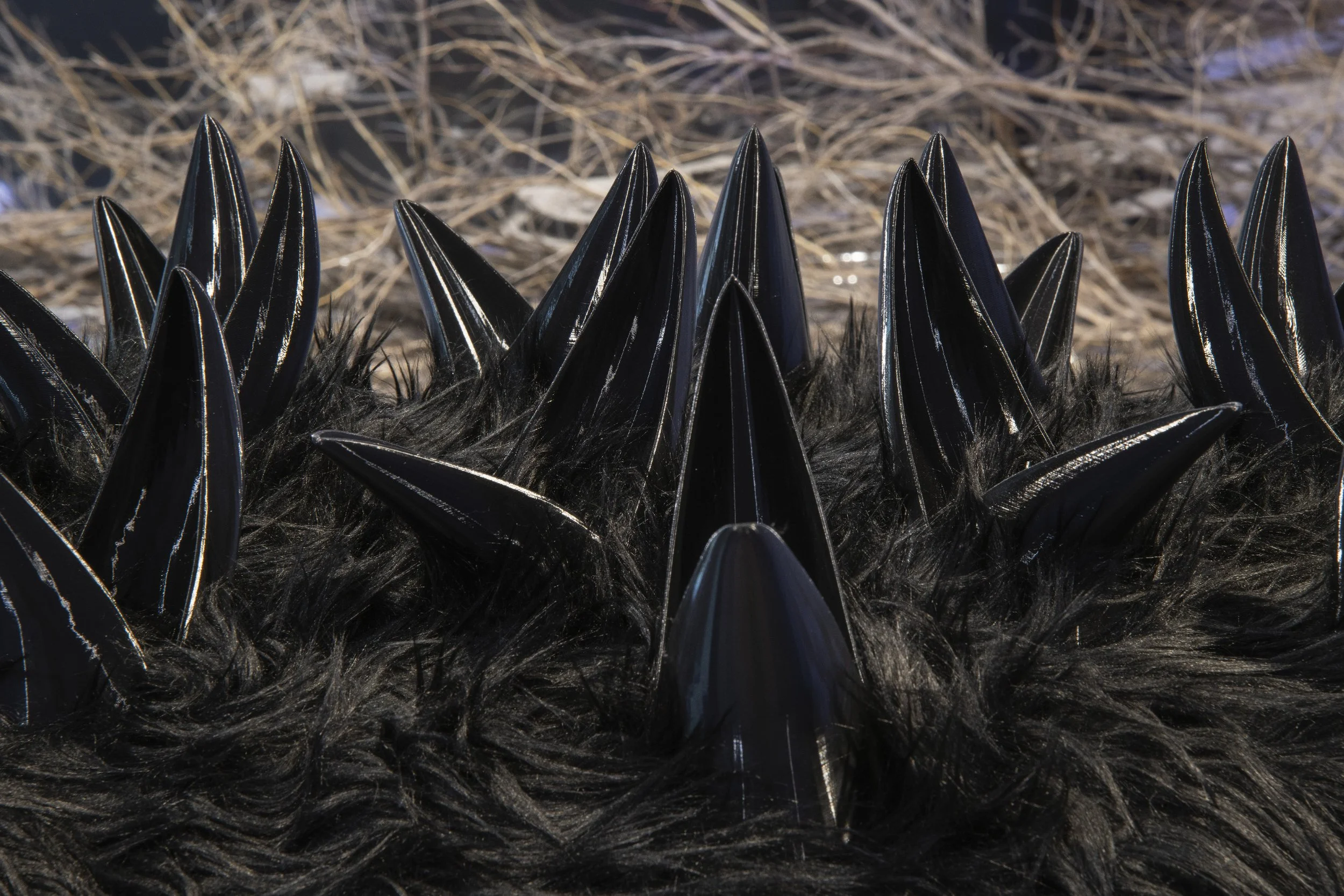
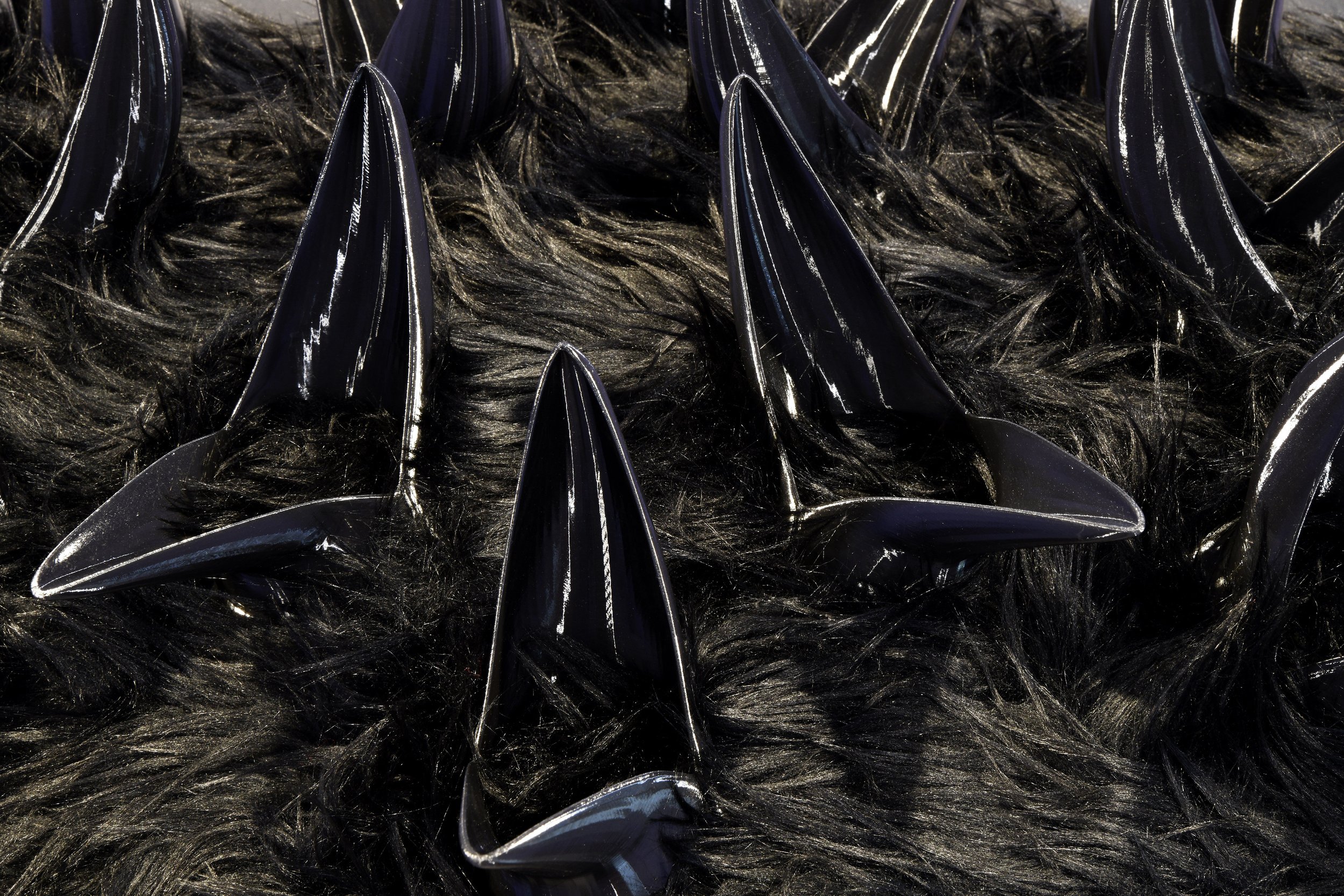
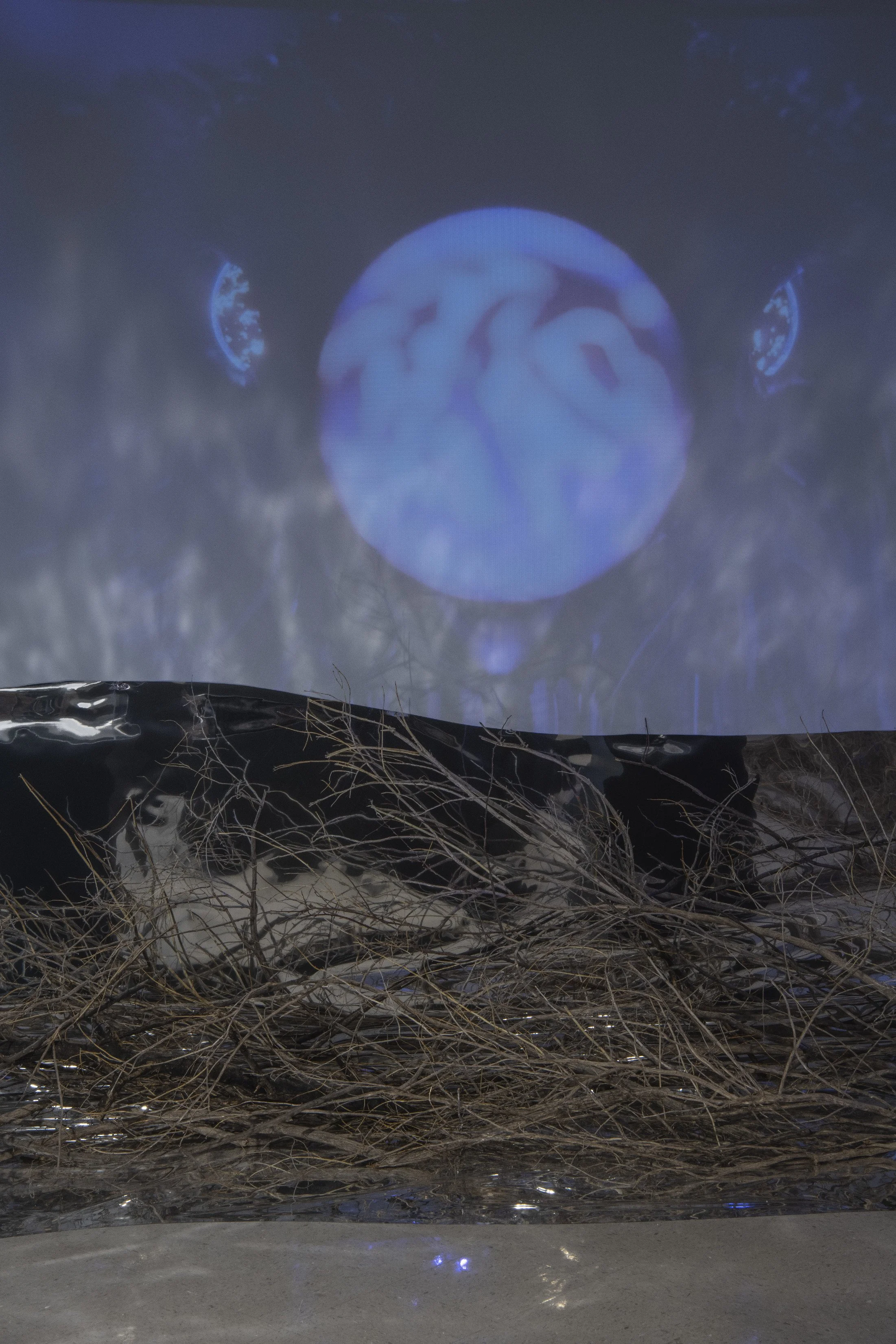
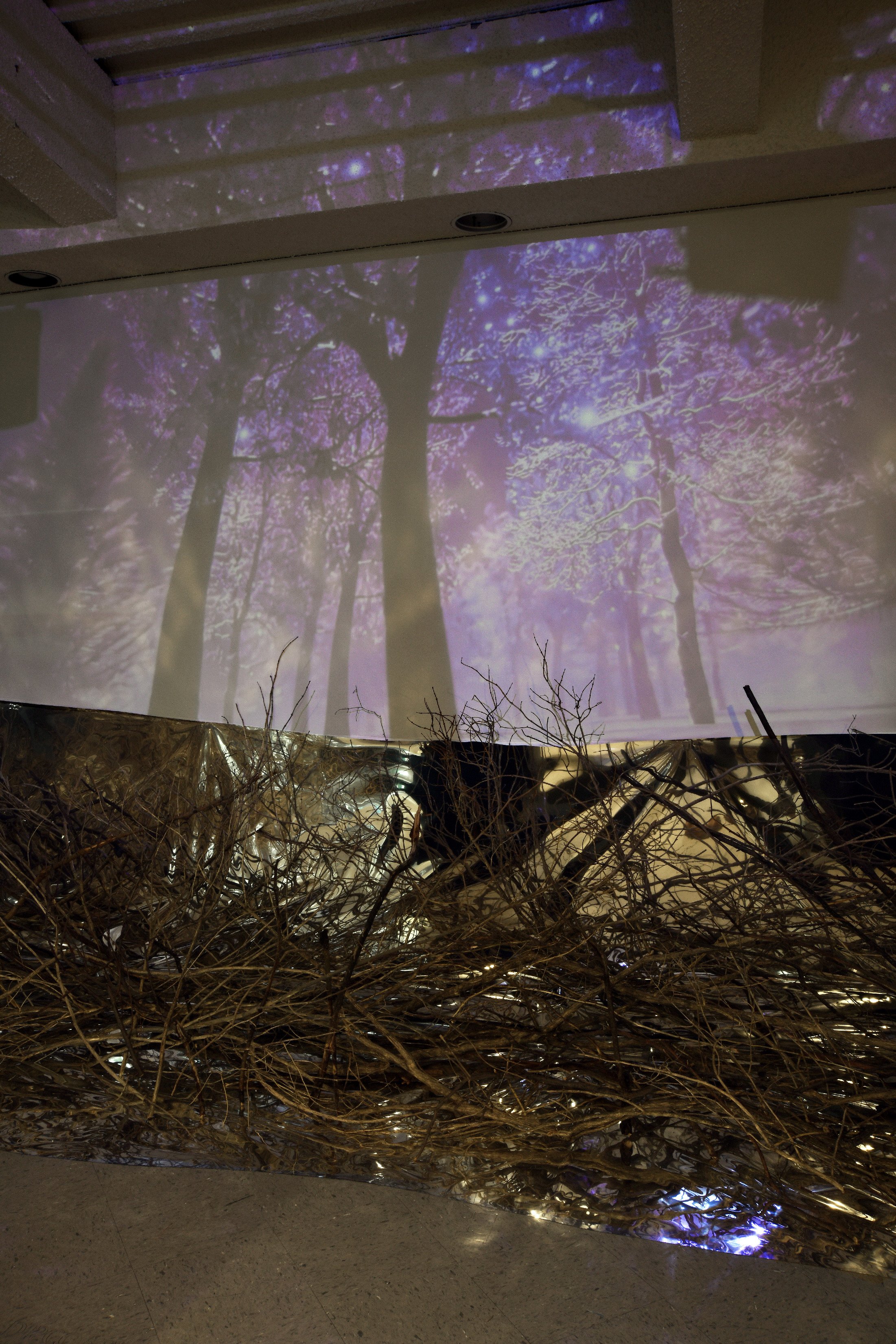
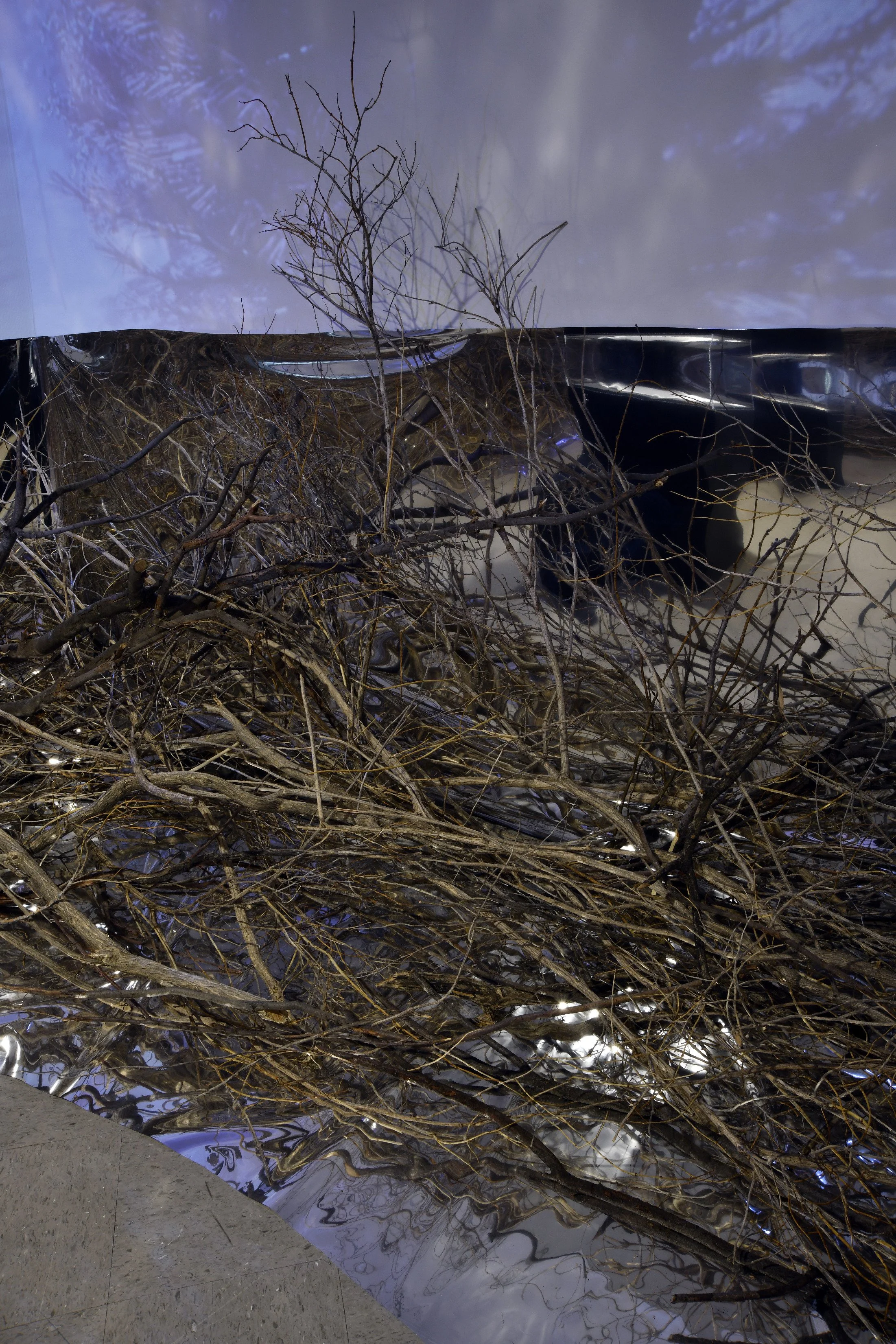
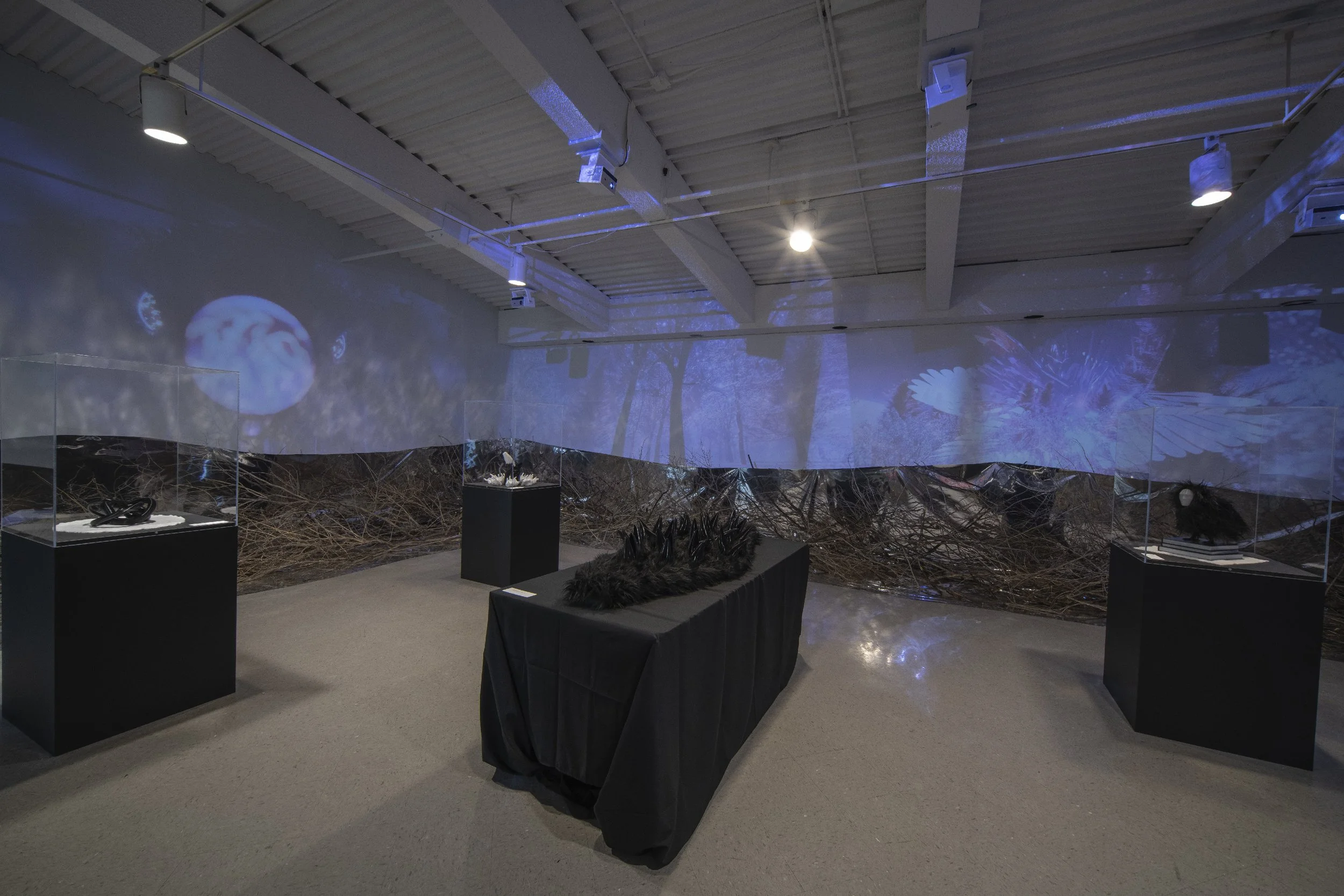
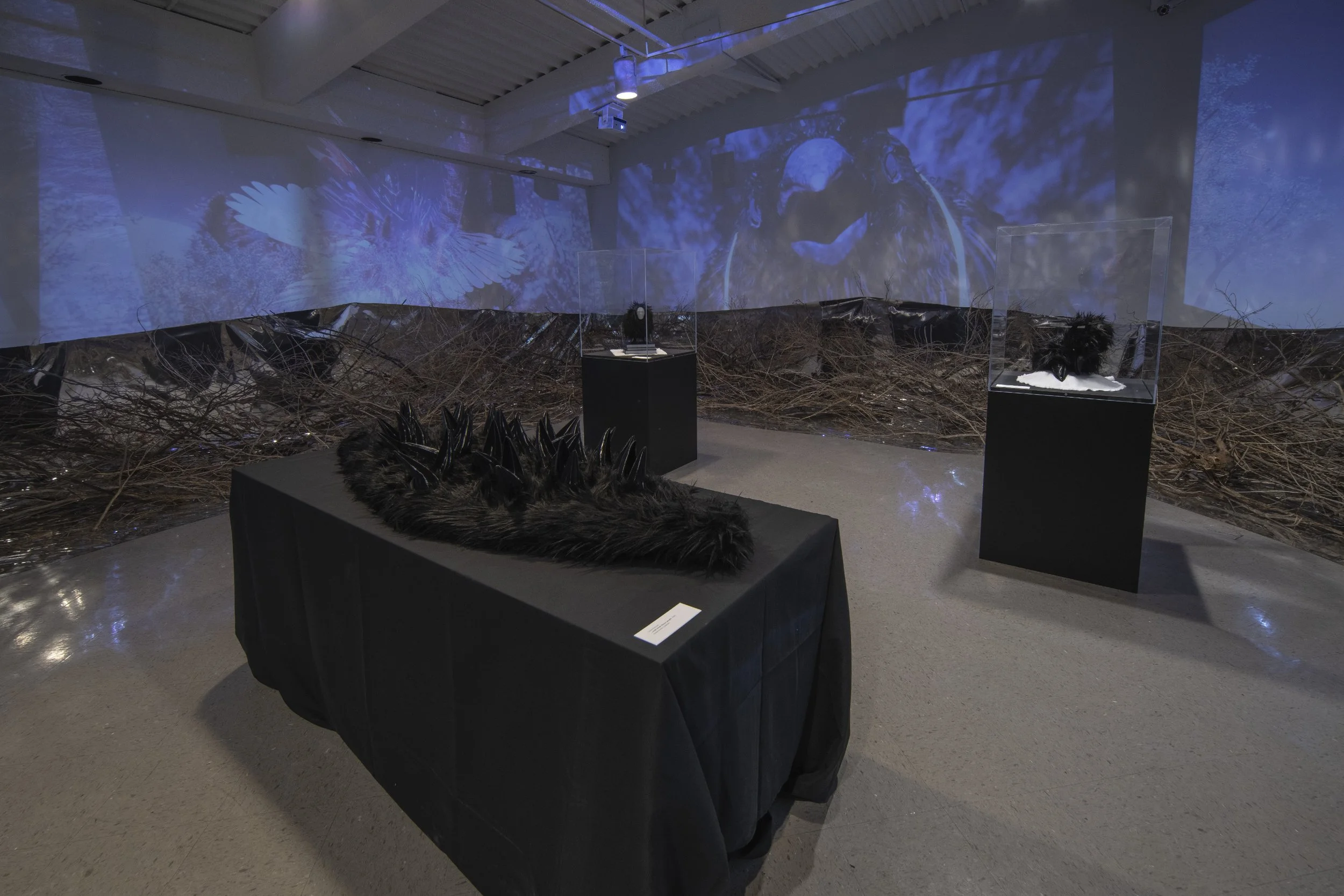
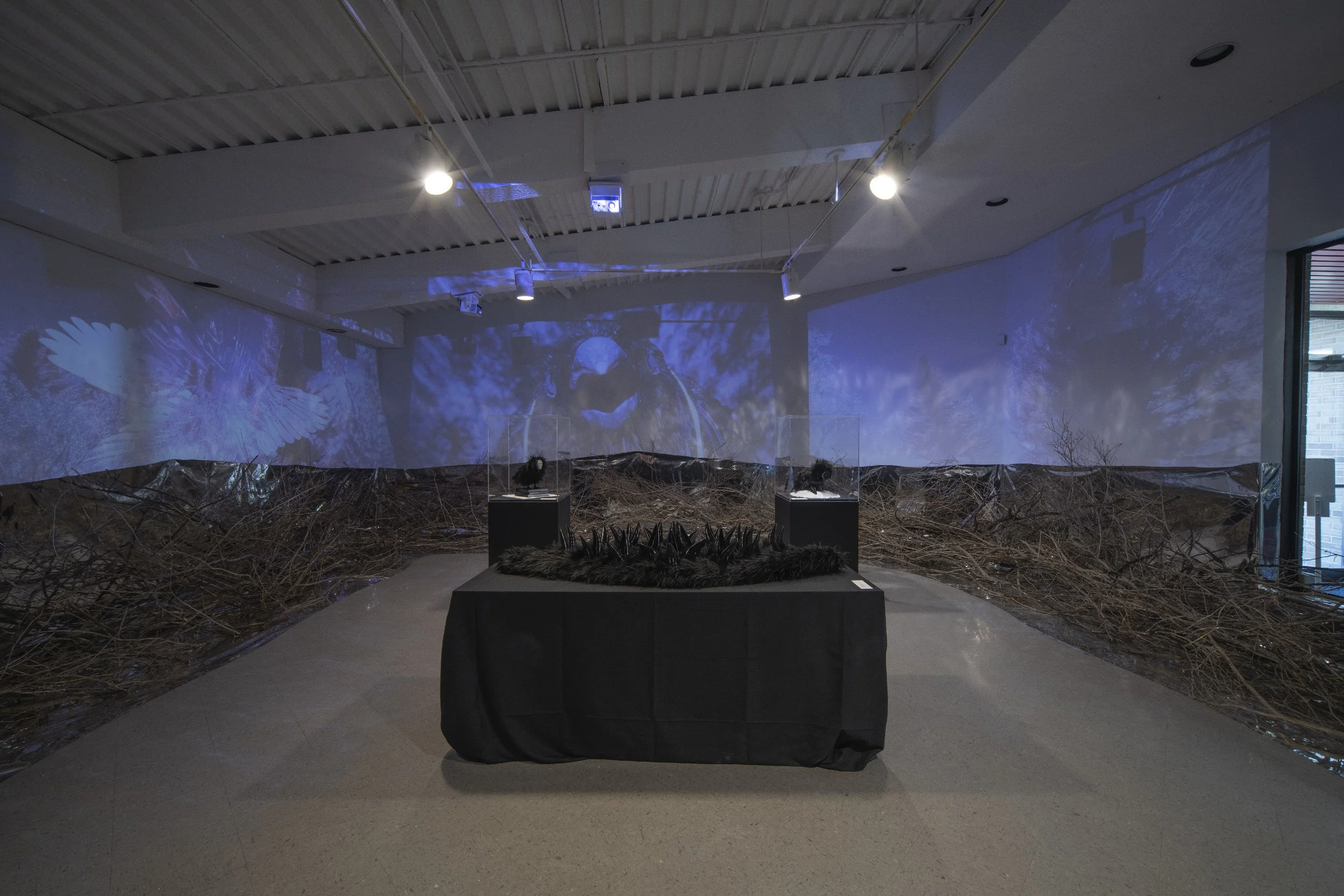
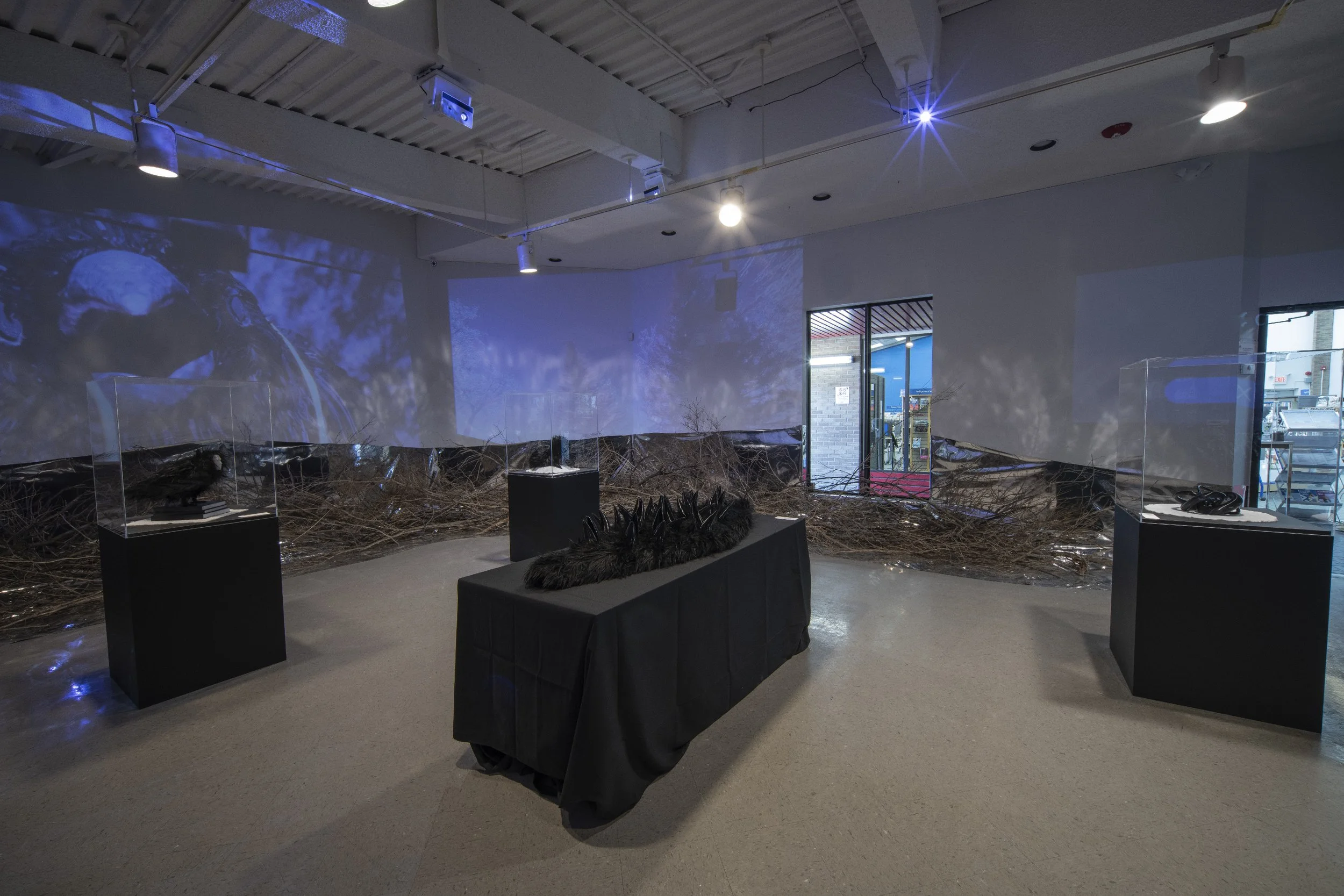
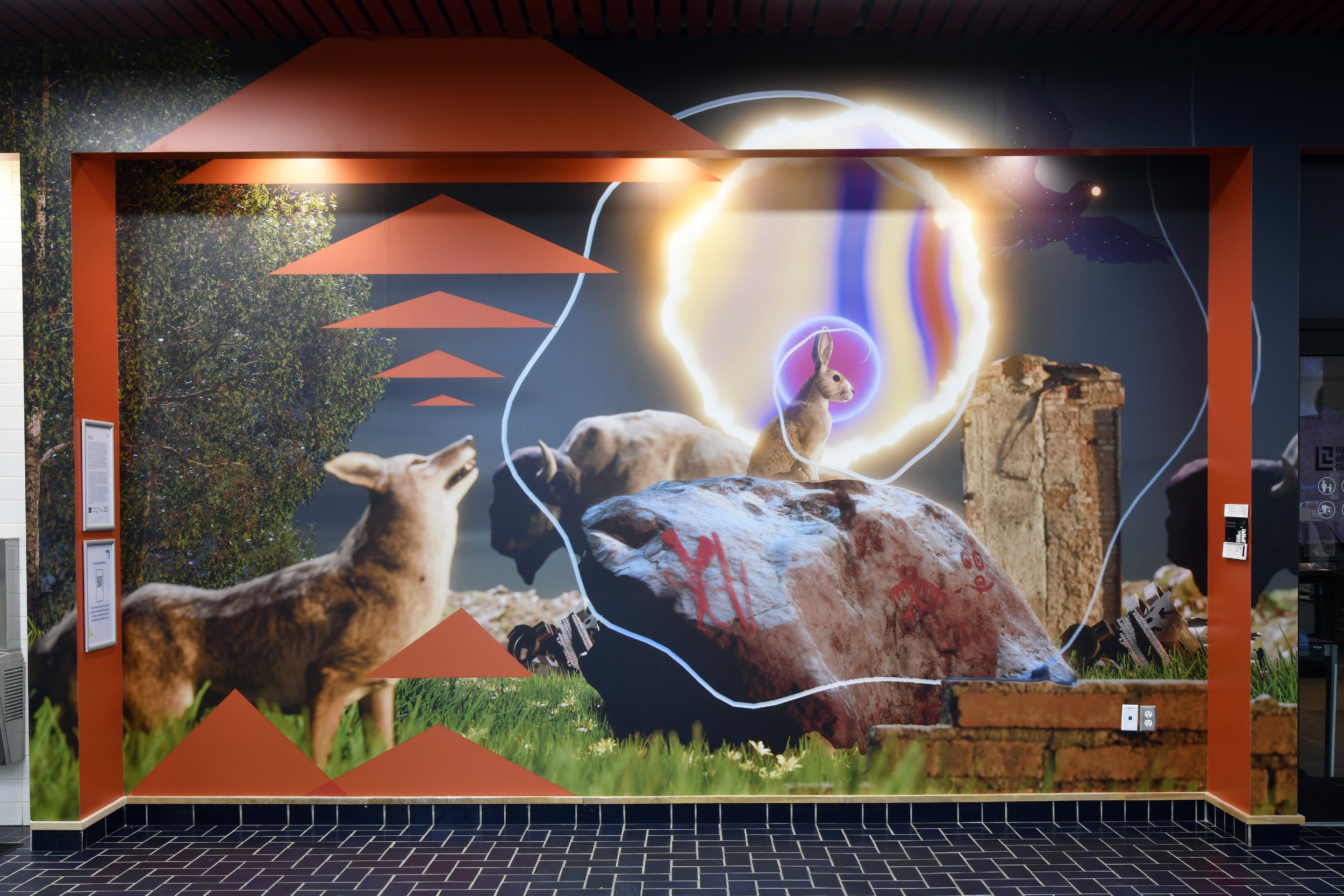
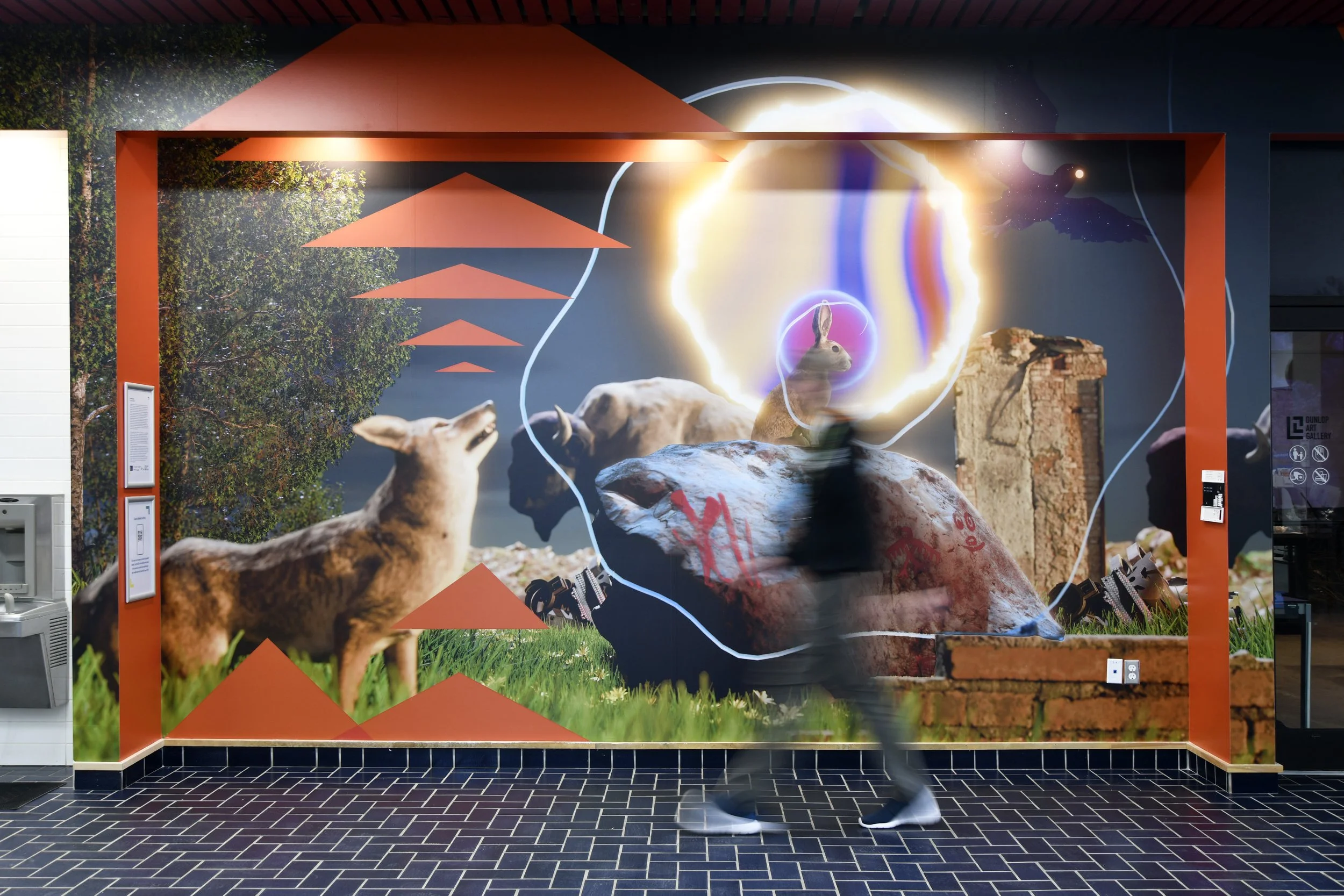
Casey Koyczan creates immersive, multisensory installations that bring nature into the gallery, blurring boundaries between the human-made and the natural. Using 3D modelling, fabrication, and organic materials such as branches and raven calls, he constructs mythic environments that feel alive and assertive. This exhibition features mixed-media sculptures and projected animations exploring themes of gossip, grief, blame, and transformation, balancing dark subject matter with subtle humour and playfulness.

Casey Koyczan is a Dene interdisciplinary artist from Yellowknife, NT, that uses various mediums to communicate how culture and technology can grow together in order for us to develop a better understanding of who we are, where we come from, and where we are going. He creates with whatever tools necessary to bring an idea to fruition, and works mostly in sculpture, installation, 3D/VR/AR/360, video, and audio works such as music, soundscapes and film scores.

Essay

Casey Koyczan – raven; tatsǫ́ The Trickster’s Mirror 

By Xiao Han 

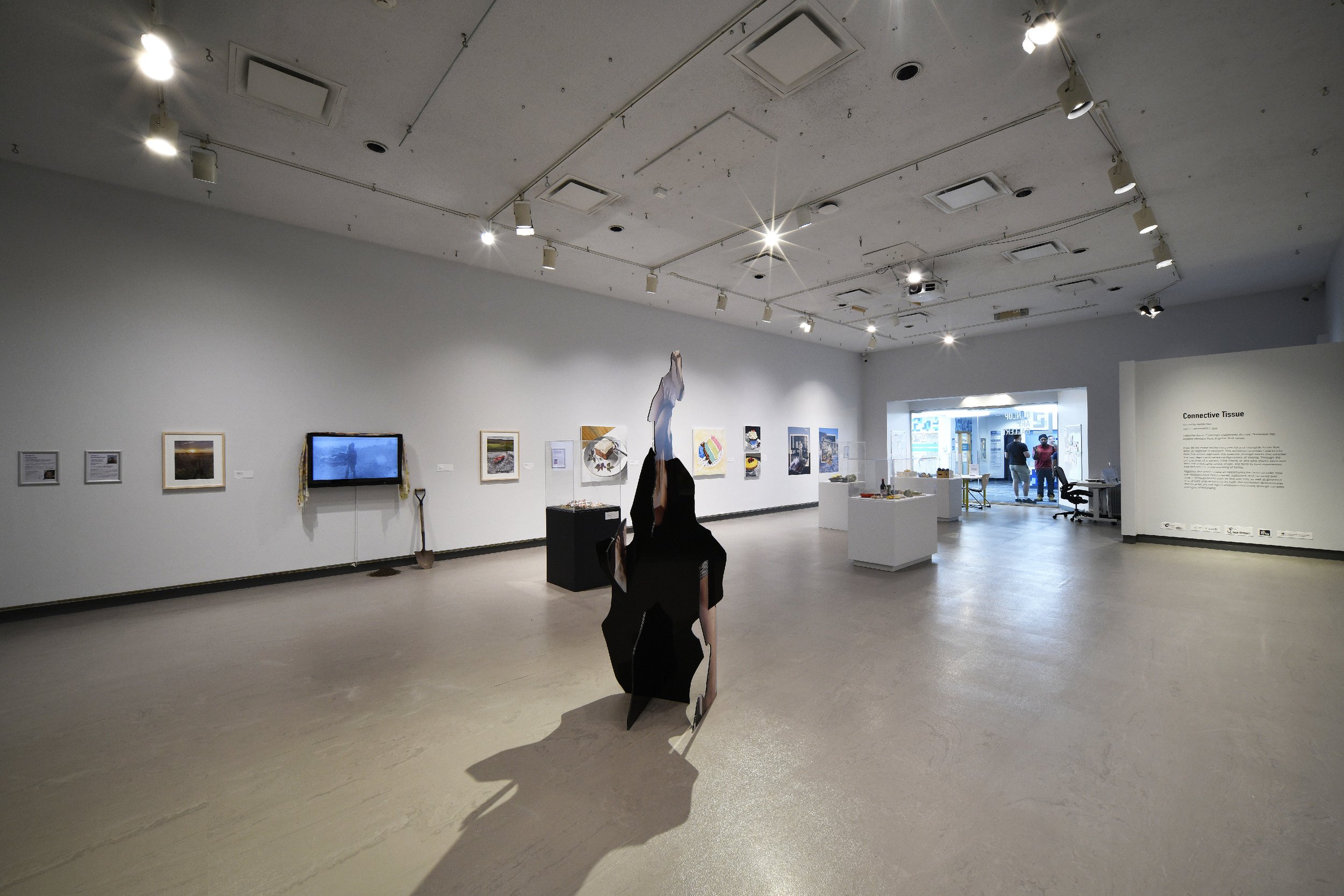
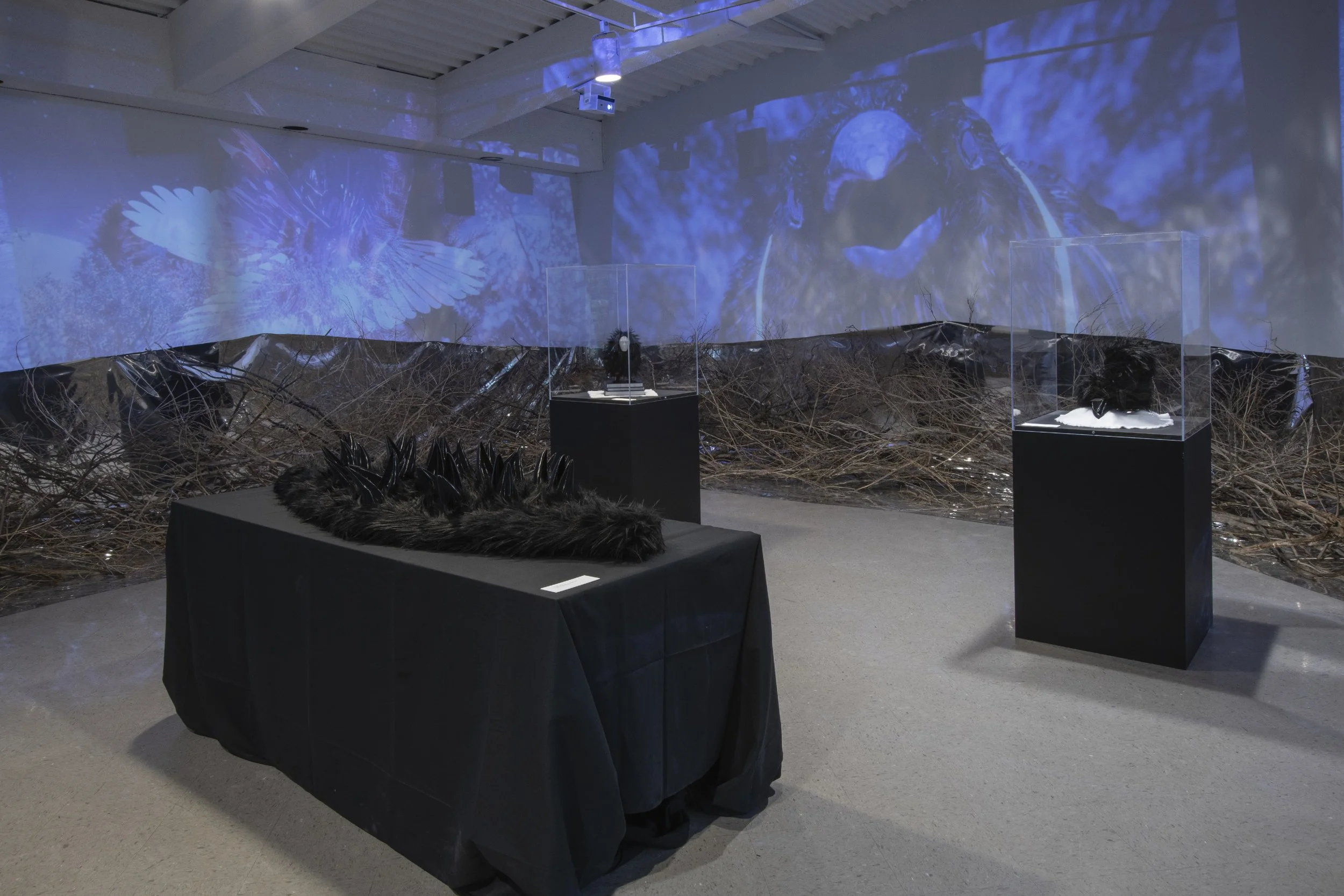
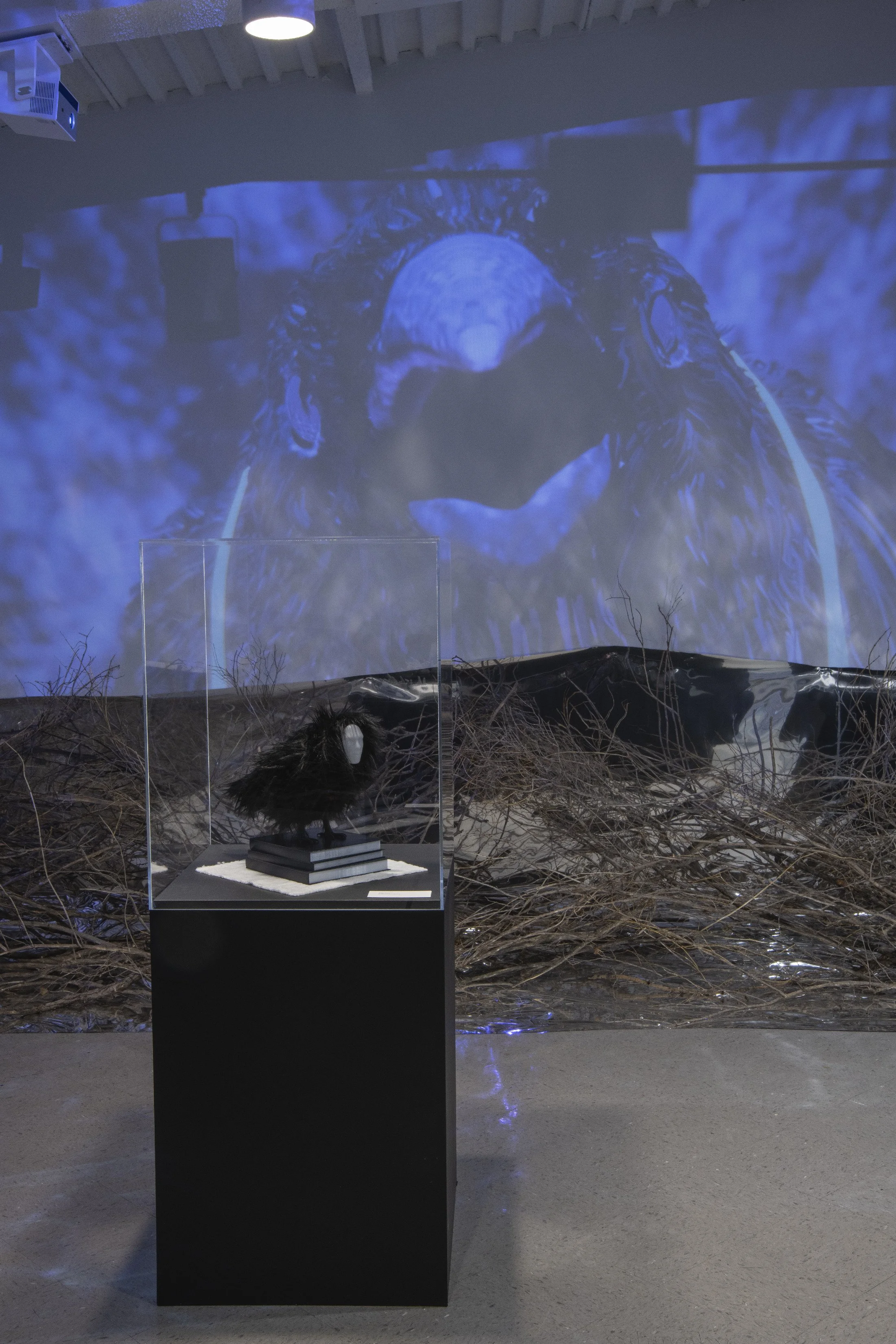
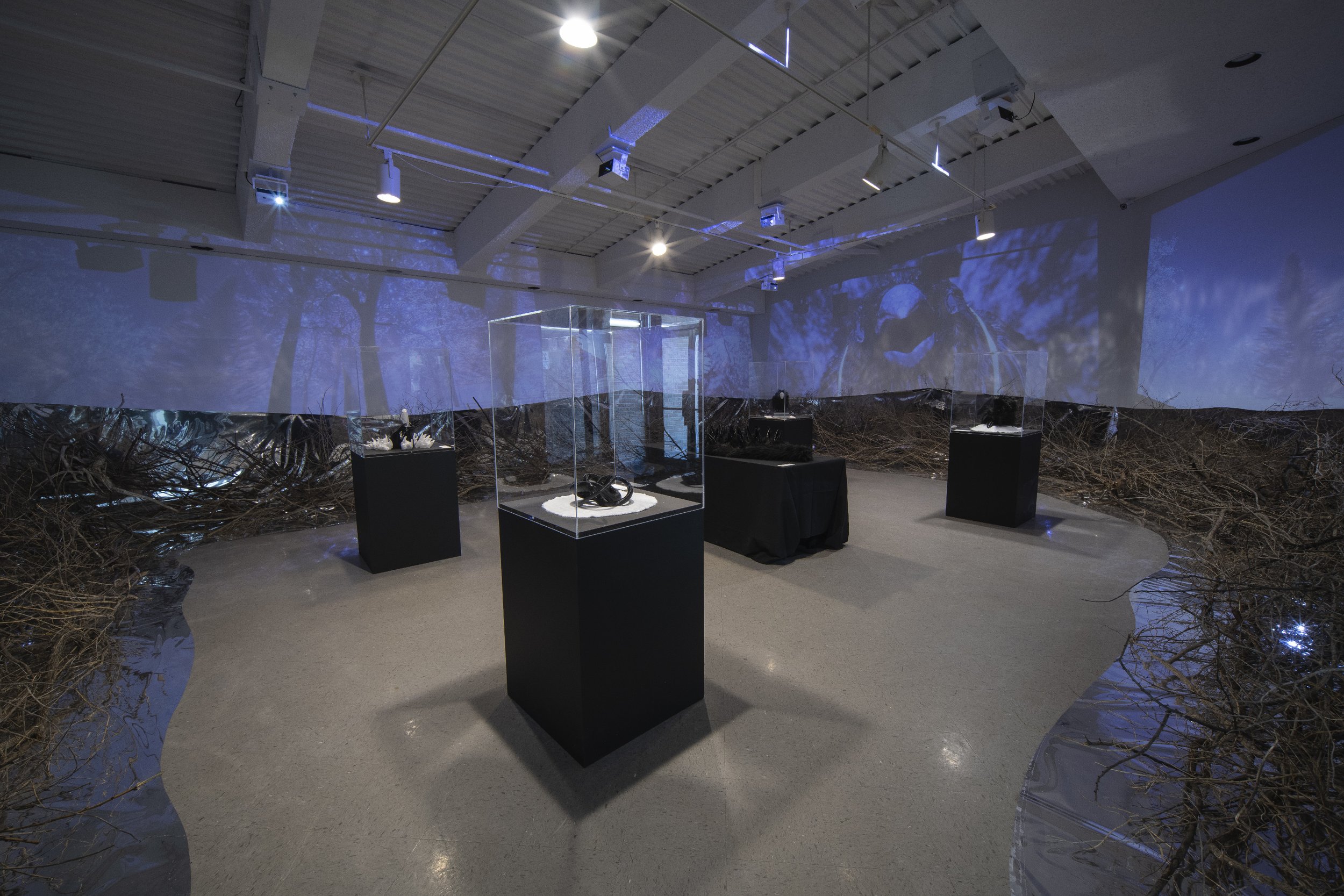
The first thing you notice when you step into raven; tatsǫ́ is the air — it feels charged, as if the room itself is holding its breath. The light is low, and the space is alive with contrasts: the scent of wood and branches mingling with the faint echo of raven calls; the softness of black, feather-like fabric against the cold precision of 3D-printed forms. Six projectors cast shifting animations across the gallery space — feathers dissolving into pixels, a beak emerging from light, eyes glowing like miniature suns. The projections bleed into one another, creating an abstract, dreamlike atmosphere that wraps around you. 

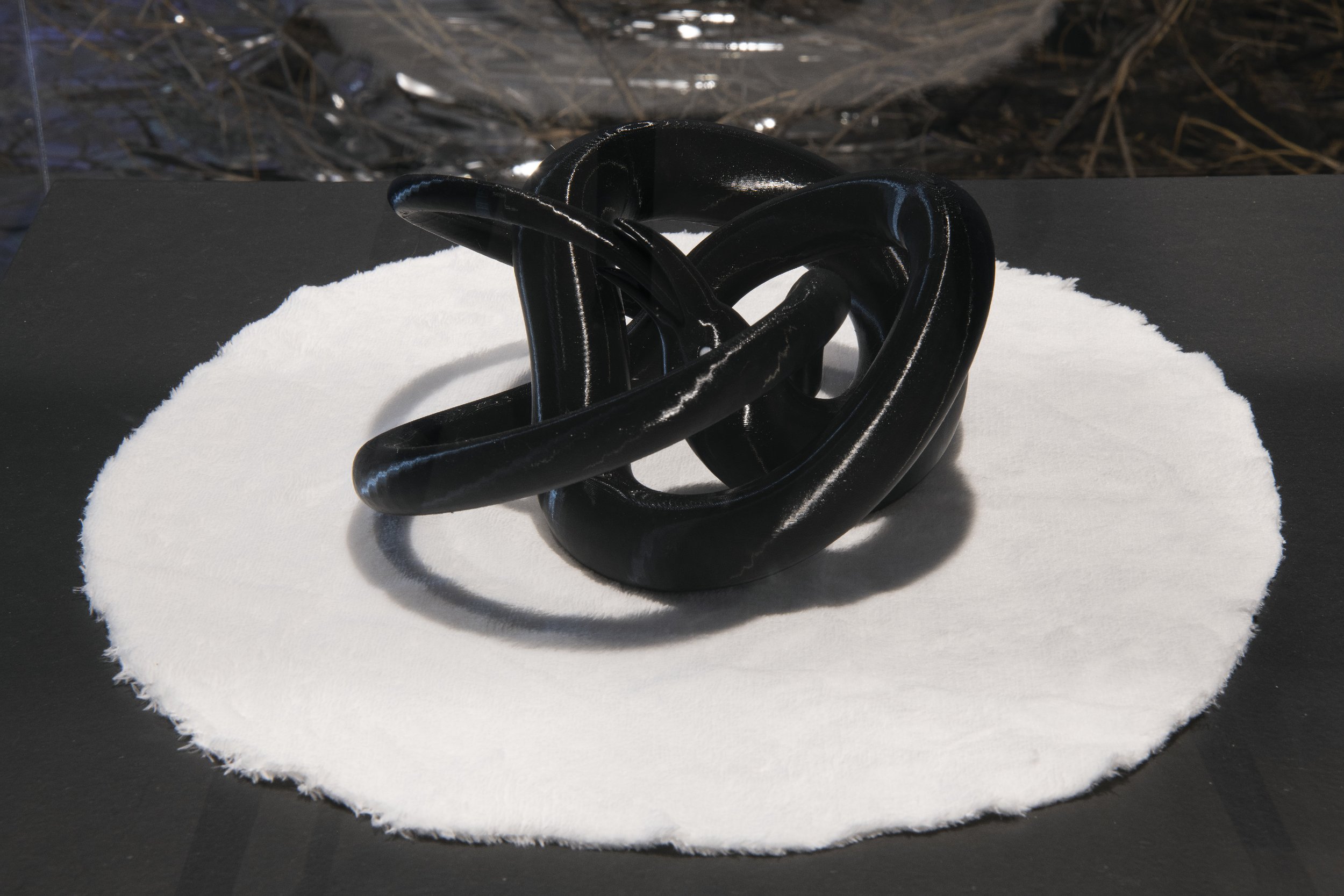
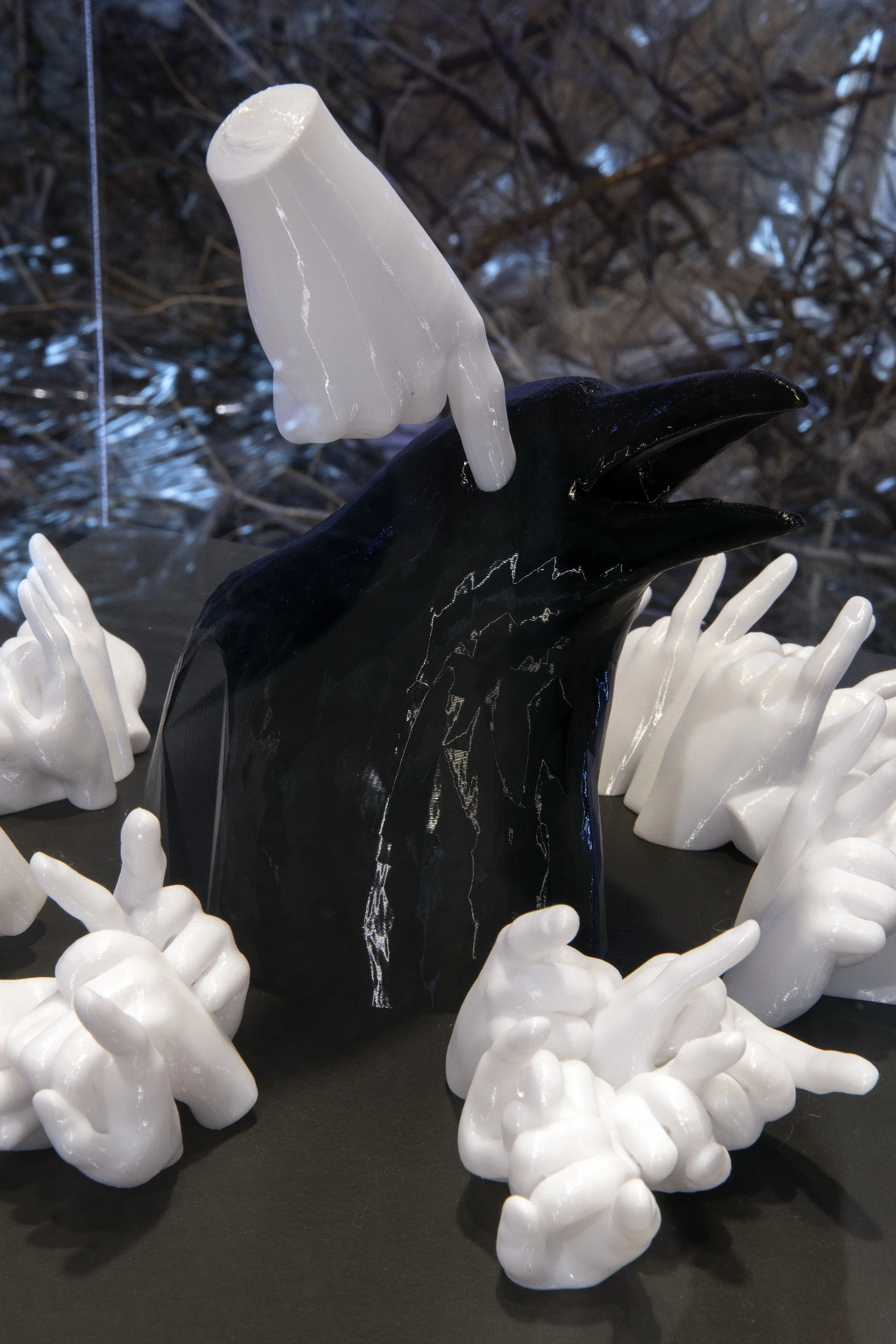
In the centre, sculptures rise like sentinels. Some are sleek and minimal, others textured and tactile. A raven’s head emerges from a pristine white form, its feathers absorbing the light while the white surface reflects it back. Another piece coils into a loop — a raven head with a snake’s body, biting its own tail. The works are not static; they feel like they’re in mid-transformation, caught between worlds. 

For Dene interdisciplinary artist Casey Koyczan, the raven is more than a bird. It is a storyteller, a shapeshifter, a national animal of the North, and a mirror for human nature. The title — tatsǫ́, the Dene word for raven — is part of his ongoing journey to learn and reclaim his language. 

During the studio visit, Koyczan told me he put trickster as the theme and “the trickster can be understood in so many ways. Sometimes it’s bad, sometimes it’s just someone joking around. I like that space — where you’re not sure if you should laugh or think harder.” 

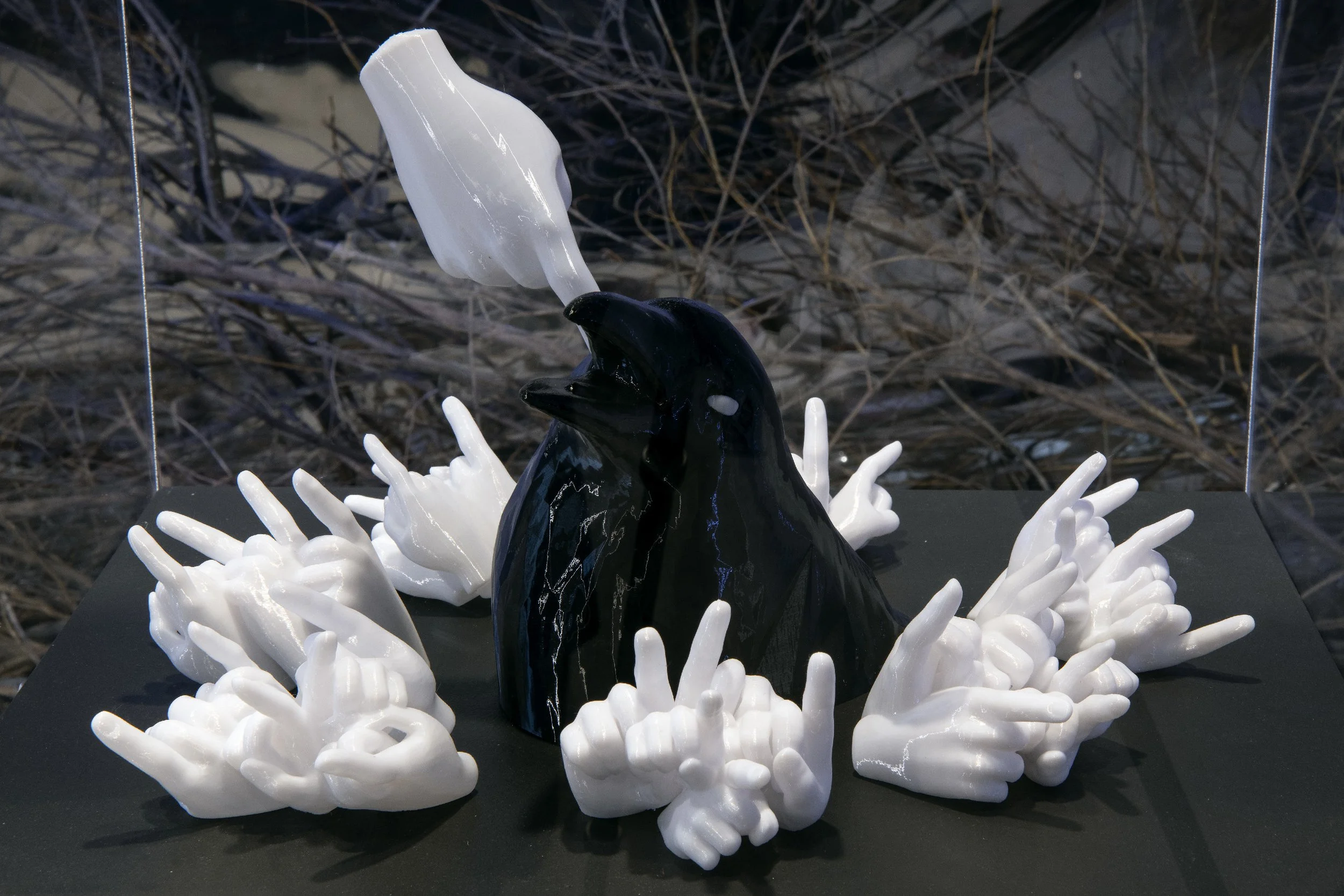
The works in raven; tatsǫ́ draw directly from Koyczan’s personal experiences. Could you not!? features a large hand with an eye in its palm, surrounded by other hands reaching up from the ground. Some point outwards, some inward — but all ultimately turn toward the viewer. “For a long time, I’ve been blamed for things that had nothing to do with me,” Koyczan said. “When you point at someone, one finger is at them, and three are pointing back at yourself.” The piece flips that gesture back on the audience, making them complicit. 

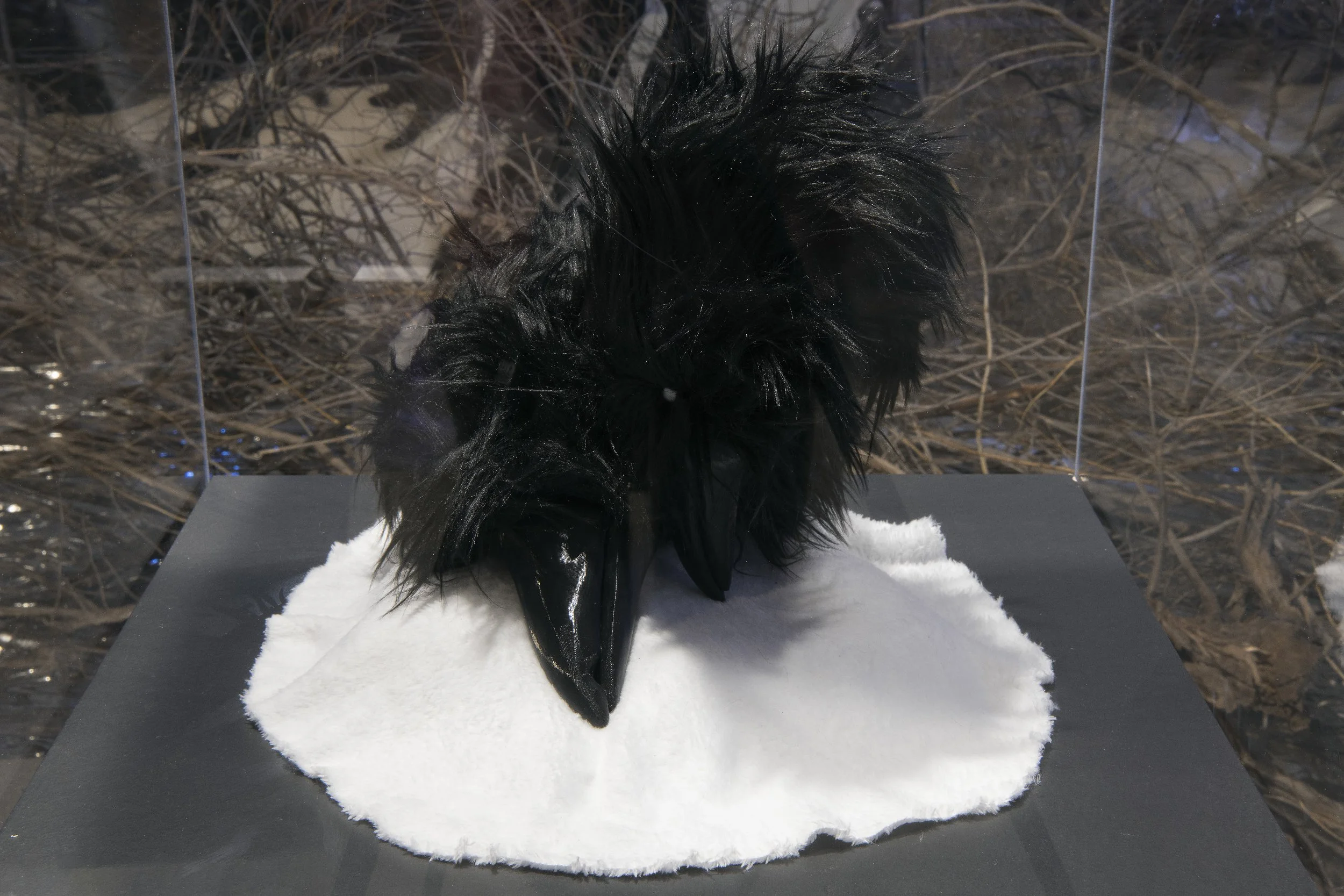
…small minds discuss people is a raven’s beak with a protruding tongue, covered in black fur. There are no eyes, no ears, no brain — only the mouth. “People gossip all the time,” Koyczan said. “It’s harmful. They don’t see, they don’t listen, they just talk.” The work doesn’t demand outrage; instead, it asks for a pause — a moment to consider whether we’ve ever been part of that harm. 

The most personal work is Miss you bro — two raven heads, one smaller, one larger, both looking down. The piece is rooted in the loss of Casey’s older brother in 2018. “It was such a strange feeling, seeing him in the coffin,” he told me. “I used to think we were made of soul and vessel. But in that moment, I realized we are just vessel.” The smaller raven looks toward the larger one with white, unblinking eyes. The black-and-white contrast is stark, the silence heavy. Koyczan admitted he cried many times while making it. “That feeling will never go away, but the capacity to deal with it grows bigger.” 

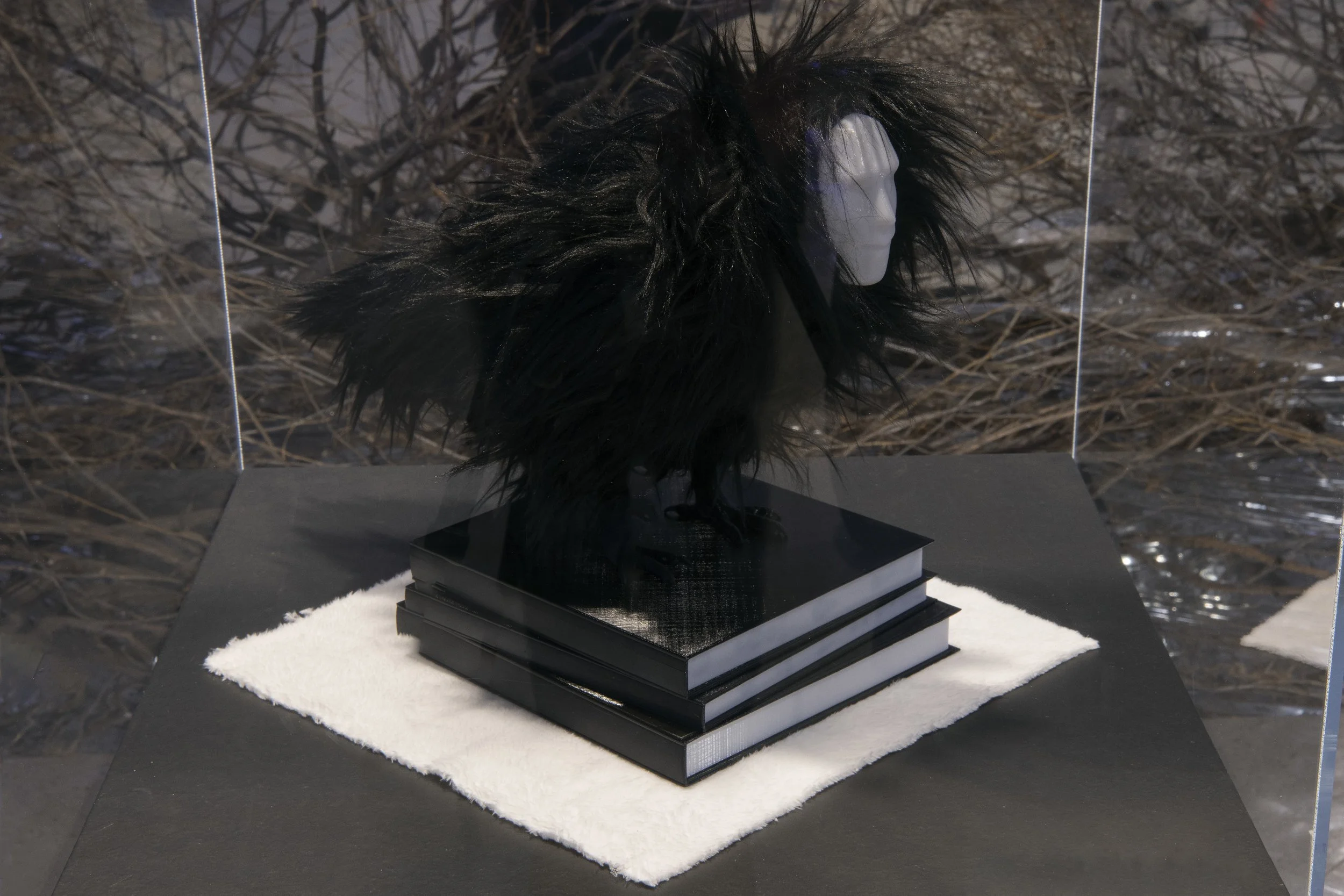
1/16* brings humour and critique together. A raven figure — representing Indigeneity — is paired with a white human face, a nod to non-Indigenous people who “dress up” as Indigenous to access resources and recognition. The figure holds a book, a symbol of privilege and academia, its surface gleaming. There’s a faint smile on the face — not of innocence, but of pride in the act. The humour is sharp, almost uncomfortable, and that’s the point. As Koyczan put it, “They can’t hide their face being white. The costume doesn’t change that.” 

I’ve known Casey Koyczan since our BFA days, and I’ve always admired his ability to balance humour with gravity. In raven; tatsǫ́, that balance is at its most refined. The works are deeply personal, yet they speak to broader truths about identity, loss, and the politics of representation. They are also unapologetically beautiful — not in a decorative sense, but in the way they command space and attention. 

What strikes most is how the exhibition feels alive. The branches, the scent of wood, the subtle soundscape, the shifting light — they create an environment where the raven is not just a symbol but a presence. You don’t simply look at the works; you move among them, and they look back at you. 

This is not an exhibition that offers easy answers. It asks you to sit with discomfort, to laugh at the absurd, to feel the weight of grief, and to question your own place in the stories we tell about culture and belonging. It’s also a reminder that art can be both a form of shedding and of holding — a way to release pain while preserving memory. 

Koyczan told me he doesn’t plan to revisit this body of work. “It’s healthy,” he said. “I’ve said what I needed to say, and now I’ll move on.” That makes raven; tatsǫ́ feel even more urgent — a singular moment in his practice, one that won’t be repeated. 

If you come to see it — and you should — don’t rush. Let the space work on you. Notice the details: the way a beak catches the light, the way a projected eye seems to follow you, the way a sculpture’s shadow stretches across the floor. Somewhere in that space between laughter and stillness, between the human-made and the natural, you might just find the trickster looking back. 

Xiao Han is an artist and curator born and raised in Wuhan, China. Han’s creative practice focuses on photography, lens-based performance, and the visualization of emotion within community-based contexts. Alongside visual work, Han maintains an art writing practice that explores process, embodied experience, and storytelling as critical tools for reflection and knowledge-sharing within artistic and diasporic communities. Han’s research investigates diasporic identity, relationships between immigrants and Indigenous land, and contemporary gender issues through a decolonial lens. Han has produced numerous projects examining Chinese Canadian immigrant identity and the aesthetics of community relationships.

Images

Photos by Don Hall
Media

View Event →

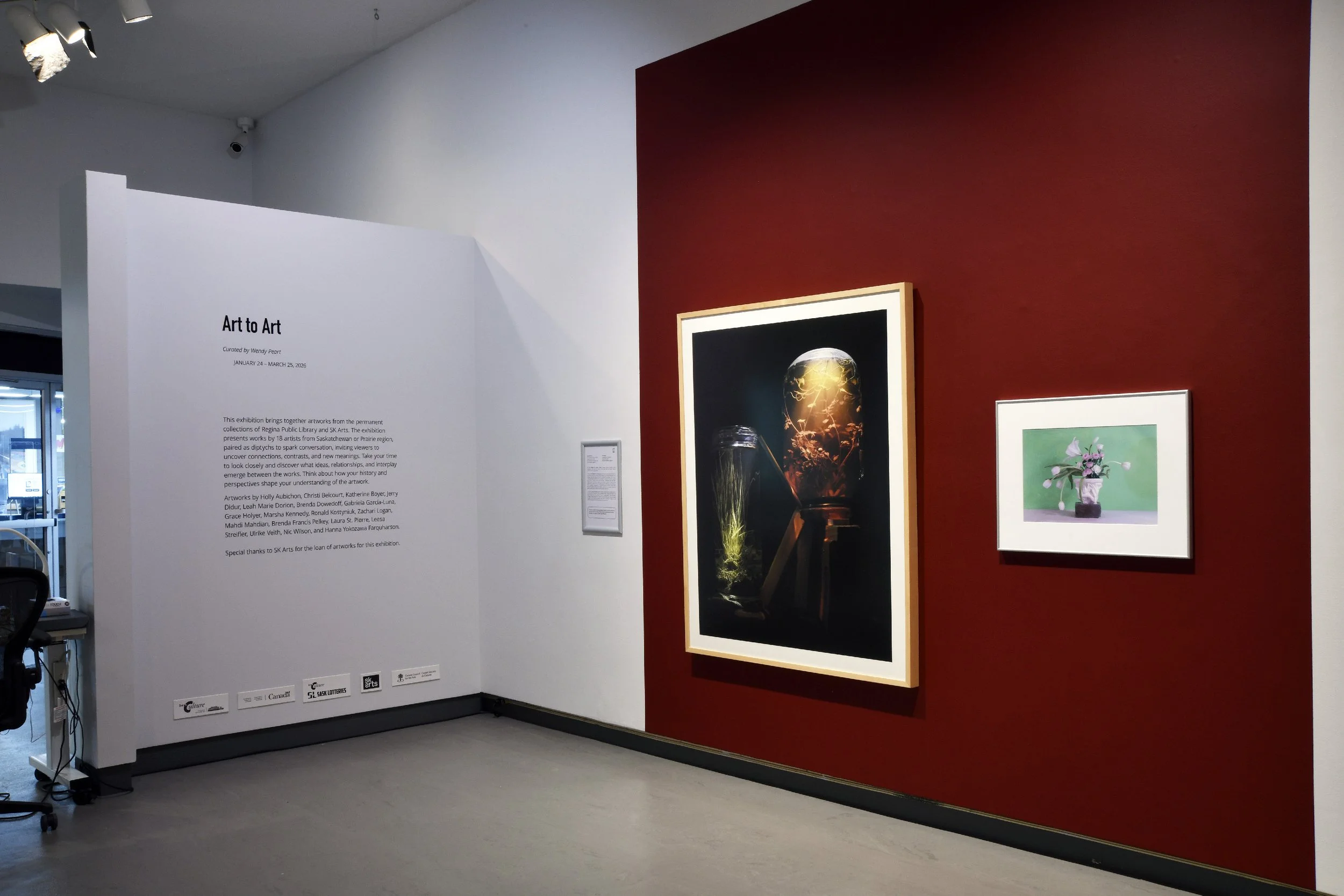
Art to Art
Jan
24
to Mar 25

Art to Art

  • Dunlop Art Gallery, Regina Public Library, Central Library, (map)
  • Google Calendar ICS

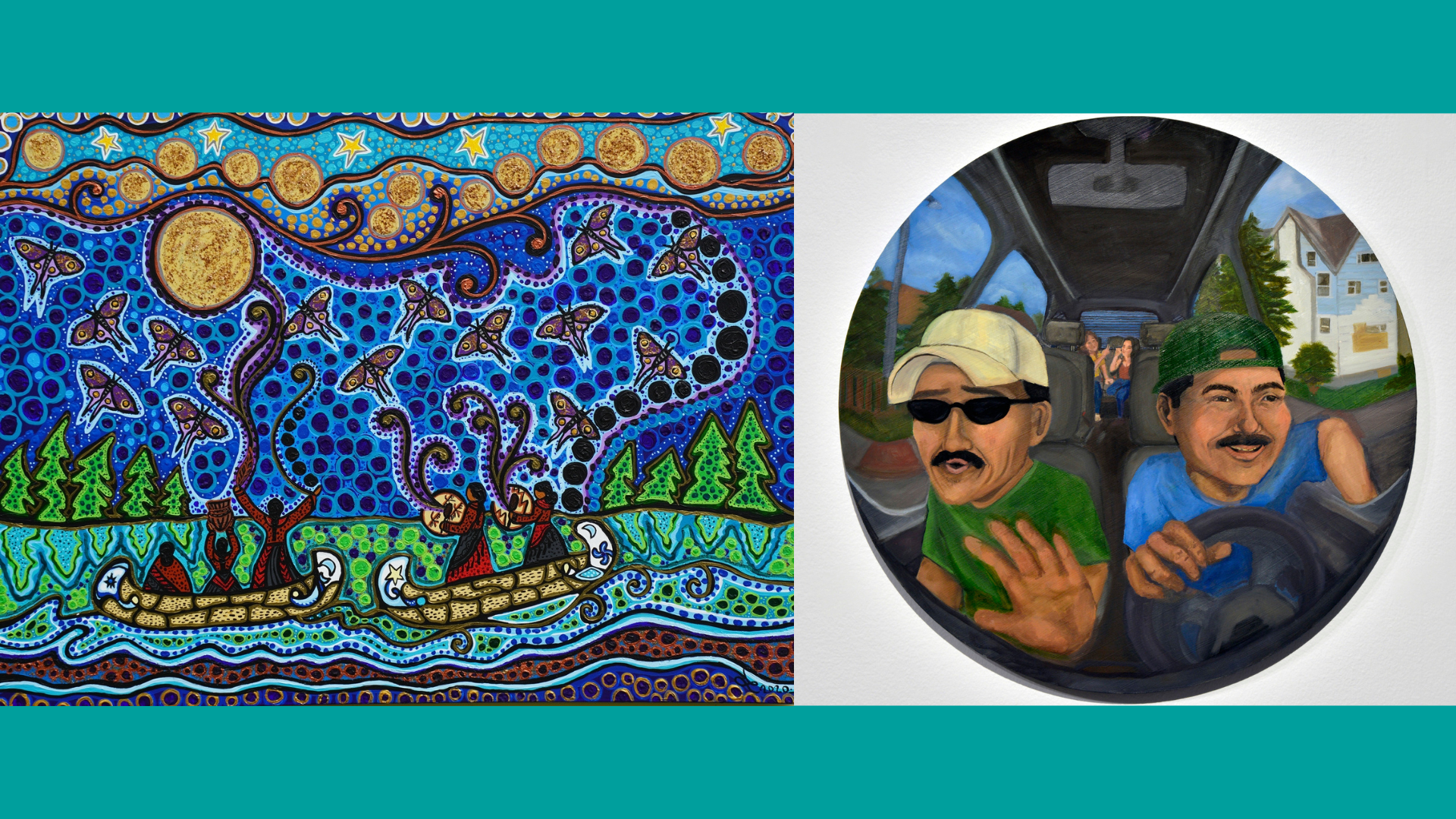
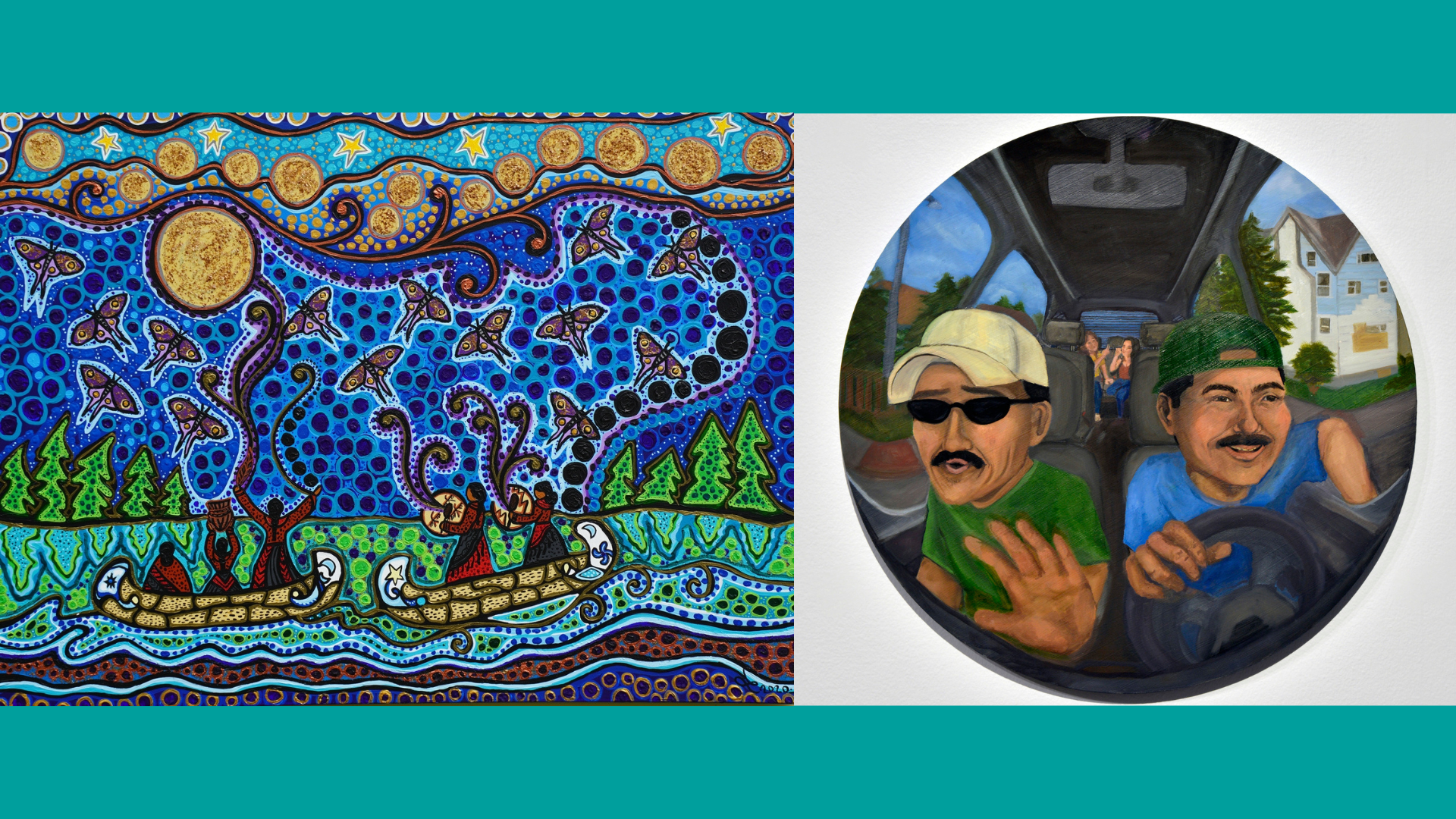
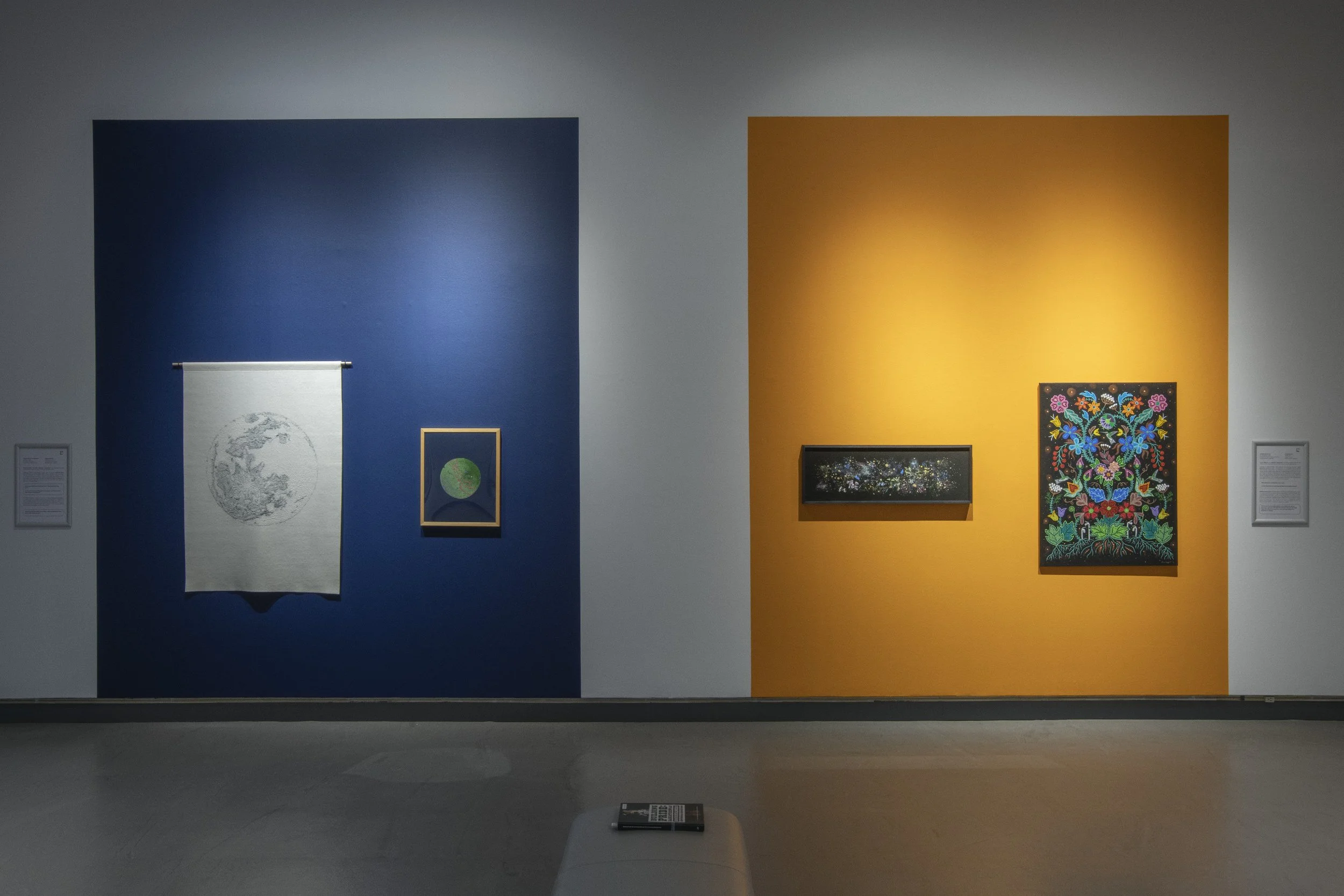
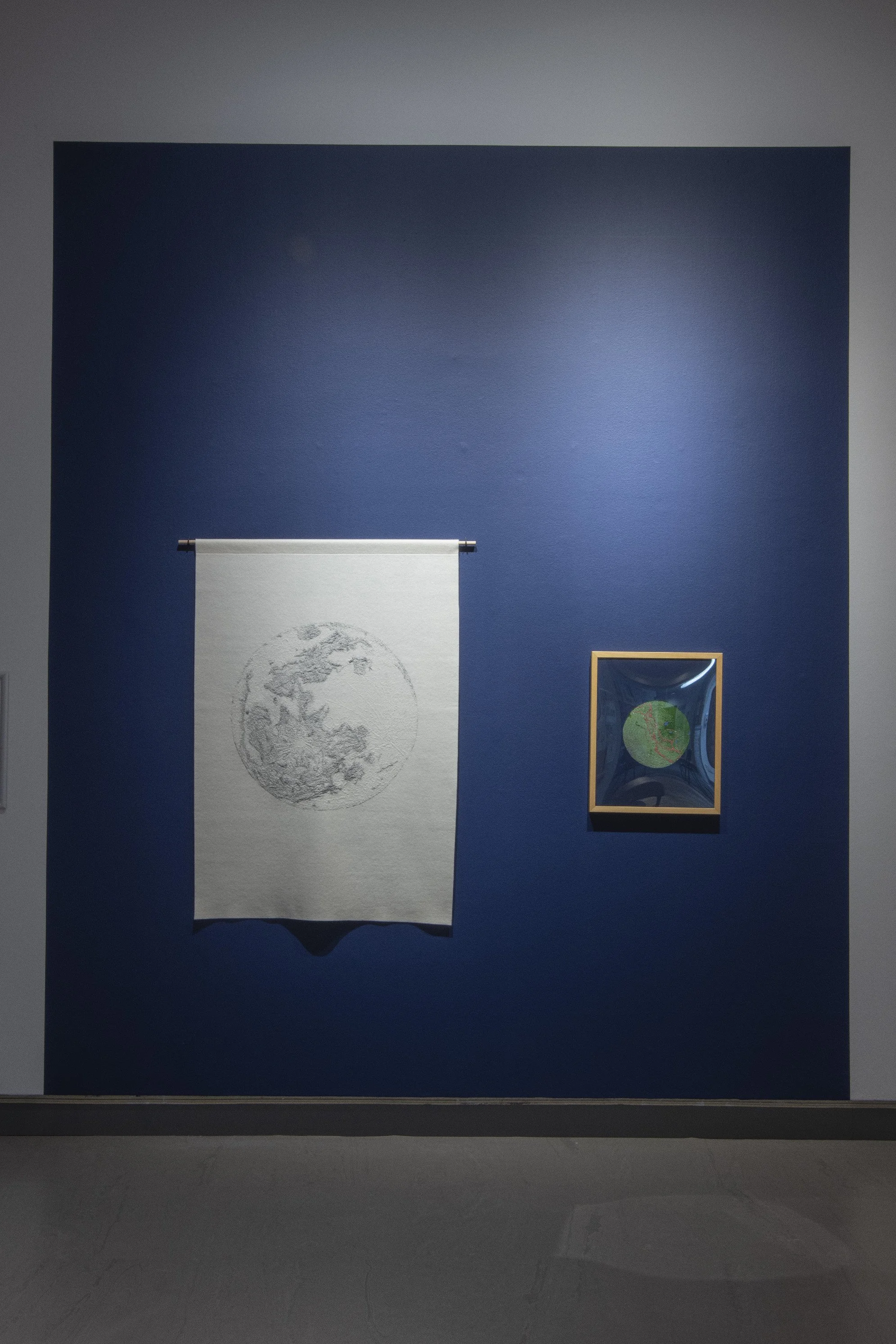
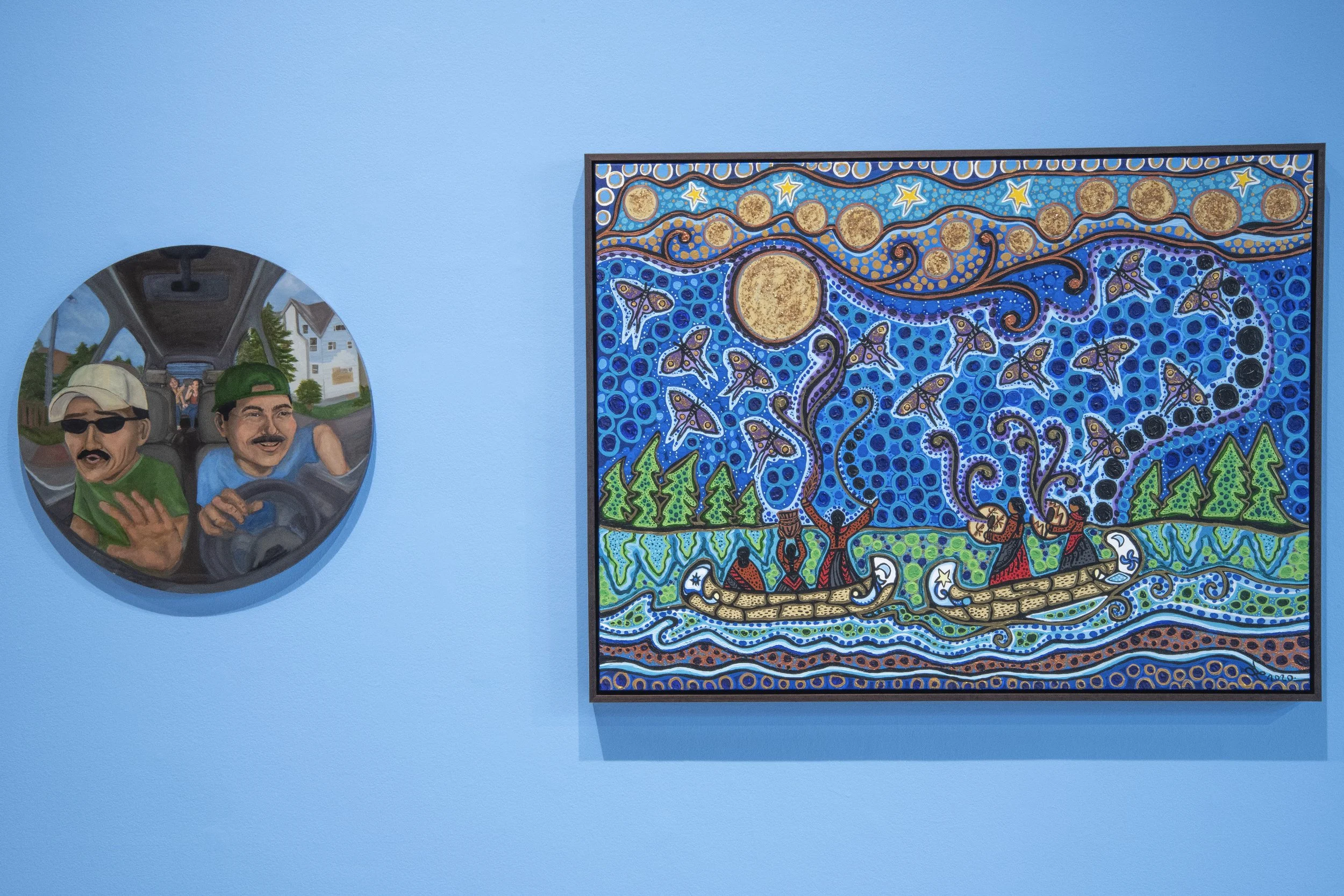
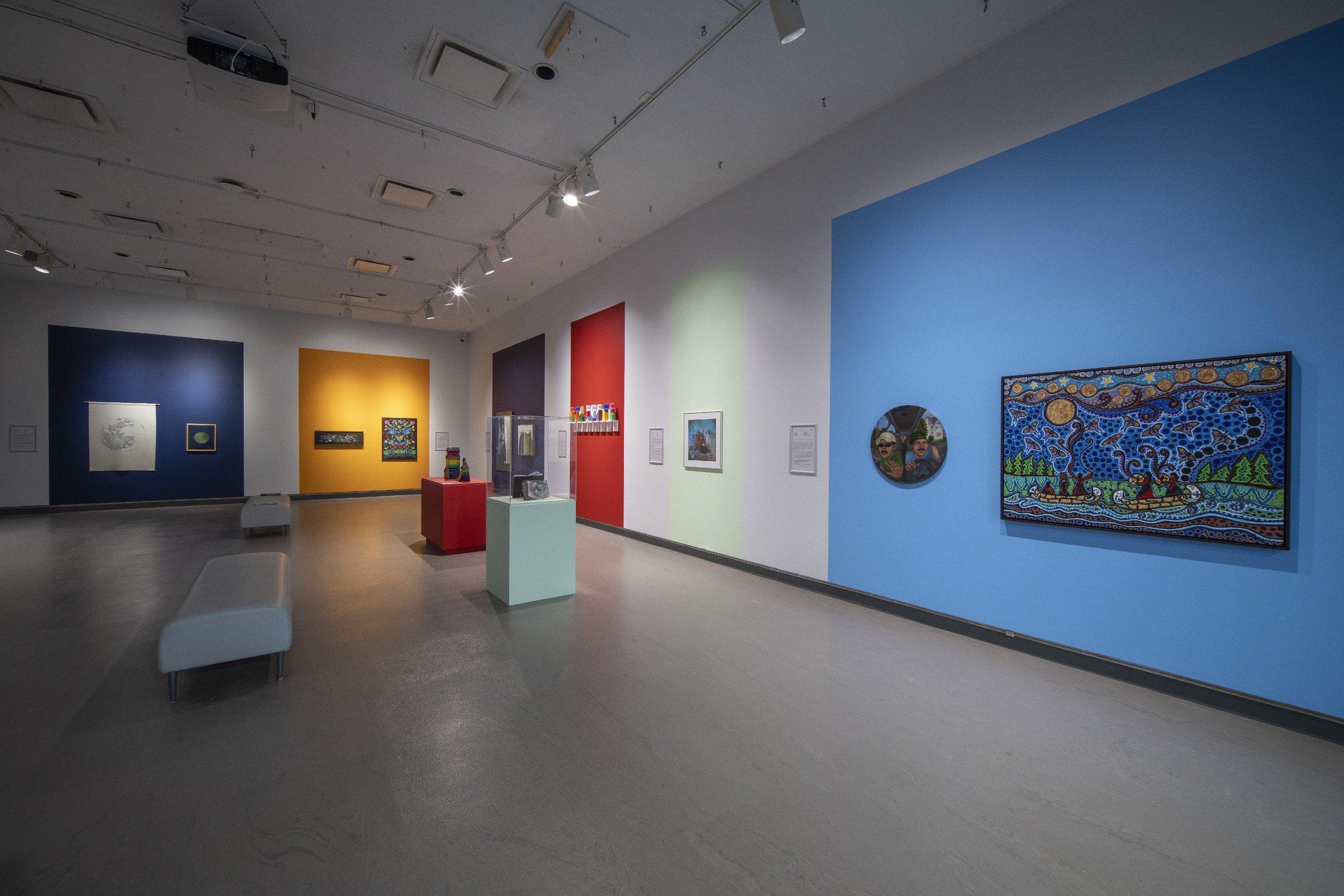
Leah Marie Dorion, Moon Song, 2020, acrylic, mica flakes, on canvas. (left)

Holly Aubichon, Sundays, 2024, oil painting on birch circular panel. (right)

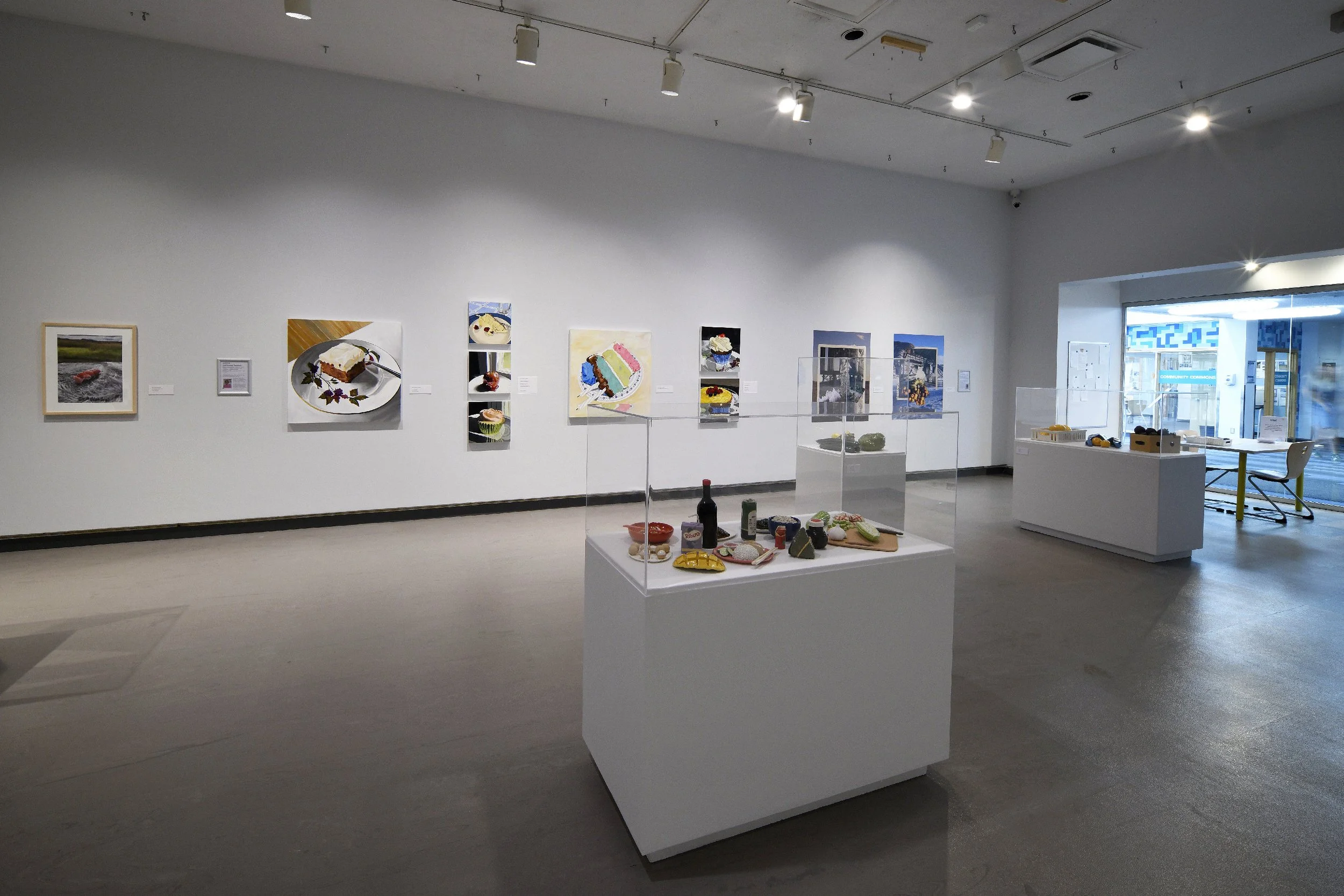
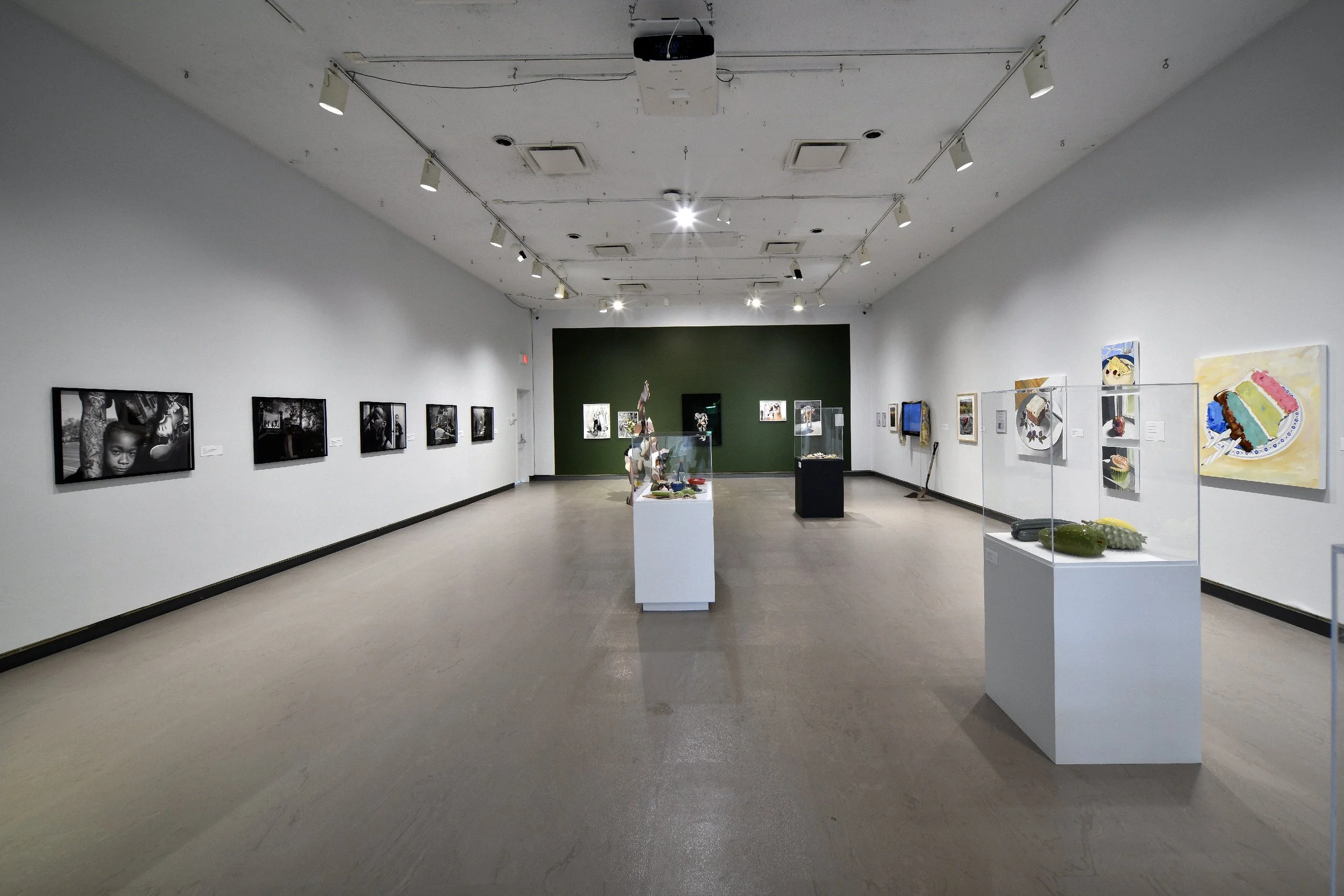
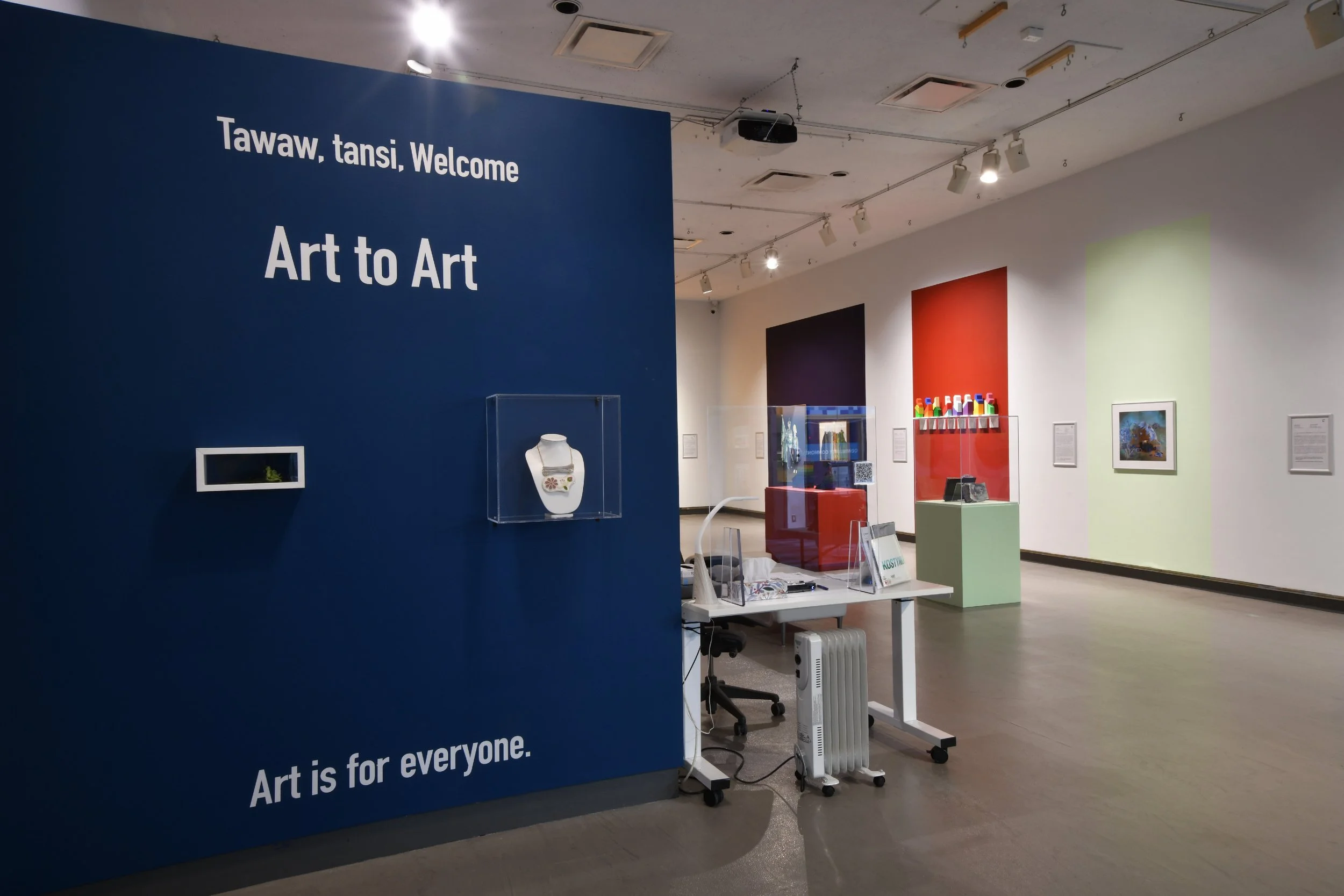
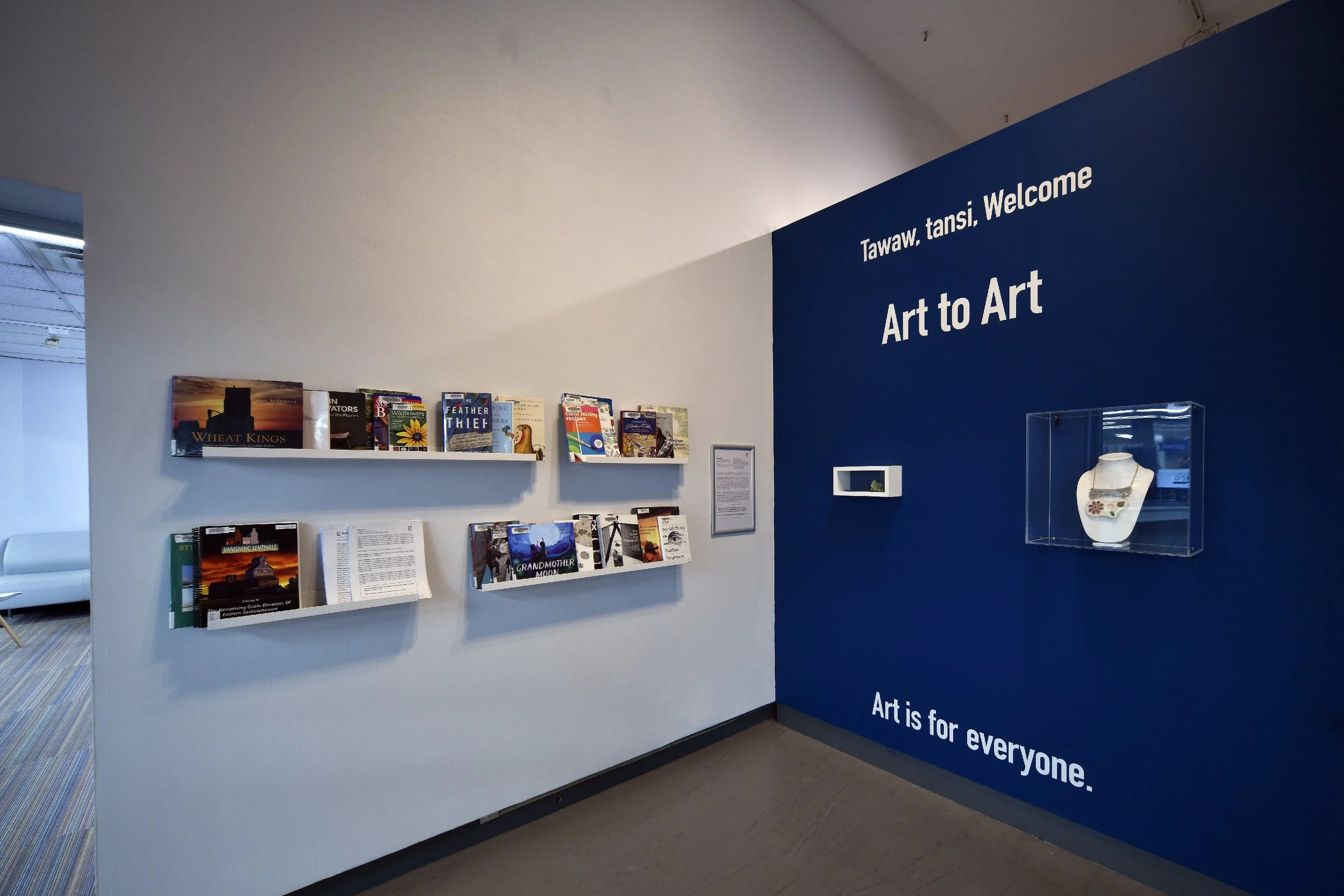
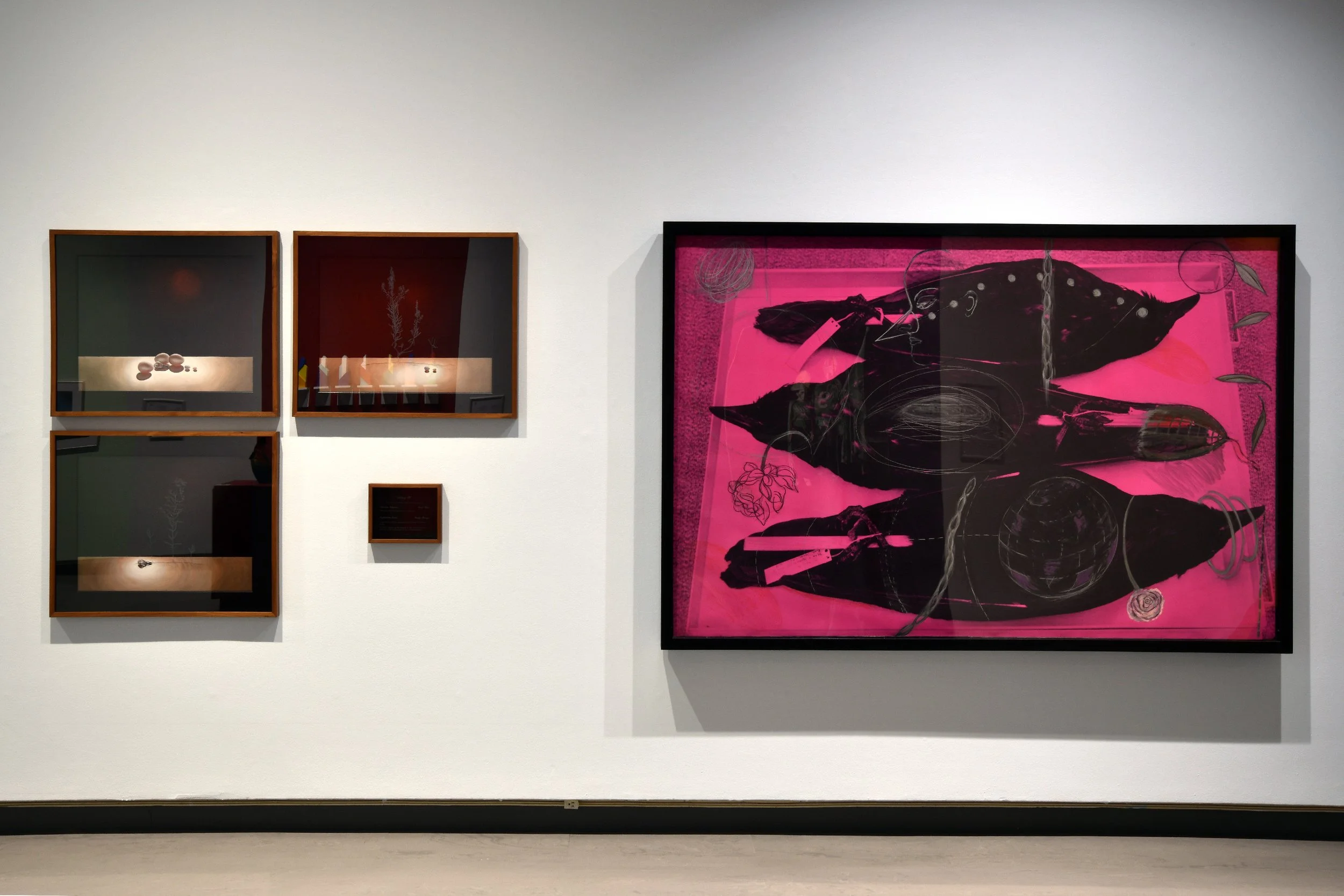
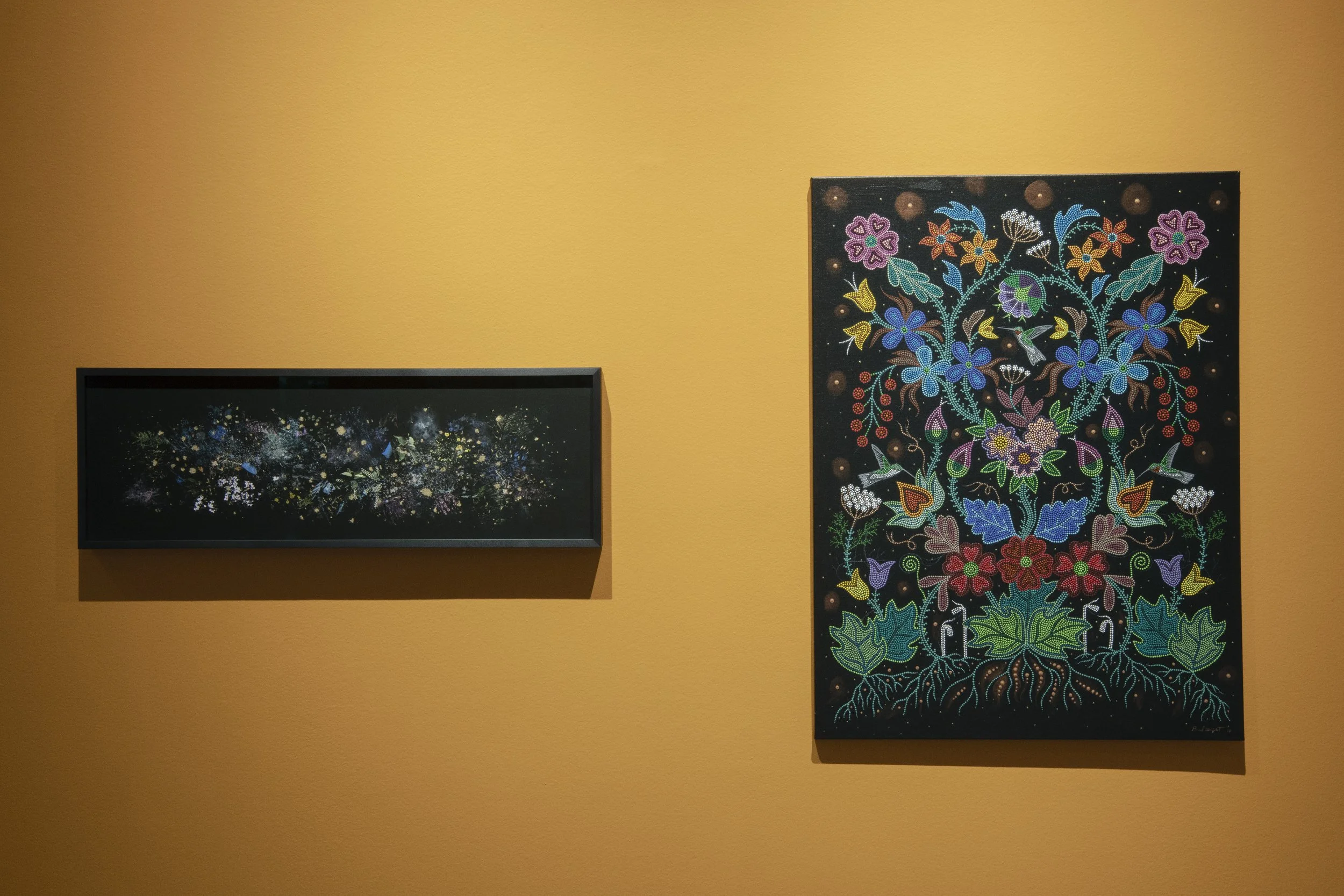
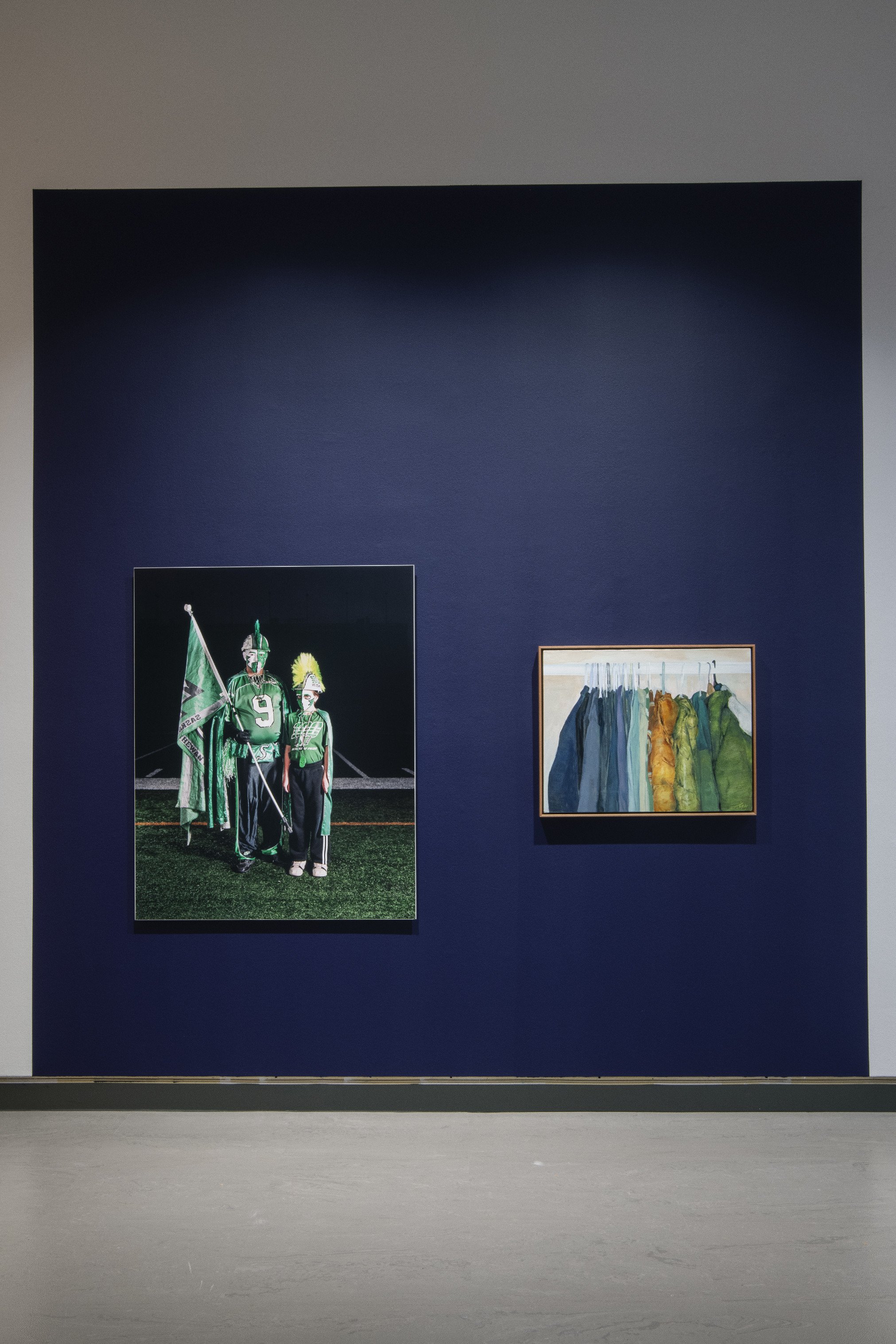
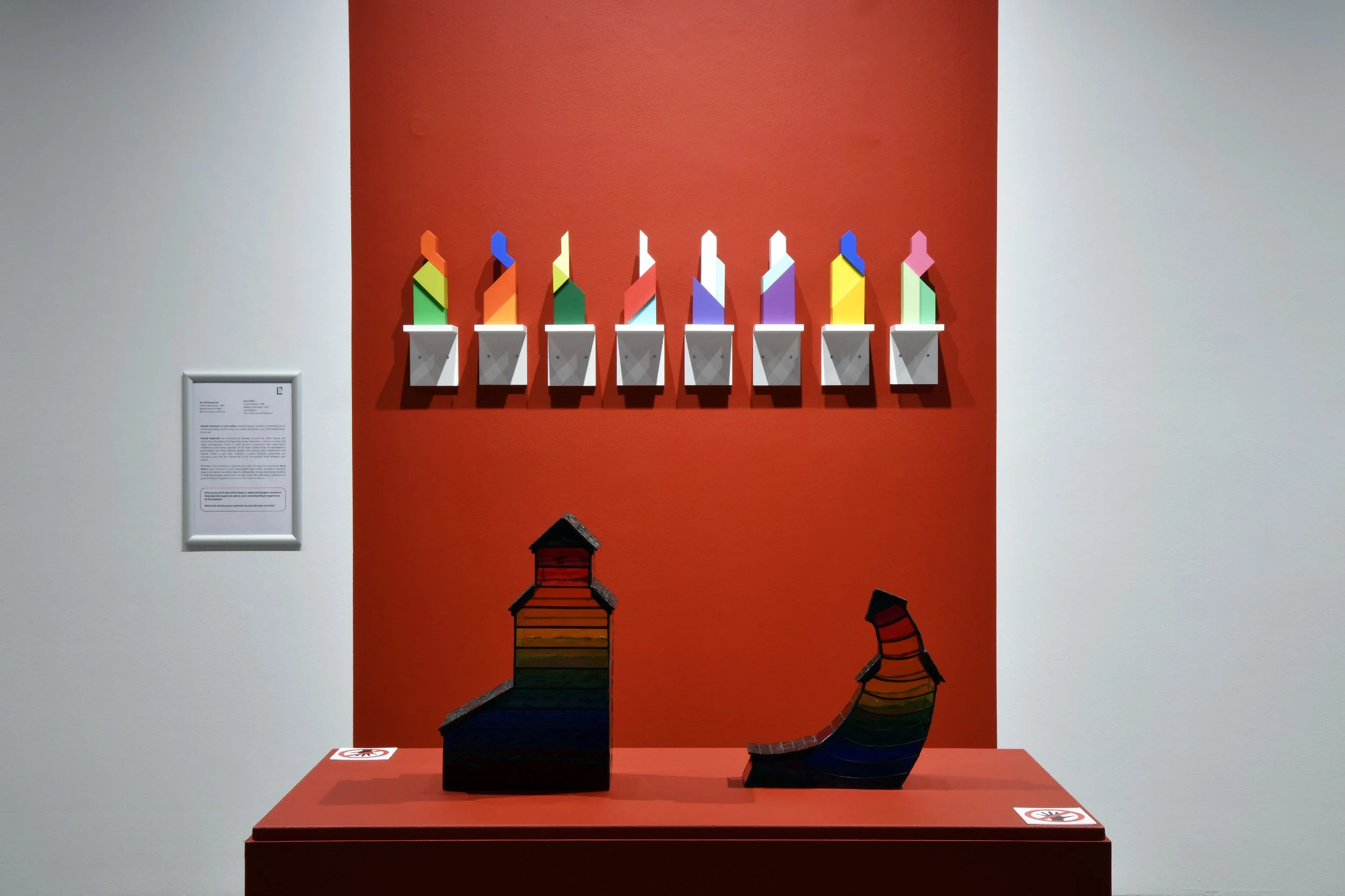
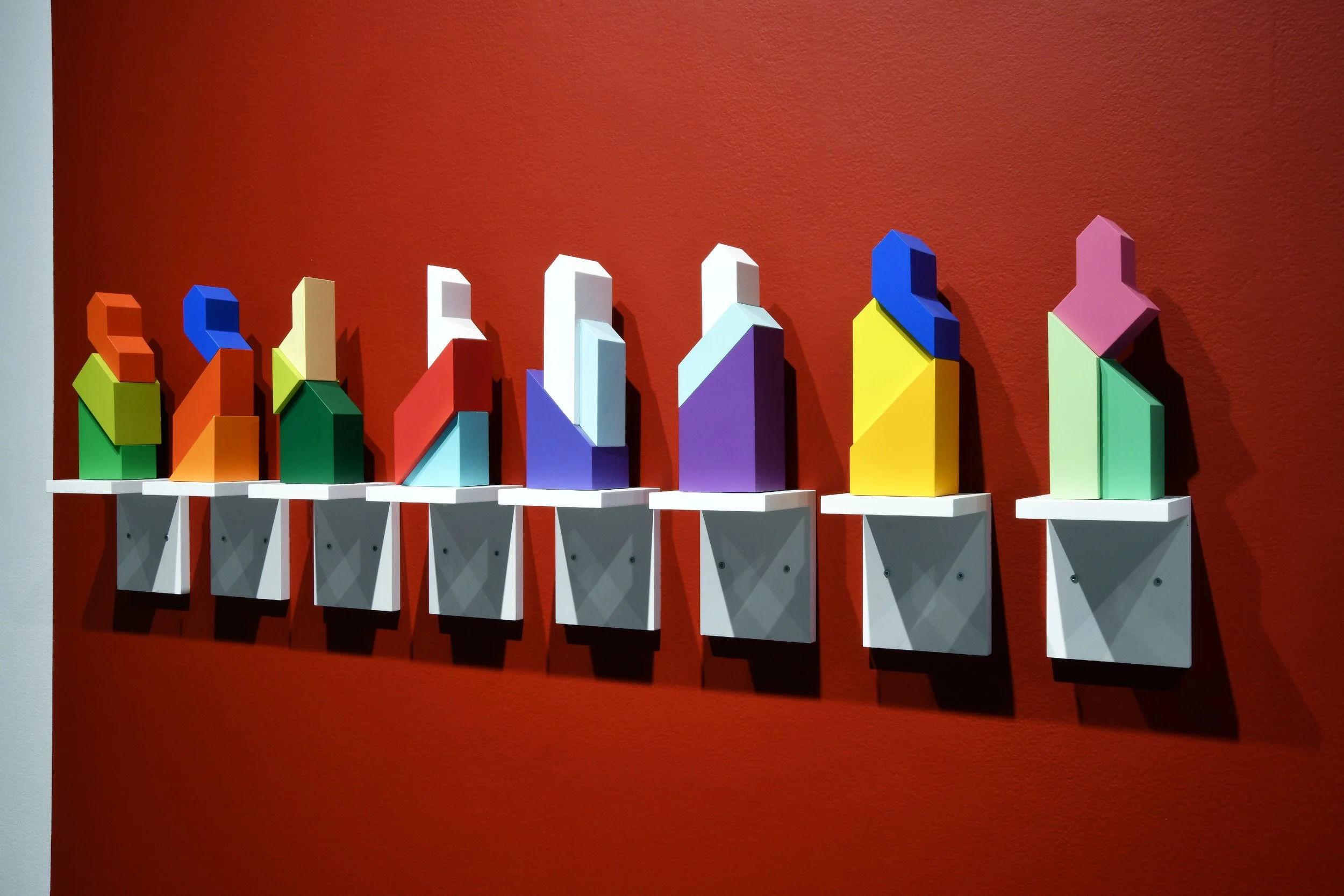
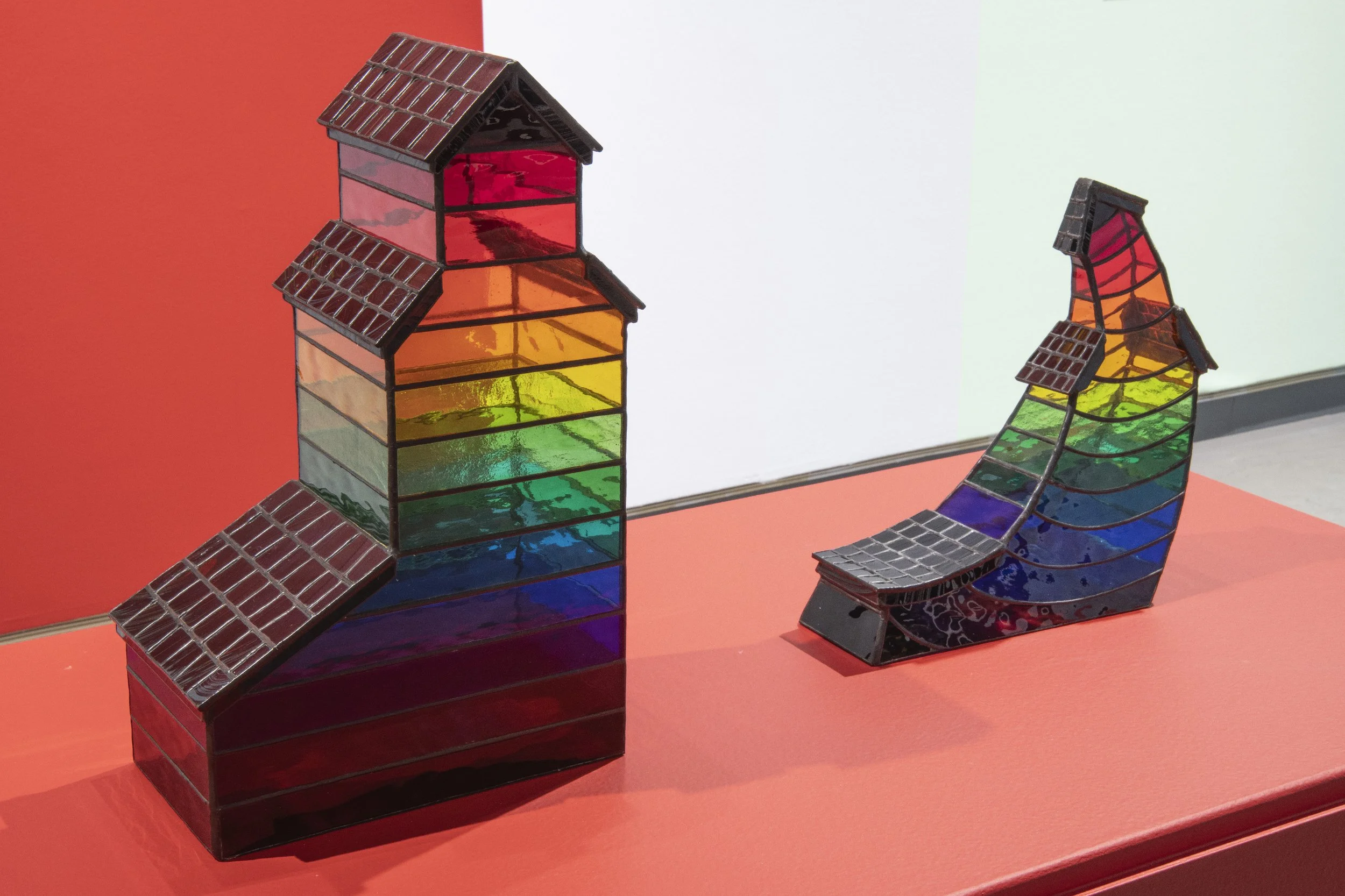
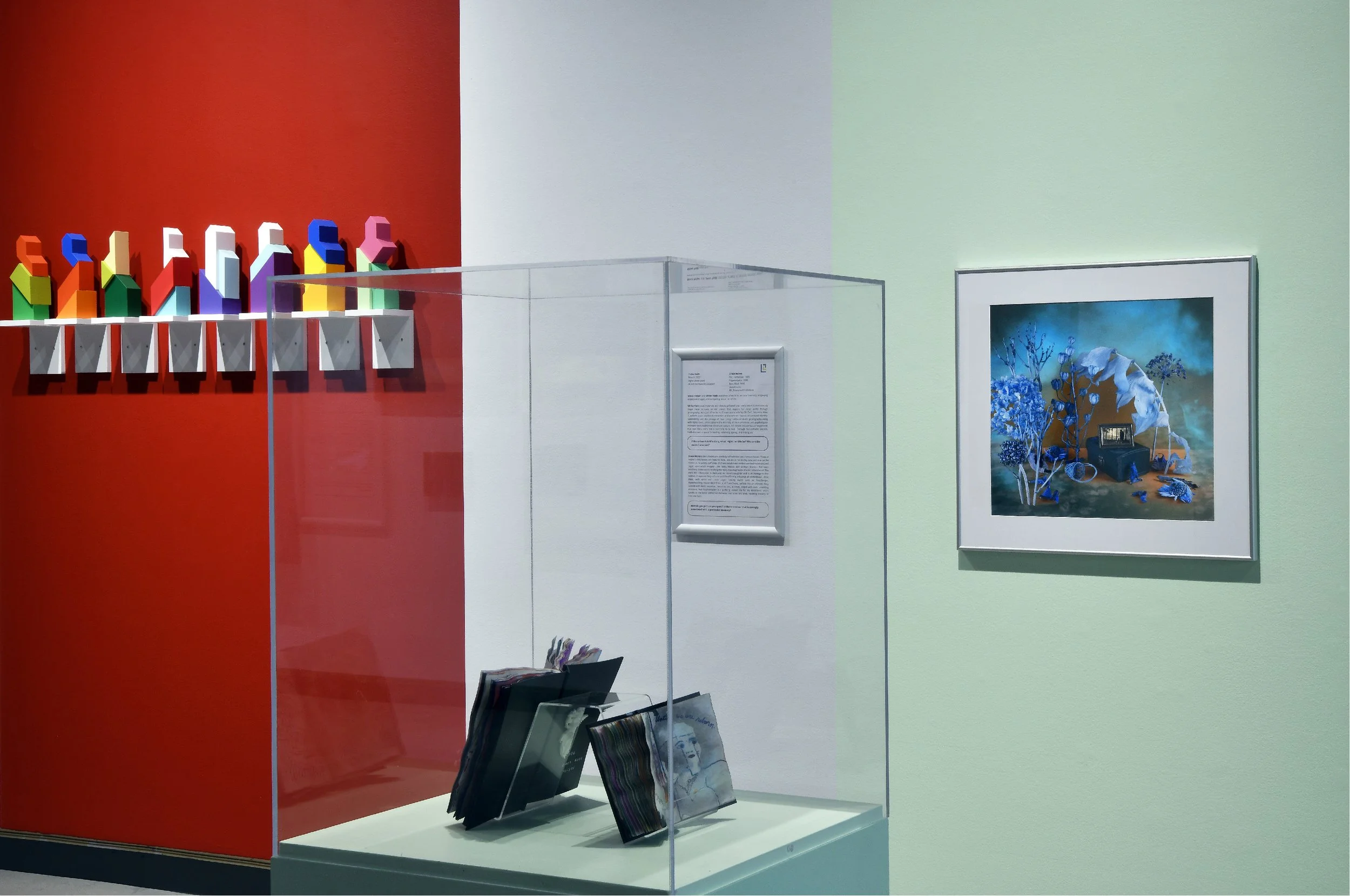
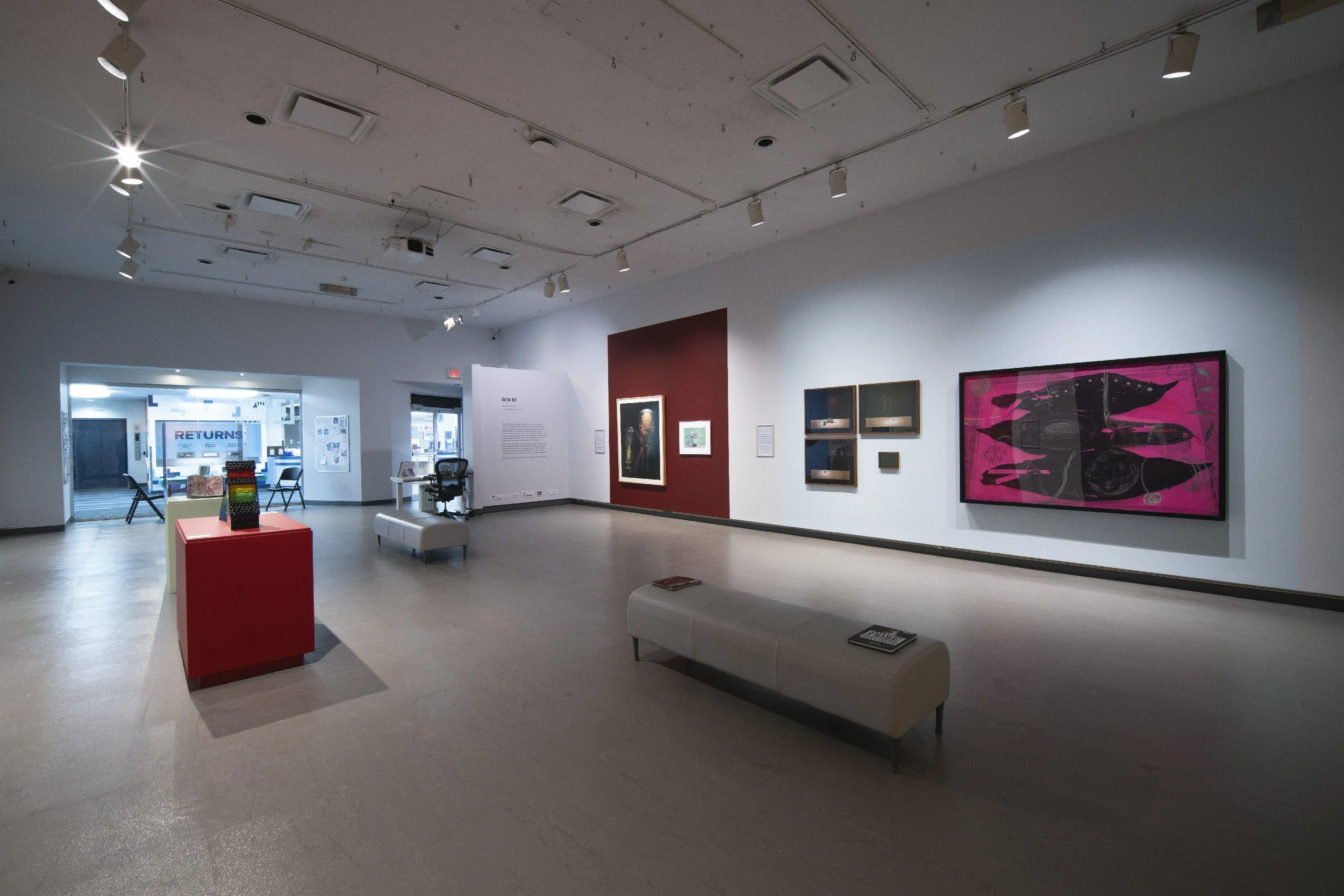
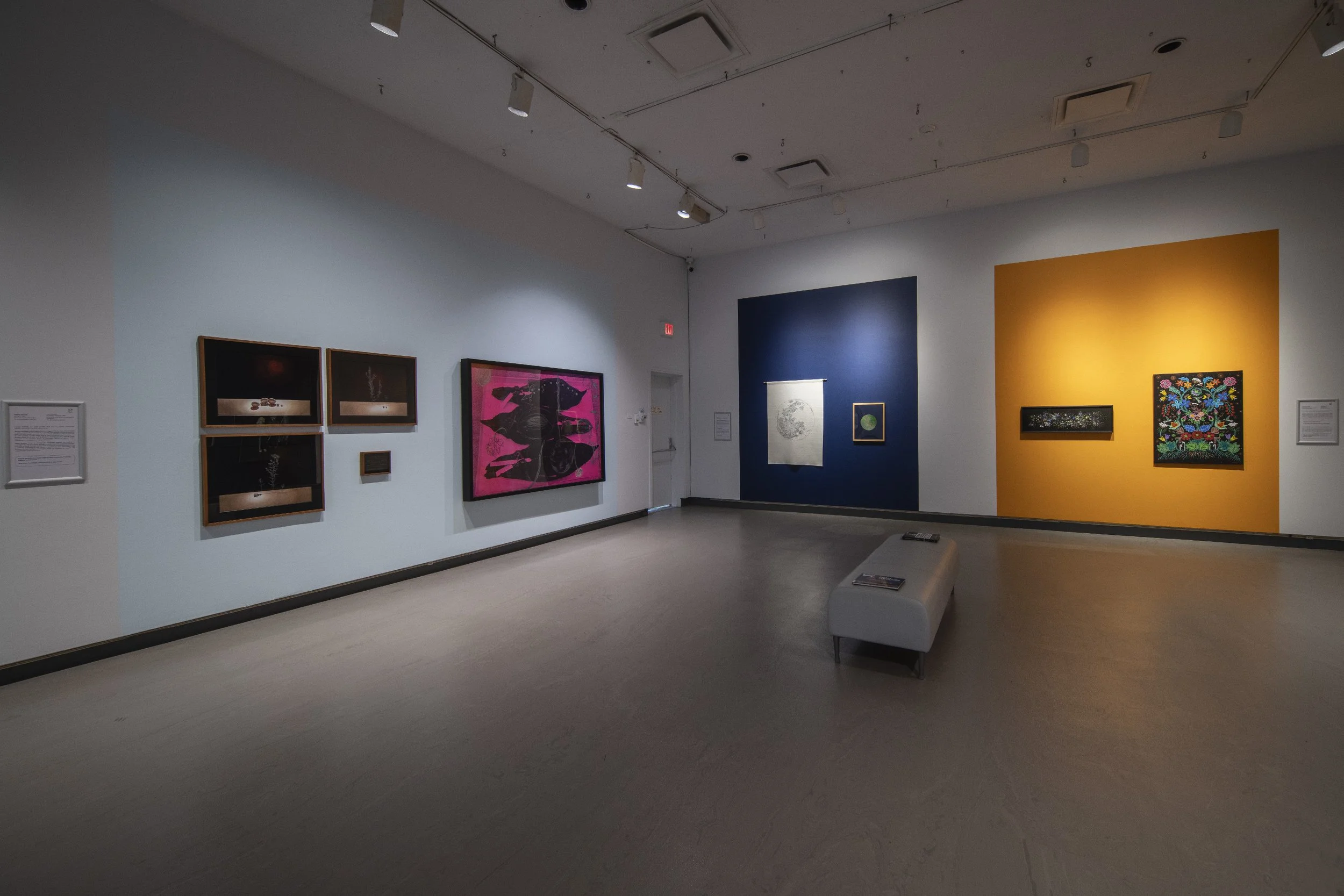
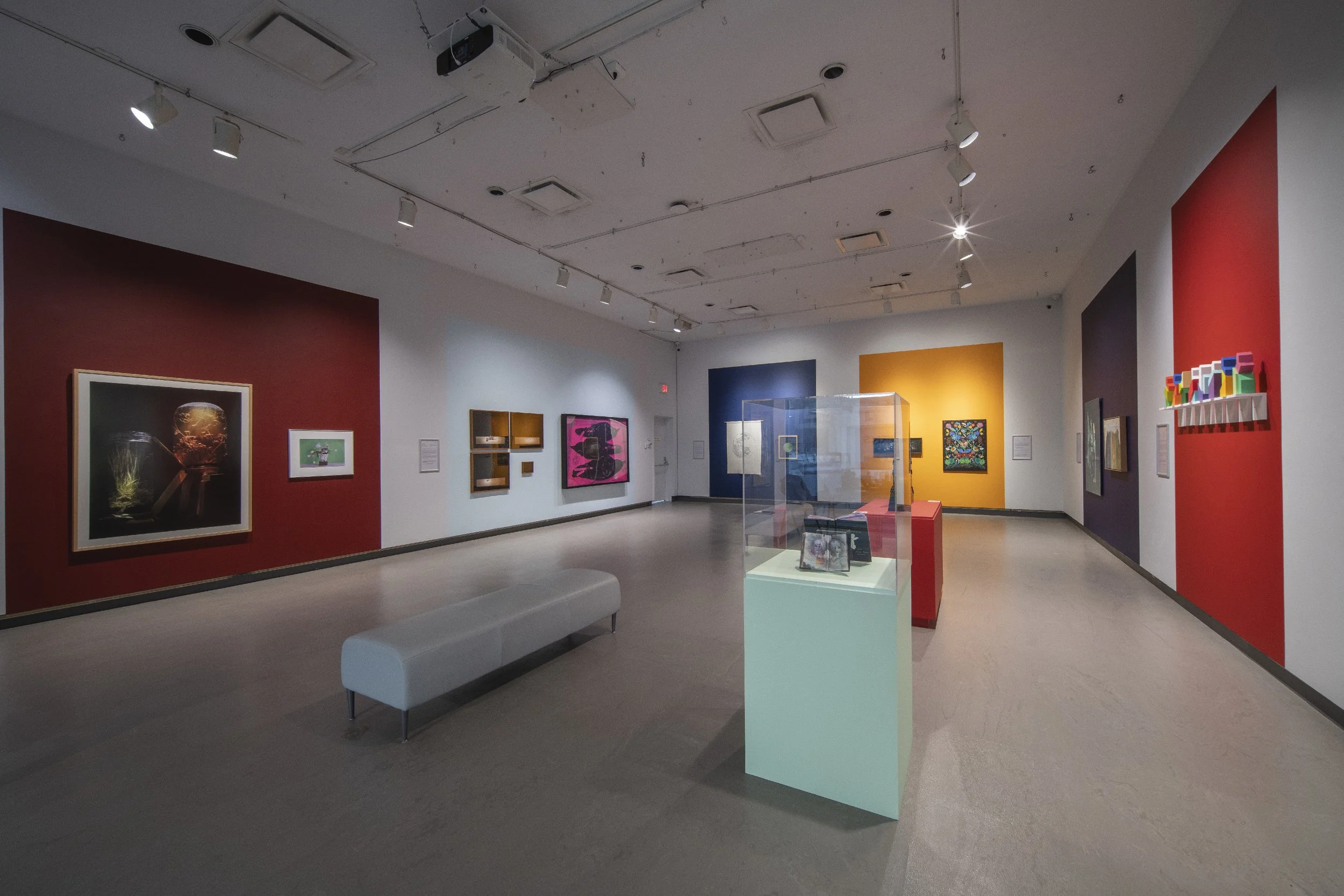
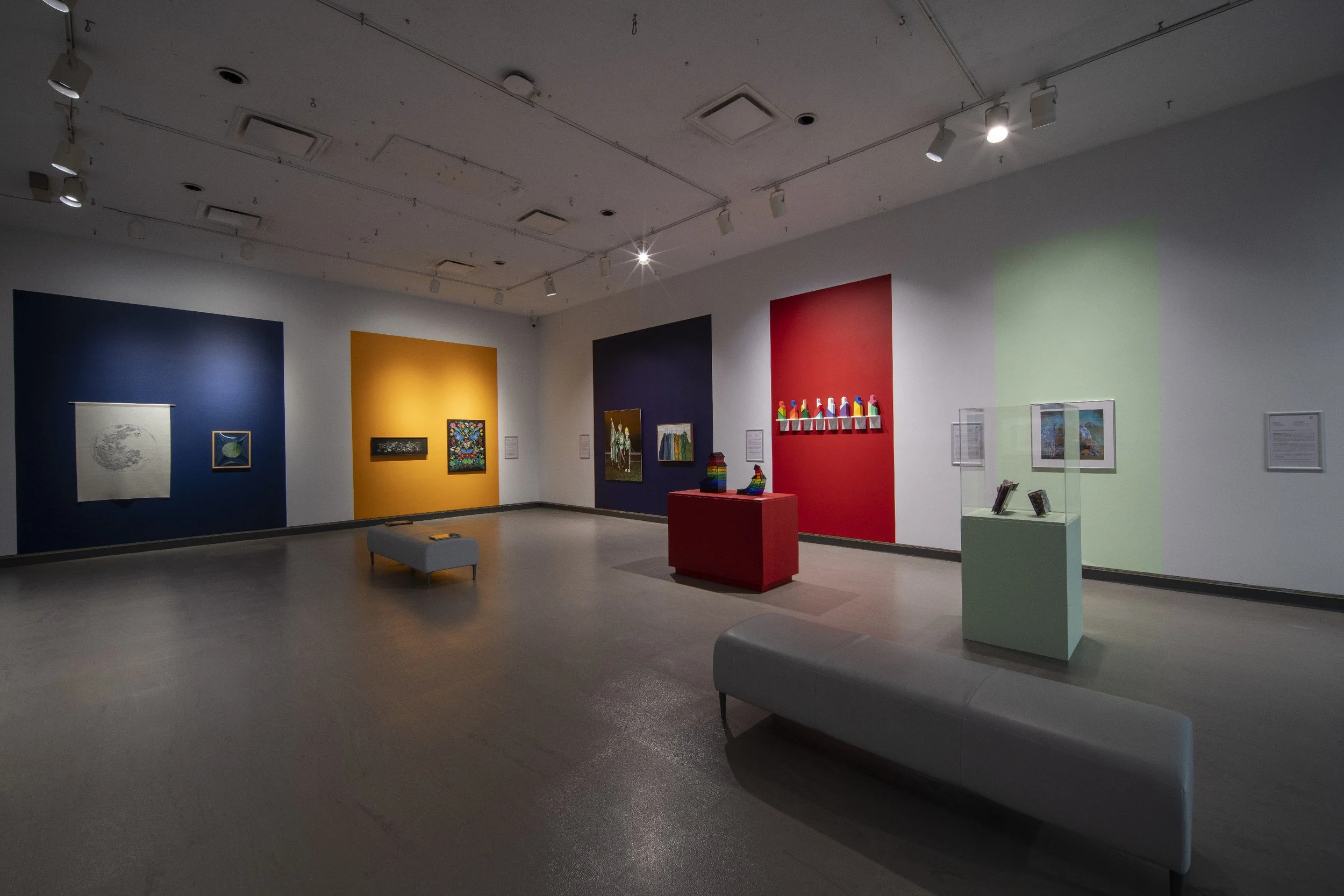
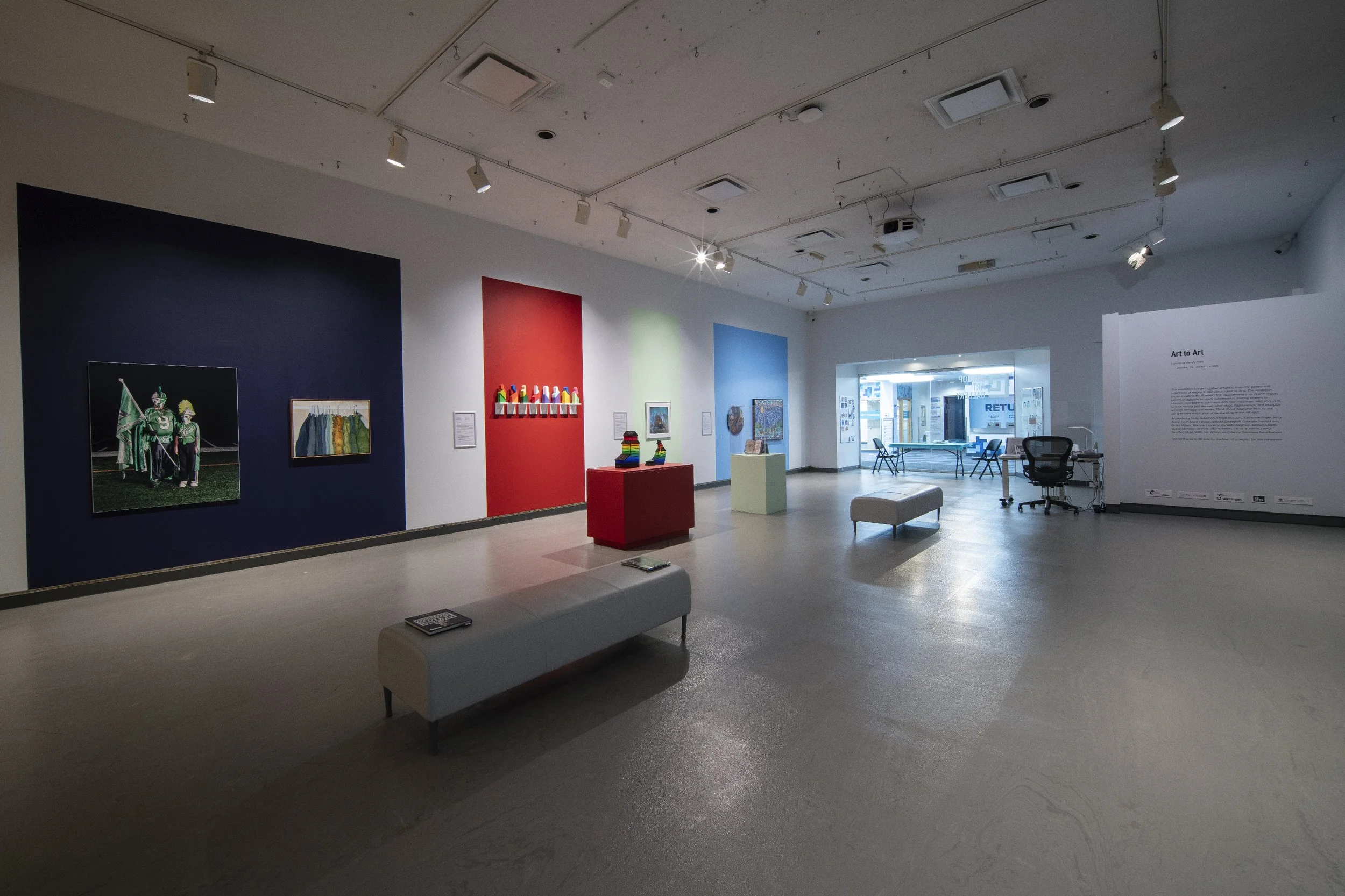
This exhibition brings together artworks from the permanent collections of Regina Public Library and SK Arts. The exhibition presents works by 18 artists from Saskatchewan or Prairie region, paired as diptychs to spark conversation, inviting viewers to uncover connections, contrasts, and new meanings. Take your time to look closely and discover what ideas, relationships, and interplay emerge between the works. Think about how your history and perspectives shape your understanding of the artwork.

Artworks by Holly Aubichon, Christi Belcourt, Katherine Boyer, Jerry Didur, Leah Marie Dorion, Brenda Dowedoff, Gabriela García-Luna, Grace Holyer, Marsha Kennedy, Ronald Kostyniuk, Zachari Logan, Mahdi Mahdian, Brenda Francis Pelkey, Laura St.Pierre, Leesa Streifler, Ulrike Veith, Nic Wilson, and Hanna Yokozawa Farquharson.

Special thanks to SK Arts for the loan of artworks for this exhibition.

Essay

Artists

Holly Aubichon investigates topics of urban Indigeneity and how ancestral knowledge is carried through to urban spaces using memory recollection, the land, and body through forms of painting, writing, tattooing and curation. Born and raised in Regina, Saskatchewan, her Indigenous relations come from Green Lake region, SK and Lestock, SK. Aubichon’s practice is laboriously reliant on retracing familial memories and connections. She uses painting as a way to foster personal healing. As an extension of her practice, she has begun a traditional Indigenous tattoo mentorship to acknowledge the memories that bodies hold, support the healing, grieving and the revival of traditional tattoo practices. She graduated from the University of Regina in the Spring of 2021 with a Bachelor of Fine Arts, minoring in Indigenous Art History. Aubichon is the 2021 BMO 1st Art! Regional winner for Saskatchewan.

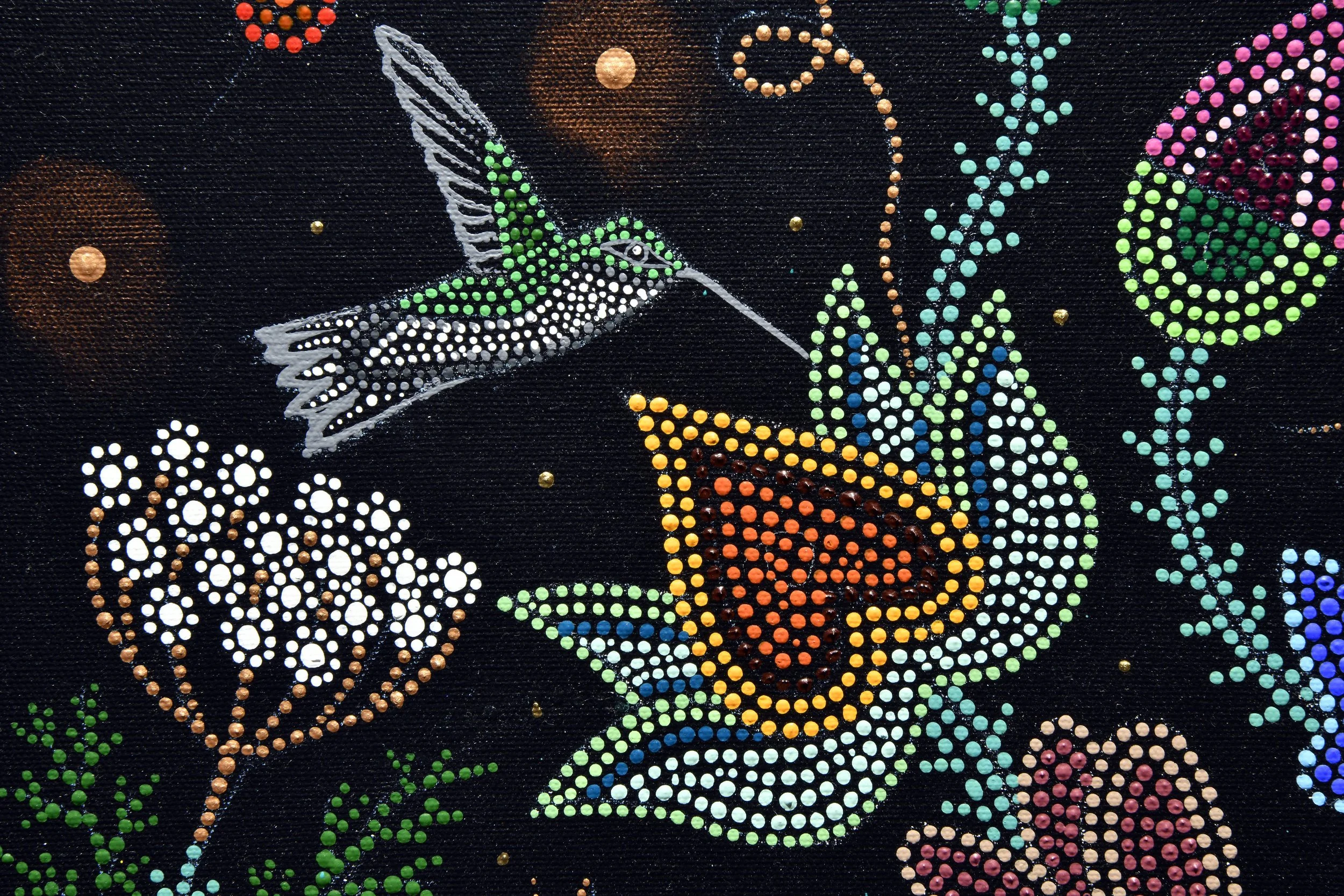
Christi Belcourt (apihtâwikosisâniskwêw / mânitow sâkahikanihk) is a Métis visual artist, designer, community organizer, and environmental and social justice advocate with roots in the historic Cree-speaking community of Manitou Sakhigan (Lac Ste. Anne), Alberta. Her work, inspired by Métis beadwork and traditional Indigenous worldviews, celebrates the natural world and addresses themes of culture, spirituality, and environmental protection. A winner of major national awards, her art appears in prominent collections across Canada and internationally. She led influential community projects including Walking With Our Sisters, a large memorial honouring missing and murdered Indigenous women, and co-founded the Onaman Collective and Nimkii Aazhibikong, dedicated to Indigenous language and cultural revitalization.

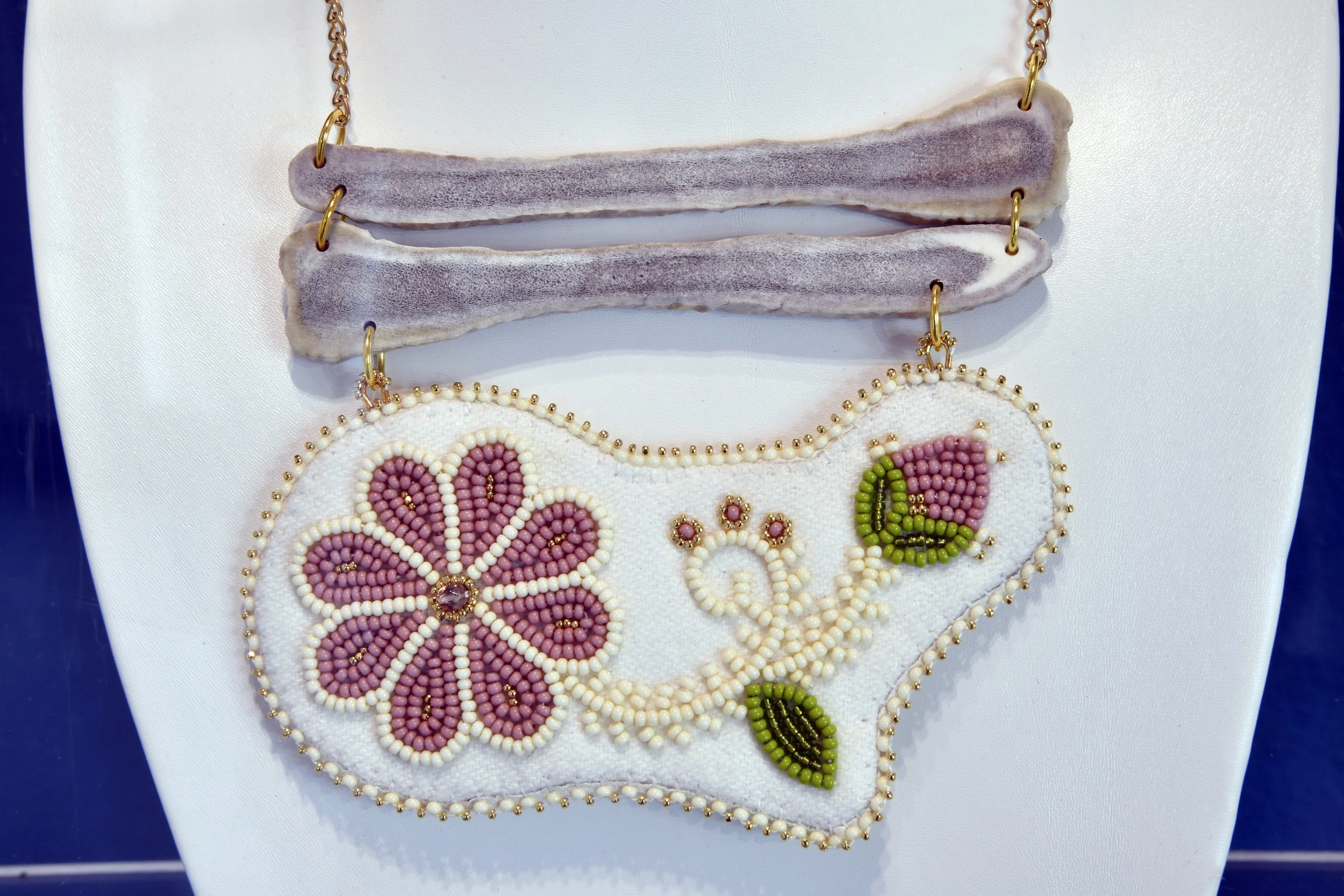
Katherine Boyer (Métis/Settler) is a multidisciplinary artist, whose work is focused on methods bound to textile arts and the handmade - primarily woodworking and beadwork. Boyer’s art and research encompass personal family narratives, entwined with Métis history, material culture, architectural spaces (human made and natural). Her work often explores boundaries between two opposing things as an effort to better understand both sides of a perceived dichotomous identity. This manifests in long, slow, and considerate laborious processes that attempt to unravel and better understand history, environmental influences, and personal memories. Boyer has received a BFA from the University of Regina (Sculpture, Printmaking) and an MFA at the University of Manitoba. She currently holds a position as an Assistant Professor at the University of Manitoba, School of Art.

Jerry Didur was born in Saskatoon, Saskatchewan. He studied ceramics at the University of Saskatchewan, receiving his BFA in 1976. Didur moved to Regina and turned to painting where he had his first solo exhibition in 1985. Didur worked in Yorkton and Lloydminster for Saskatchewan Society for Education Through Art and the Organization of Saskatchewan Arts Councils, developing arts programs and awareness in these communities. Didur has been the recipient of several grants from the Saskatchewan Arts Board. His works have been exhibited extensively and can be found in several prominent collections.

Leah Marie Dorion is an artist, teacher, filmmaker and writer from Prince Albert, Saskatchewan. Dorion holds a Bachelor of Education and a Bachelor of Arts from the University of Saskatchewan and a Master of Arts from Athabasca University. Dorion is also a published author of books about Métis history, cultural teachings and storytelling. She has numerous creative projects to her credit, including academic papers for the Royal Commission of Aboriginal Peoples, children’s books, art exhibitions, and numerous video documentaries that showcase Métis culture and history. Leah’s paintings honour the spiritual strength of Indigenous women and the sacred feminine. Leah believes that women play a key role in passing on vital knowledge for all of humanity which is deeply reflected in her artistic practice. She believes women are the first teachers to the next generation.

Brenda Dowedoff (n. Desjardins) is a Métis artist of Cree, Saulteaux and French descent. Brenda was born in Neepawa, Manitoba and raised in Treaty 2 territory in southern Manitoba, currently residing in Wadena, Saskatchewan. She grew up with a proud Métis father, who made sure she knew where she came from and taught her to appreciate all that our Creator made for us. He taught her ‘to never throw away anything that the birds cannot eat.’ Which taught her to respect the earth that has been entrusted in our care. Brenda aims to use as much natural material in her products as possible.


Grace Rose Holyer was born in Weyburn, SK. Grace Holyer She earned her BFA (1989), and B Ed.(1993) at the University of Regina, and her MFA in painting at the University of Saskatchewan (1999). An artist and writer, Holyer is known for her expressionistic work in painting, artist-made books and poetry. Her writing has also been included in artwork by other artists, notably the text in Gisele Amantea’s work, “August the Sixteenth, 1984”. In 1991, Holyer’s paintings and book works were featured in a solo exhibition, “Antiromantic: The Work of Grace Rose Klatt” at what was then the Glen Elm Branch of Dunlop Art Gallery. Holyer’s work is held in several public collections, including Regina Public Library and SK Arts.

Gabriela García-Luna is a Mexican multimedia artist based in Saskatchewan whose photography‑driven practice blends analogue and digital methods through drawing, printmaking, video, and installation. Her work explores the interconnectedness of the natural world and human experience, shaped by the landscapes of Mexico, India, and Saskatchewan—including recent research on the Saskatchewan River. She has exhibited internationally and led community‑based projects in Mexico, Canada, and India. García-Luna has received support from FONCA, the SK Arts, and the Canada Council for the Arts, and her work is held in major public and private collections such as TD Bank, SK Arts, MacKenzie Art Gallery, and Global Affairs Canada. She holds an MFA from the University of Saskatchewan and a BDes from the Autonomous Metropolitan University in Mexico City.

Marsha Kennedy received a BFA at the University of Regina in1976 and an MFA in at York University (Toronto) in 1981. She taught in the Department of Visual Art at the University of Regina from 1991-2016. Kennedy’s artwork has focused primarily on the complex and interconnected relationships between humans and nature. Kennedy’s traveling retrospective exhibition titled “Embodied Ecologies”, curated and organized by Jennifer McRorie of the Moose Jaw Art Museum & Gallery, was also presented in Swift Current, Estevan, and Vernon, BC.  She has had numerous exhibitions across Canada and is represented by the Slate Fine Art Gallery in Regina, SK.  In 2022, Kennedy received the SK Arts Artistic Excellence Award.

Ronald Kostyniuk was born in Wakaw, Saskatchewan to a Ukrainian-Canadian family, and began his career as a high school biology teacher. Kostyniuk earned a BA in Biology and a BEd from the University of Saskatchewan, Saskatoon (1963); BFA, University of Alberta, Edmonton (1969); MSc (1970) and an MFA (1971), University of Wisconsin, Madison, WI USA. Kostyniuk began teaching as a professor at the University of Calgary in 1971, and is now Emeritus, retired and living in Calgary. Elected to the Royal Canadian Academy of Art in 1975, he has exhibited internationally, and his work is represented in numerous collections including the Institute of Modern Art (Chicago), Canada Council Art Bank (Ottawa), MacKenzie Art Gallery (Regina), Winnipeg Art Gallery, Museum of Modern Art (Germany).

Zachari Logan is a Canadian artist whose drawing, ceramics, and installation work has been exhibited widely across North America, Europe, and Asia. He has participated in numerous international residencies, including programs in Paris, Vienna, London, New York (ISCP and Wave Hill), the McMichael Canadian Art Collection, Venice's Spazio Thetis during the 2019 Biennale, and recent projects in Bulgaria and at MOCA London. Logan has collaborated with noted artists such as Ross Bleckner and Sophie Calle. His recognitions include the Lieutenant Governor’s Award for Emerging Artist, an Alumni of Influence Award from the University of Saskatchewan, and the long list for the Sobey Award. He has received funding from SK Arts, Creative Saskatchewan, Canada Council for the Arts, and the Peter S. Reed Foundation. His work is held in numerous private and public international collections.

Mahdi Mahdian is an Iranian-born figurative artist based in Regina, SK. Born in 1985 in Neyshabur, he left mechanical engineering to pursue painting, completing a BFA at the University of Tehran and MFAs from the Kharkiv State Academy of Design and Arts and the University of Regina. His work explores tensions between tradition and modernity, masculinity and vulnerability, and experiences of memory and displacement. Through layered, improvisational painting he blends classical realism with contemporary experimentation to convey the psychological tension between tradition and transformation. Influenced by both Old Masters and modern figurative artists, Mahdian seeks a hybrid visual language shaped by diasporic experience. He has exhibited in Iran, Ukraine, Lebanon, the U.S., and Canada, including solo and group exhibitions, and works across oil painting, large-scale drawing, and photo‑based mixed media.

Brenda Francis Pelkey was born in Kingston, Ontario. She studied art at Sir Sanford Fleming College of Applied Arts and Technology and Trent University in Peterborough, Ontario. Pelkey moved to Saskatoon, Saskatchewan in 1980 and received her MFA from the University of Saskatchewan in 1994. She was an Associate Professor in the Department of Art and Art History at the University of Saskatchewan from 1994 to 2003, when she moved to the University of Windsor in Windsor, Ontario. Pelkey has exhibited throughout Canada, as well as in England, Scotland, France, Germany, Czechoslovakia and Finland. Her work appears in many public and private collections, including MacKenzie Art Gallery, The Mendel Art Gallery Collection at Remai Modern (Saskatoon) and the Canadian Museum of Contemporary Photography in Ottawa, Ontario.

Laura St.Pierre is a Fransaskoise artist who works primarily in photo, video and installation from an ecological perspective. Her studio, located on Treaty 6 Territory, incorporates a native plant and food garden, as well as a refuge for insects, birds and wild creatures. She studied psychology at UBC and visual art at the University of Alberta and earned an MFA from Concordia University. Recent projects include participation in the international broadcast Earth (Okâwîmâw Askiy – ᐅᑳᐧᒫᐊᐧᐢᑭᕀ), as well as solo exhibitions at the MacKenzie Art Gallery, the Galerie d’art Louise et Ruben Cohen, and the Kenderdine/College Art Galleries. Her work has also been featured in BlackFlash Magazine and the Malahat Review of late. She writes about art on the prairies and teaches part time at the University of Saskatchewan.

Leesa Streifler received a BFA at the University of Manitoba and an MFA from Hunter College in New York. She taught in the Department of Visual Arts at the University of Regina for over 30 years, influencing generations of art students. She has exhibited widely in Canada and internationally. She is passionate about feminism and art education, actively mentoring other artists through MAWA (Mentoring Artists for Women’s Art) in Winnipeg, MB. Streifler lives and works in Winnipeg on Treaty One territory, the original lands of the Anishanaabeg, Oji-Cree, Dakota, and Dene Nations, and on the National Homeland of the Red River Métis.

Ulrike Veith was born in Germany, and currently lives and photographs in Saskatchewan, Canada. During her career, she has worked as a curator, educator, programmer, administrator, and writer. She has received grants from the German Academic Exchange Service, SK Arts, and the Canada Council. Her work is in the collection of SK Arts. Having started out in the 1980s in analog photography (black & white and Cibachrome), she recently made the switch to digital photography and image creation. Veith is inspired by Imogen Cunningham and Thelma Pepper who

undertook significant photographic projects over the age of 65, in Cunningham’s case over the age of 90 and who shared unique insights into older women’s lives.

Nic Wilson (they/he) is an artist born in the Wolastoqiyik territory known as Fredericton, NB, in 1988. He graduated with a BFA from Mount Allison University, Mi’kmaq territory, in 2012, and an MFA from the University of Regina, Treaty Four Territory, in 2019, where he was a SSHRC graduate fellow. They have shown work across Canada and participated in projects with Remai Modern, Plug In ICA, Art Souterrain, and the Mackenzie Art Gallery. They have shown work internationally with Venice International Performance Art Week, Casa de la Primera Imprenta de América in Mexico City, NADA in Bogotá, and OpenArt In Örebro, Sweden. Working across media, Wilson creates videos, texts, performances and artist books. Their work often engages time, language, queerness, mysticism, decay, and the distance between art practice and literature. In 2021, they were longlisted for the Sobey Art Award. They were the 2022 writer-in-residence for G44 Centre for Contemporary Photography.


Hanna Yokozawa Farquharson is a Saltcoats, Saskatchewan–based artist who moved from Japan to Canada in 2011. Her textile and painted works blend imagery of rural Saskatchewan with the Japanese aesthetic of wabi-sabi, reflecting her deep spiritual connection to nature. Rooted in the belief that all elements of the natural world carry spirit, her art seeks peace, joy, and appreciation for life’s ephemeral beauty. In 2024 she debuted as a painter, with work represented by The Black Spruce Gallery. Her practice ranges from contemplative textile pieces to vibrant pop‑art paintings of northern Canadian animals. She was nominated for the 2021 Emerging Artist Award and her solo exhibition toured Saskatchewan with OSAC until 2024. Her pieces appear in private and corporate collections nationally and internationally.

Images

Photos by Don Hall
Embed Block
Add an embed URL or code. Learn more
View Event →