
Dunlop Art Gallery acknowledges the support of key funders: Canada Council for the Arts, SK Arts, Saskatchewan Lotteries, SaskCulture, and the Government of Canada, Canadian Heritage.
Scroll
2025 EXHIBITIONS


2024 EXHIBITIONS




2023 EXHIBITIONS

Elian Mikkola’s work examines the impact of historic German film actor Ruth Leuwerik upon ideals of Western femininity. Leuwerik starred as Maria von Trapp in the 1956 film Die Trapp-Familie (The Trapp Family), a precursor to the popular Hollywood version The Sound of Music. Working with remnants of this 35 mm film sourced from the Berlin archives in this time-based light and sound installation, Mikkola dismantles and reconstructs the power of Leuwerik’s mediated identity. Ultimately, Mikkola frees Ruth from her celluloid construction, giving her dimension and boundless possibility. Through this counter-archival act, Mikkola likewise liberates themself as an artist, filmmaker, and individual.
Elian Mikkola is a Finnish queer filmmaker and media artist currently based between Treaty 4 Regina and Tiohtià:ke, also known as Montréal, Canada. Mikkola works closely with both analog and digital images and explores themes such as memory, spatial dependences and queer belonging. They’ve done extensive research in the field of eco-processed film since 2017. Mikkola finds motivation in challenging film traditions that have been dominated by the Western world and cisgender artists and approaches this critique primarily through personal archives, found footage, and comedic release.


This exhibition includes immersive, interactive new work by Indigenous interdisciplinary artist Cheryl L’Hirondelle created as elaborations on the songs she wrote in collaboration with incarcerated and detained populations in Saskatchewan’s correctional facilities.
Cheryl L’Hirondelle (Cree/Halfbreed; German/Polish) is an award winning and community-engaged interdisciplinary artist, singer/songwriter and critical thinker whose family is from Papaschase First Nation / amiskwaciy wâskahikan (Edmonton) and Kikino Metis Settlement, Alberta. Her work investigates and articulates the intersections of nêhiyawin (Cree worldview) and contemporary time-place incorporating sound, Indigenous languages, music, and old and new technology. Her current projects include: Why the Caged Bird Sings, a collaborative songwriting project with incarcerated women, men and detained youth; nîpawiwin ohci, a series of immersive media-rich installations created to evoke embodied concepts towards solidarity; and Singing Land- a multi-iterative international songwriting/sonic mapping project as a process towards personal treaty-making. She is currently a PhD candidate at University College Dublin.

This exhibition includes immersive, interactive new work by Indigenous interdisciplinary artist Cheryl L’Hirondelle created as elaborations on the songs she wrote in collaboration with incarcerated and detained populations in Saskatchewan’s correctional facilities.
Cheryl L’Hirondelle (Cree/Halfbreed; German/Polish) is an award winning and community-engaged interdisciplinary artist, singer/songwriter and critical thinker whose family is from Papaschase First Nation / amiskwaciy wâskahikan (Edmonton) and Kikino Metis Settlement, Alberta. Her work investigates and articulates the intersections of nêhiyawin (Cree worldview) and contemporary time-place incorporating sound, Indigenous languages, music, and old and new technology. Her current projects include: Why the Caged Bird Sings, a collaborative songwriting project with incarcerated women, men and detained youth; nîpawiwin ohci, a series of immersive media-rich installations created to evoke embodied concepts towards solidarity; and Singing Land- a multi-iterative international songwriting/sonic mapping project as a process towards personal treaty-making. She is currently a PhD candidate at University College Dublin.
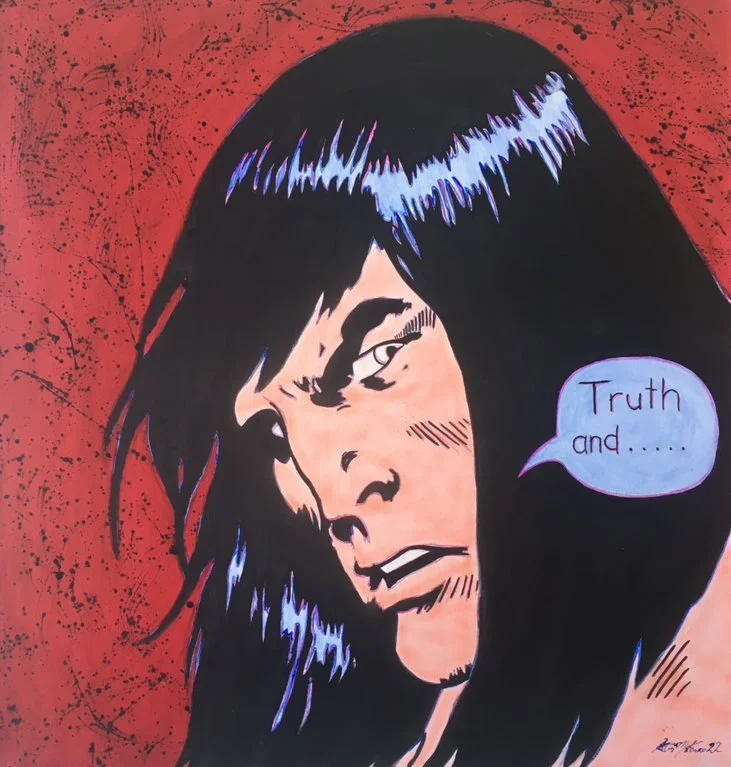
“My father was a survivor of the Lebret (Qu’Appelle) Indian Industrial Residential School. Unfortunately, he did not survive the accumulated effects of intergenerational trauma. We lost our dear father in 1978, he was 39 years old, I was seventeen.” - Kevin McKenzie
Edge of Seventeen collects and preserves the memories and knowledge McKenzie’s father instilled in Kevin as a child, translating his father’s teachings and passion for hockey into a contemporary Indigenous experience. The exhibition serves as a portal, linking repressed childhood memories of McKenzie’s father to his current state of Indigenous regeneration and resistance to colonial assimilation. Edge of Seventeen reflects a personal transformation, through a process of reconstructing Indigenous identity and masculinity.

Coyote continuously whispers in Anderson's ear, "yes, you can joke about something while simultaneously being completely serious.” - Judy Anderson
Through multimedia installations that stimulate the senses Judy Anderson interrogates what it means to “Indigenize” a place. After more than two decades of creating sly and meaningful interventions to mark her presence in the world, Anderson’s work unquestionably pronounces nêhiyaw as integral to this place, known as Treaty Four territory.
Judy Anderson is nêhiyaw from Gordon First Nation, SK. Anderson’s practice includes beadwork, installation, painting, three-dimensional pieces, and collaborative projects. Her work focuses on issues of spirituality, nêhiyaw intellectualizations of the world, relationality, graffiti, colonialism and decolonization. She is an Associate Professor of Canadian Indigenous Studio Art in the Department of Art and Art History at the University of Calgary.

Bodies are complex entities, both built and viewed from many scientific, social, and personal networks. In My Skin brings together artists who dare to self-determine what is means to live in their own bodies. Through diverse feminist perspectives, they resist dominant definitions of how one’s body "should" look, feel, move, and act. Consequently, they embrace the intricacies of what our bodies are and can be. These are acts of resistance and self-reclamation that are actionable calls to respect more fully, love more completely, and care more intentionally for the bodies we inhabit and, by extension, those of others.

2022 EXHIBITIONS
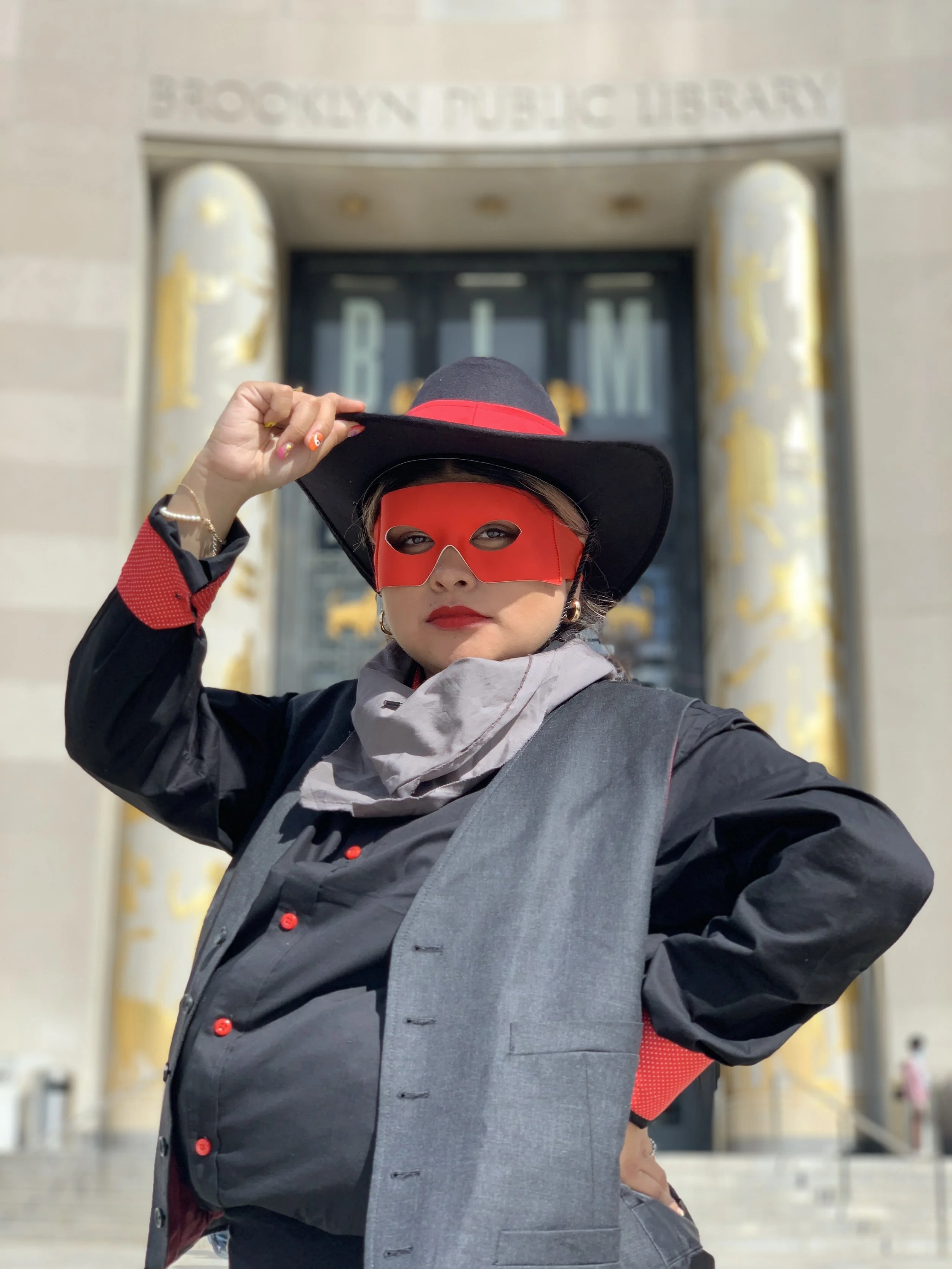
Bodies are complex entities, both built and viewed from many scientific, social, and personal networks. In My Skin brings together artists who dare to self-determine what is means to live in their own bodies. Through diverse feminist perspectives, they resist dominant definitions of how one’s body "should" look, feel, move, and act. Consequently, they embrace the intricacies of what our bodies are and can be. These are acts of resistance and self-reclamation that are actionable calls to respect more fully, love more completely, and care more intentionally for the bodies we inhabit and, by extension, those of others.

With for those of us who live at the shoreline we are reminded of methods of self-soothing and affirmation that we return to as both salve and testimony. Here, kinship, self-imagining, and ancestral knowledge take precedent, and movements of both embrace and refusal are offered as an act of care. Relations here are multi-faceted: they are tactile, immaterial, and otherworldly; they reside on the same embodied plane as liberation, as rest, as joy; they privilege the immediacy of feeling and spirit. The works in this exhibition act as witness to both us and their makers, communally grounding us within the freedom of each of our expansiveness and with love for our specificities.

With for those of us who live at the shoreline we are reminded of methods of self-soothing and affirmation that we return to as both salve and testimony. Here, kinship, self-imagining, and ancestral knowledge take precedent, and movements of both embrace and refusal are offered as an act of care. Relations here are multi-faceted: they are tactile, immaterial, and otherworldly; they reside on the same embodied plane as liberation, as rest, as joy; they privilege the immediacy of feeling and spirit. The works in this exhibition act as witness to both us and their makers, communally grounding us within the freedom of each of our expansiveness and with love for our specificities.
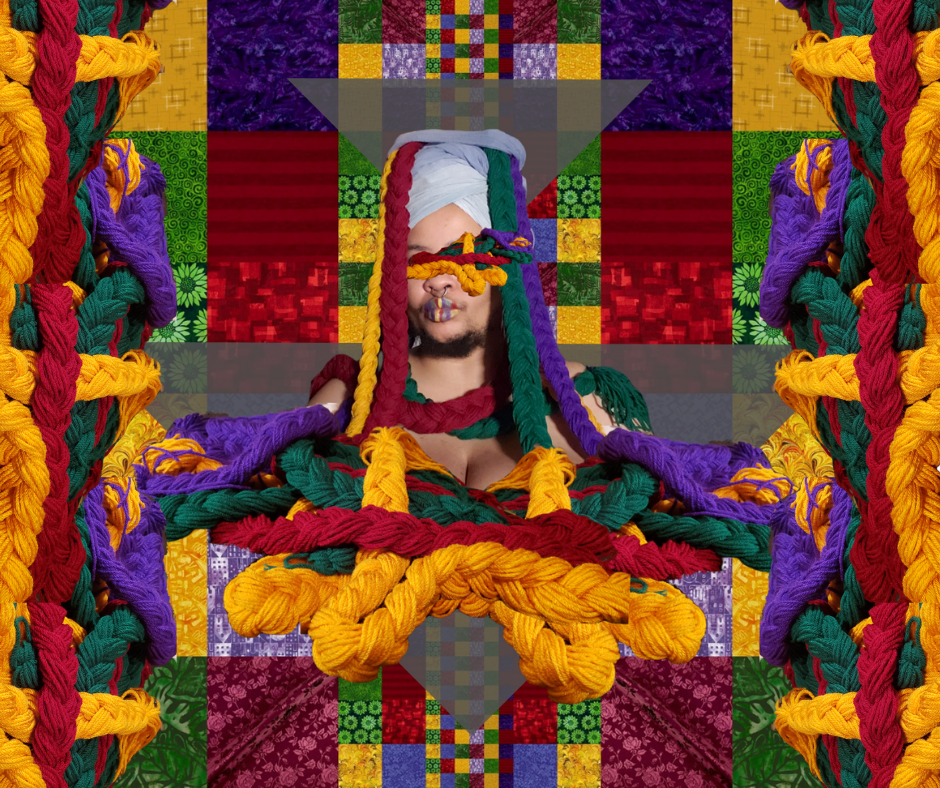
Bodies are complex entities, both built and viewed from many scientific, social, and personal networks. In My Skin brings together artists who dare to self-determine what is means to live in their own bodies. Through diverse feminist perspectives, they resist dominant definitions of how one’s body "should" look, feel, move, and act. Consequently, they embrace the intricacies of what our bodies are and can be. These are acts of resistance and self-reclamation that are actionable calls to respect more fully, love more completely, and care more intentionally for the bodies we inhabit and, by extension, those of others.

The Salt, the Milk, the Donkey, the Honey, the Folk Singers is part of an ongoing series of work about global trade, food production, and advanced industrialism and has been presented at various locations throughout the world. These images, drawings and installations continue his interest in connected global patterns of production, trade and sustainability, articulated through the embodied connections he builds between individuals and the more-than-human world.
Accompanying this exhibition, a live performance will take place on July 2, 2022, with the support of the Regina Farmers Market. The performance includes a procession of musicians, goats, farmers, beekeepers and a donkey.

Bodies are complex entities, both built and viewed from many scientific, social, and personal networks. In My Skin brings together artists who dare to self-determine what is means to live in their own bodies. Through diverse feminist perspectives, they resist dominant definitions of how one’s body "should" look, feel, move, and act. Consequently, they embrace the intricacies of what our bodies are and can be. These are acts of resistance and self-reclamation that are actionable calls to respect more fully, love more completely, and care more intentionally for the bodies we inhabit and, by extension, those of others.

For over 30 years, Shelley Niro has challenged dominant perceptions of Indigenous people throughout her extensive art and filmmaking practice. Often using humour and a flair for storytelling, Niro addresses stereotypical representations of Indigenous people to expose powerful colonial attitudes. From her unique perspective as a Mohawk artist, Niro frequently casts herself and family members in her work to harnesses her familial agency. Niro’s work continually stresses the significance of the land within Indigenous worldviews, languages, and ways of being.
Shelley Niro is a member of the Turtle Clan, Bay of Quinte Mohawk from the Six Nations Reserve. holds a degree from Ontario College of Art and a Master of Fine Art from the University of Western Ontario. Niro has exhibited across Canada has work in collections of the Canada Council Art Bank, Canadian Museum of History, and Canadian Museum of Contemporary Photography. Her award-winning films have been screened in festivals worldwide, and she presented work at the 2003 Venice Biennale. Shelley Niro lives in Brantford, Ontario.

For over 30 years, Shelley Niro has challenged dominant perceptions of Indigenous people throughout her extensive art and filmmaking practice. Often using humour and a flair for storytelling, Niro addresses stereotypical representations of Indigenous people to expose powerful colonial attitudes. From her unique perspective as a Mohawk artist, Niro frequently casts herself and family members in her work to harnesses her familial agency. Niro’s work continually stresses the significance of the land within Indigenous worldviews, languages, and ways of being.
Shelley Niro is a member of the Turtle Clan, Bay of Quinte Mohawk from the Six Nations Reserve. holds a degree from Ontario College of Art and a Master of Fine Art from the University of Western Ontario. Niro has exhibited across Canada has work in collections of the Canada Council Art Bank, Canadian Museum of History, and Canadian Museum of Contemporary Photography. Her award-winning films have been screened in festivals worldwide, and she presented work at the 2003 Venice Biennale. Shelley Niro lives in Brantford, Ontario.
2021 EXHIBITIONS
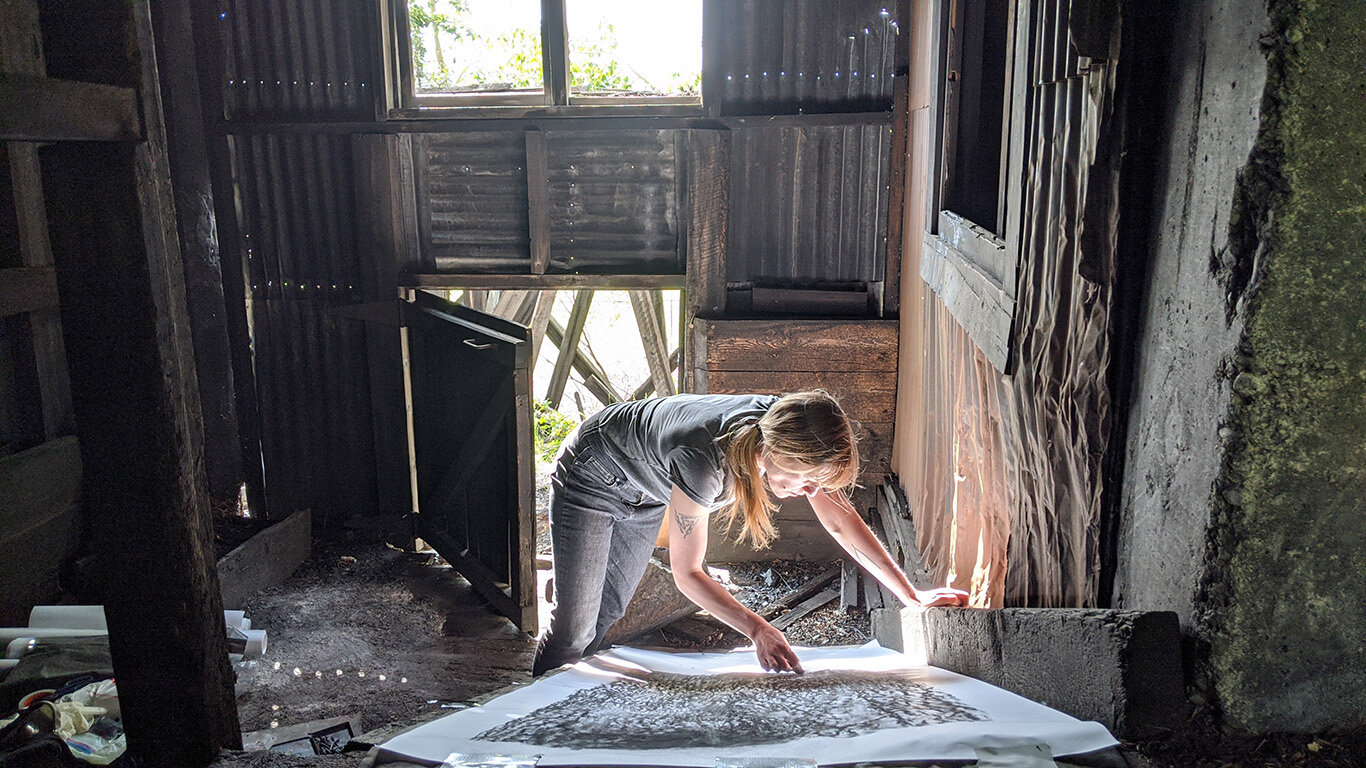
This exhibition draws on Bartol’s work with dowsing (she comes from a long line of water witches) and the history of dowsing in connection to mining/resource extraction. Specifically, Bartol researched Martine de Bertereau, one of the first (recognized) female mineralogists and mining engineers in 17th century France who traveled Europe in search of mineral deposits utilizing specialized divining instruments and other techniques including botany. Martine de Bertereau was accused of witchcraft and died in France while in prison. The story of de Bertereau is a complex one that points to the violence of resource extraction and the development of capitalism that she both participated in and was killed by. In her artwork, Bartol uses dowsing to ask audiences to reconsider consumption-driven relationships to the earth and what are known as 'natural resources'.
Alana Bartol comes from a long line of water witches. Her site-responsive works explore divination as a way of understanding across places, species, and bodies. Through collaborative and individual works, she creates relationships between the personal sphere and the landscape, particular to this time of ecological crisis. Of Scottish, German, English, French, Irish, and Danish ancestry, Bartol is a white settler Canadian currently living in Mohkínstsis (Calgary), Alberta where she is a sessional instructor at Alberta University of the Arts.
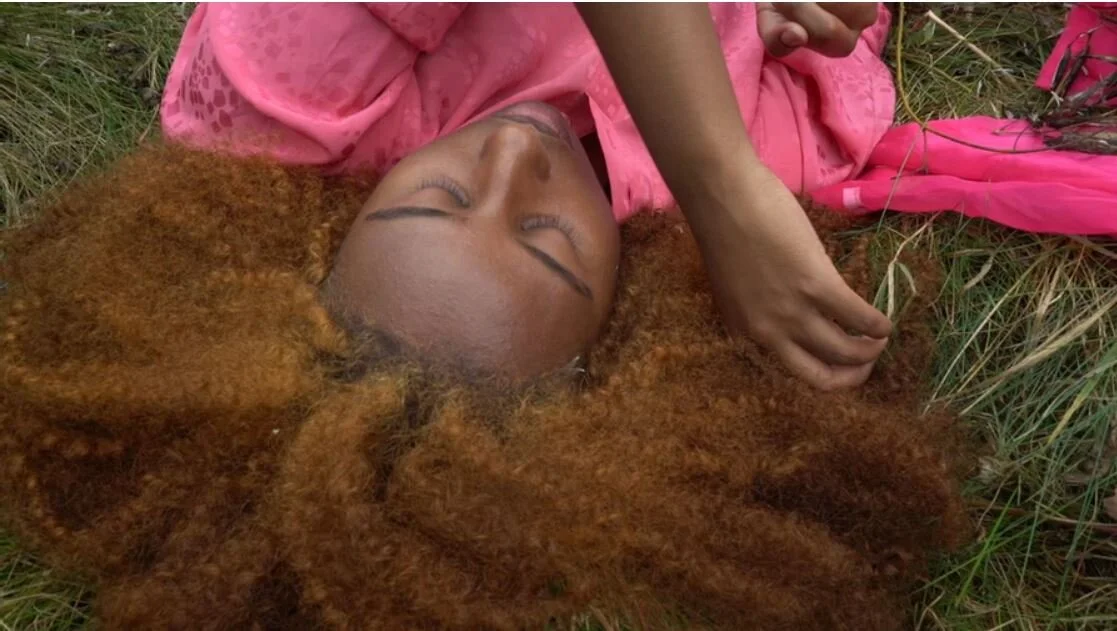
The exhibition Projections addresses perceptions of queerness, sexuality, race, and gender while considering the expanded potential of Indigenous, Black and Queer futurisms.
In their video works, Eshrāghi and Karuhanga express concerns rooted in freedom, defiance, empowerment, presence and self-affirmation, and the disposition and power of the independent projected image brings with it characteristics that align with these concerns.
The artists’ exploration of pleasure and self-care is evident in their videos capturing subjects in nature and/or natural environments, non-verbal narratives, and acts involving touch, desire, movement, ceremony, ritual, and expressions intimate and spiritualized.
Presented within the gallery in spaces created to reference film theatres/projection booths and other voyeuristic contexts, the viewer can watch, observe, consider, anticipate, and dwell in the fantastication of the projected scenarios. In doing so, each work allows the intimate space, within separate alcoves, to assemble personal narratives, individuality, and criticality within the contexts of territory, ownership, and the physical and cultural occupation of space and land.
Léuli Eshrāghi is a Sāmoan/Persian/Cantonese interdisciplinary artist, writer, curator and researcher working between Australia and Canada. Ia/they intervene in display territories to centre global Indigenous and Asian diasporic visuality, sensual and spoken languages, and ceremonial-political practices.
Jessica Karuhanga is a first-generation Canadian artist of British-Ugandan heritage whose work addresses issues of cultural politics of identity and Black diasporic concerns through lens-based technologies, writing, drawing and performances. Through her practice she explores individual and collective concerns of Black subjectivity: illness, rage, grief, desire and longing within the context of Black embodiment.
Gary Varro is a curator and visual artist based in Regina, where in 1996 he established and continues to present Queer City Cinema Festival and Performatorium Festival of Queer Performance. Gary is also a freelance curator.

The exhibition, Particularly Tentative, explores Luther Konadu’s interest in portrait photography as it relates to personal and collective beliefs of identity. He considers making portraits as a way to reflect on ideas with no expected outcome or goal. Luther Konadu considers using images to depict people as a way to question our belief in photographs. Instead of a quick snap of a person’s likeness and presenting it as a portrait, the portrait is a question that is never answered. Konadu considers the portrait as always shifting. The subject can change its meaning with every viewing. Unlike photographs used as tools of facts, proof or for “knowing” something about those depicted, the people in Konadu’s images will always appear in parts, unspecific, and unsettled.

Curated by Alyssa Fearon, Director/Curator and Tomas Jonsson, Curator of Moving Image and Performance.
Showcasing recent process-based works on paper, textile and 360º animation, Otipemisiwak* celebrates the lives and material cultures of three women: the artist’s great-grandmother, Eléanore; her grandmother, Clémence; and her mother, Anita. Works feature a digital-beading technique the artist invented called ‘Berries to Beads.’ The technique mirrors spectacular traditional Métis beading; it is both a meticulous and technically demanding practice and art form.

Curated by Wendy Peart, Curator of Education & Community Outreach
John Peet’s installation is the result of finding a box of old family photographs, including images of his grandfather’s time at the Mount Cashel Orphanage in St. John’s, Newfoundland in the early 1900’s. This institution was operated by the Irish Christian Brothers, a Roman Catholic lay order from 1898 -1990, and has been notably reported as a place where countless youth suffered abuses by those who were entrusted with their care and education. Through this work, Peet develops a posthumous relationship with his grandfather that is deepened by exposing the complex powerful systems that have enabled such tragic conditions. Through his work, he also uncovers the vital interconnectedness of the boys at the school who developed life-affirming friendships and familial bonds.

Curated by Wendy Peart, Curator of Education and Community Outreach
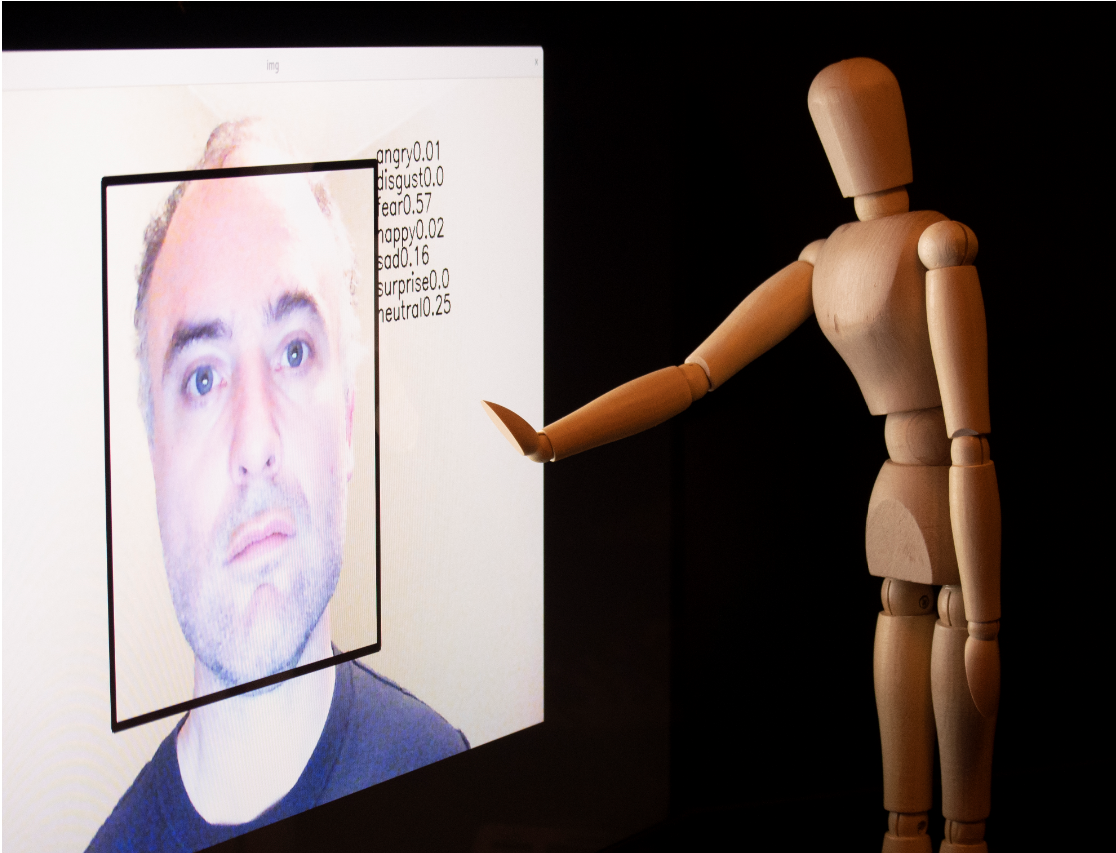
Organized by Dr. Rebecca Caines, multiPLAY features artists from across Canada working in improvisation, sound, new media and performance. Included is radio artist Michael Waterman’s experimental audio collage group “Mannlicher Carcano”, a video installation of archival recordings. John Campbell’s Recognition, is an installation that uses Artificial Intelligence to read human emotion and playfully control real-world objects. multiPLAY artists also include Rebecca Caines, Holophon Audio Arts, James Harley, Helen Pridmore, and Michelle Stewart.

Curated by, Amber Christensen (Sherwood Village Branch Manager), Stacey Fayant (Independent curator), Tomas Jonsson (Curator of Moving Image and Performance) and Wendy Peart, Curator of Education and Community Outreach
Featuring works by Naomi Bebo, Andrea Carlson, Ruth Cuthand, Nicole Dextras, Jude Griebel, Jill Ho-You, Rachelle Viader Knowles, David Opdyke, Geoffrey Pugen, Rolande Souliere, Jeff Wizniak, Pinar Yoldas, and Sylvia Ziemann.
The end of the world has been a human preoccupation since basically the beginning of the world. The exhibition Apocalypse features multiple artists who explore the unimaginable complexity of a cataclysmic crisis. Regardless of the cause, the work in Apocalypse challenges us to consider our own response to a radical change to the world as we know it.

Curated by, Amber Christensen (Sherwood Village Branch Manager), Stacey Fayant (Independent curator), Tomas Jonsson (Curator of Moving Image and Performance) and Wendy Peart, Curator of Education and Community Outreach
Featuring works by Naomi Bebo, Andrea Carlson, Ruth Cuthand, Nicole Dextras, Jude Griebel, Jill Ho-You, Rachelle Viader Knowles, David Opdyke, Geoffrey Pugen, Rolande Souliere, Jeff Wizniak, Pinar Yoldas, and Sylvia Ziemann.
The end of the world has been a human preoccupation since basically the beginning of the world. The exhibition Apocalypse features multiple artists who explore the unimaginable complexity of a cataclysmic crisis. Regardless of the cause, the work in Apocalypse challenges us to consider our own response to a radical change to the world as we know it.
PAST 2020 EXHIBITIONS

Cui Jinzhe’s work The Nymph of the Luo River was inspired by the ancient Chinese poem by the same name, written by famous poet Cao Zhi 曹植, who lived between 192-232. Cui intricately and tenderly traces this story of a man who falls in love with a water nymph, which follows a familiar narrative arc of an unfulfilled love story. Combining elements of traditional Chinese art with pop culture visual styles, Cui weaves a complex and beautiful mesh, connecting time and culture through the common human experience of love and longing.
Cui Jinzhe is an Edmonton-based multidisciplinary artist whose practice includes drawing, painting, installation and public art. Cui was born in Dalian, China and earned a Bachelor of Art from Dalian University of Foreign Languages and Master of Art at Dalian Polytechnic University. In 2008, she came to Canada where her work has focused on self-enlightenment, community intervention and cultural integration.
Organized by Rhizome
Curated by Artistic Director Michael Connor with Assistant Curator Aria Dean.
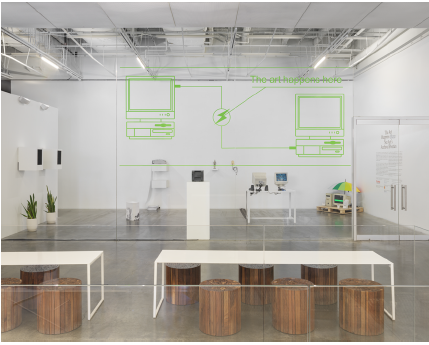
In its decades-long history, net art has served as a testing ground for artists. Through net art, artists have interrogated politics, economies, and material cultures. The Art Happens Here offers a selection of works from Rhizome’s Net Art Anthology. The exhibition restages historical works of net art from its fragments – a timely approach as many institutions now frame the internet as a historical subject, rather than a novelty.
Net art is made up primarily of practices, not objects. This poses problems around how net art is historicized and exhibited. The Art Happens Here explores the new modes of authorship, collaboration, and distribution that have evolved through net art.
Rhizome champions born-digital art and culture through commissions, exhibitions, digital preservation, and software development. Founded by artist Mark Tribe as a listserv that included some of the first artists to work online, Rhizome has played an integral role in the history of contemporary art engaged with digital technologies and the internet. Since 2003, Rhizome has been an affiliate in residence at the New Museum.

Métis artist Leah Marie Dorion shares the moon teachings through her detailed painting and poetry. Important to Indigenous women’s wisdom and traditional cultural knowledge, the moon teachings honour women as vital life-givers. The moon, known by many Elders as “Our Grandmother”, marks the passage of time. It provides wisdom, comfort, protection and strength from its position above us in the sky. Through her work, Dorion restores Indigenous women’s teachings and connects us to the sacred and healing natural law cycles.
Leah Marie Dorion is an interdisciplinary Métis artist, teacher, filmmaker and writer from Prince Albert, Saskatchewan. Dorion holds a Bachelor of Education and a Bachelor of Arts from the University of Saskatchewan and a Master of Arts from the Athabasca University. She has received numerous awards and grants and her work is held in many public and private collections and. Dorion is a published author of books about Métis history, cultural teachings and storytelling.

The artworks of this exhibition bring together elements of trade, treaty and territory to demonstrate ideas of relationship, both Indigenous and colonial. Through sensory engagement with materials, light and shadow, her installations piece together an atemporal space critical of Western ideologies and systems.
Hannah Claus is an intermedia artist of English and Kanien’kehá:ka heritage who has been living and working in Tiohtià:ke [Montreal] since 2001. Within her practice, Claus engages with an Onkwehon:we epistemology to highlight ways of being in relationship with the world and those around us. She completed her undergraduate studies at the Ontario College of Art and Design (1998) and her Master’s of Fine Art at Concordia University (2004). Her work belongs to various public and private collections, including the National Gallery of Canada, the City of Montreal and the Department of Global Affairs. She is a recipient of the 2019 Eiteljorg fellowship. Current exhibitions include Àbadakone| Continuing Fire at the National Gallery of Canada (Ottawa, ON), Blurring the Line at the Eiteljorg Museum (Indianapolis, IN) and Inaabiwin at the Ottawa Art Gallery (Ottawa, ON). Claus is a member of the Tyendinaga Mohawks of the Bay of Quinte, Ontario.
PAST 2019 EXHIBITIONS
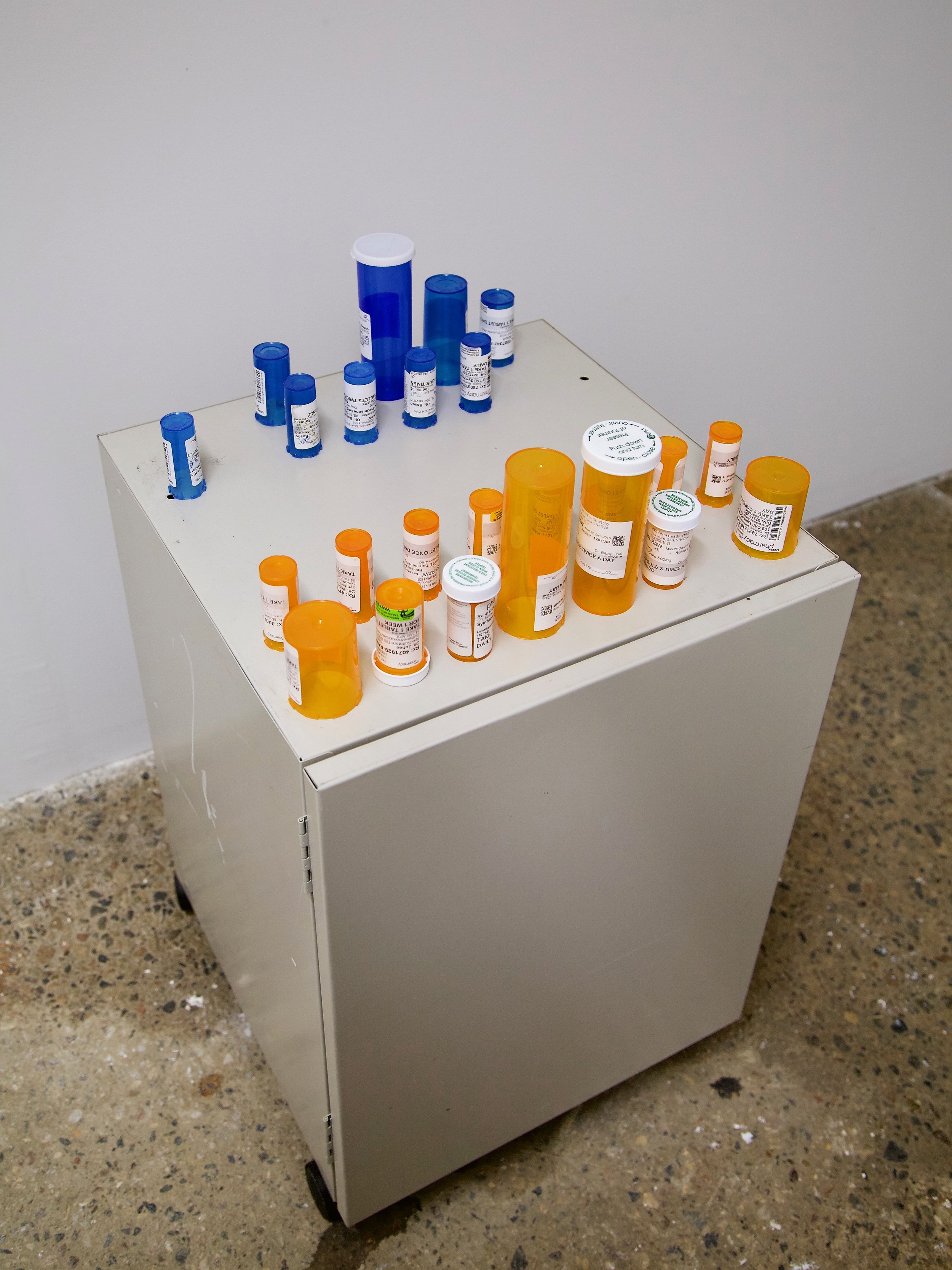
Julie Oh works with photography, video, and installation to examine our understanding of, and relationships with, common objects. By questioning her selected object’s use and nature using intuitive, sometimes nonsensical approaches, Oh positions the viewer to consider the use and values of these objects in new ways.
Julie Oh is an emerging artist from Saskatoon. She completed her MFA as a Fulbright Fellow at the School of the Art Institute of Chicago in 2012 and holds a BFA from the University of Saskatchewan. Her work has been featured in group exhibitions including: Living Architecture (2018), 6018 North, Chicago; Double Gaze (2018), ACRE Projects Gallery, Chicago; Punctured Landscape (2017), Art Museum of the Americas, Washington, DC; The New Normal (2017), Supa Salon, Istanbul, Turkey and The Hanger (an UMAM D&R Project), Beirut, Lebanon.

Marigold Santos’ practice explores the ways in which ideas of self-hood can become multiple, fragmented, and dislocated and then reinvented and recreated through a reflection of movement, migration and change. In particular, she returns to the memories associated with her family’s immigration from the Philippines to Canada in the late 80’s as an auto-biographical point of departure, and considers the experiences of a young person coming to terms with a new sense of self in relation to their new environment. Negotiating narratives of the past and present results in the creation of a personal myth, a visual vocabulary influenced by the hybrid of Filipino and Western folktales of Santos' early youth, the Canadian pop culture of the late 80’s and early 90’s, the science and social politics of that period, and the Canadian geography and landscape.
The imagery within Santos' interdisciplinary work consists of elements that reflect on the notion of a self that is plural and in-process, and takes place within the realms of the otherworldly - where the porous boundaries of reality and the fantastical rupture, overflow, and reconfigure. Persistent in her work is the reference to the creature of fear in Filipino folklore known as the Asuang - a supernatural shape-shifting witch and ghoul who has the ability to self-sever. In her work the narrative is reconfigured; these Asuang speak not of malevolence, but of lived experience, self-awareness, transformation, and empowerment to celebrate and embrace plurality and fragmented identities.

Flags of Unsung Countries charts artist Liz Ikiriko’s process to understand her father’s struggles as an African immigrant challenged with mental illness living in the Canadian prairies. The work asks several questions: What is required of a home? Do we choose to belong or does belonging choose us? Flags of Unsung Countries uses photography to map a path of the African diaspora. Ikiriko’s deeply personal and moving work explores memory, family and identity, and reimagines boundaries between past and present.

Off-Centre is a survey of artworks by queer artists from the Canadian Prairies. The exhibition title describes how this central region is often thought to be in the cultural and political margins. It also speaks to the experience of being queer – particularly in smaller communities.

This group exhibition brings togethers artists who work in collaboration with nature and rely on natural processes to make their work. The selected artists generate conditions where at various points during their artwork’s creation, the pieces begin to develop according to the laws of nature without artist intervention. The Experiment reminds viewers of the existence of entities that are larger and more powerful then human forces, encouraging closer consideration of the natural world.

In his recent paintings, Saulteaux and Cree artist Keith Bird honours Indigenous leaders and warriors of past and present, recognizing historical leaders such as Crazy Horse, Pound Maker, Geronimo, Chief Piapot and many others. Through Spiritual Veterans, Bird sheds light on the spirituality, strength and resilience of Indigenous veterans who have fought and continue to fight to protect land, culture and human dignity.
Keith Bird was raised on Gordon First Nation in Saskatchewan. He received a BFA from the University of Regina in 2008, followed by an MFA in 2013. His work is both privately and publicly collected.
The artist would like to thank the Saskatchewan Arts Board for the generous support of this project.

We want a potential that is wide and ebullient, luminous and spacious, quivering with the hues of a waning day. We like the kind assurance of the exiting sun, a finale to another day lived, ushering in the sweetness of night that falls like a blanket. We’d like a promise of perfect sunsets.

Whether the relationships are close, strained, or absent, being parented (or disconnected from caregivers) is a universal experience. Are You My Mother? considers what is shared about the experience of being raised, while underscoring the less universal, more specific circumstances that shape how we feel about our caregivers – feelings of warmth and love, and in the case of grief, loss and gratitude.
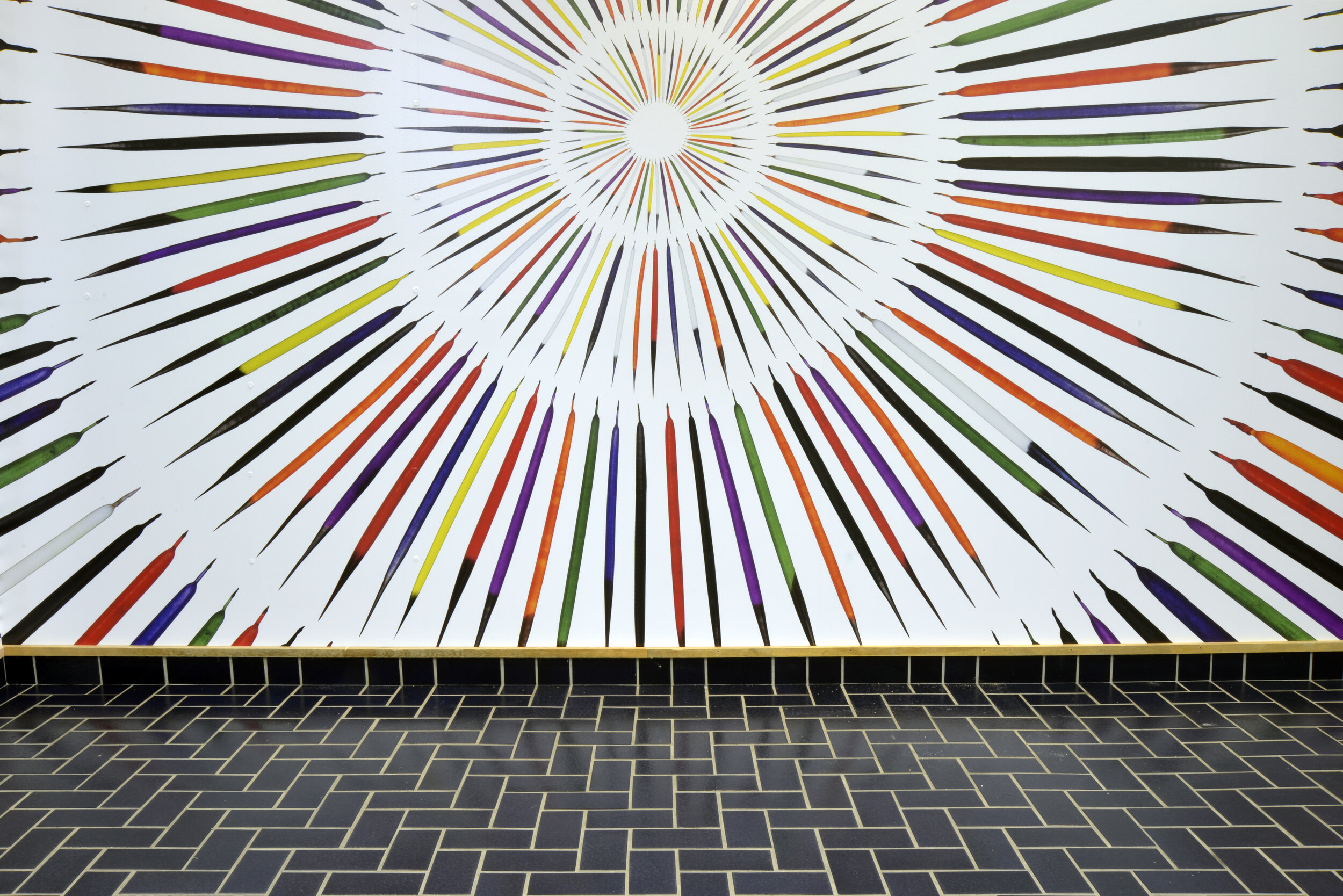
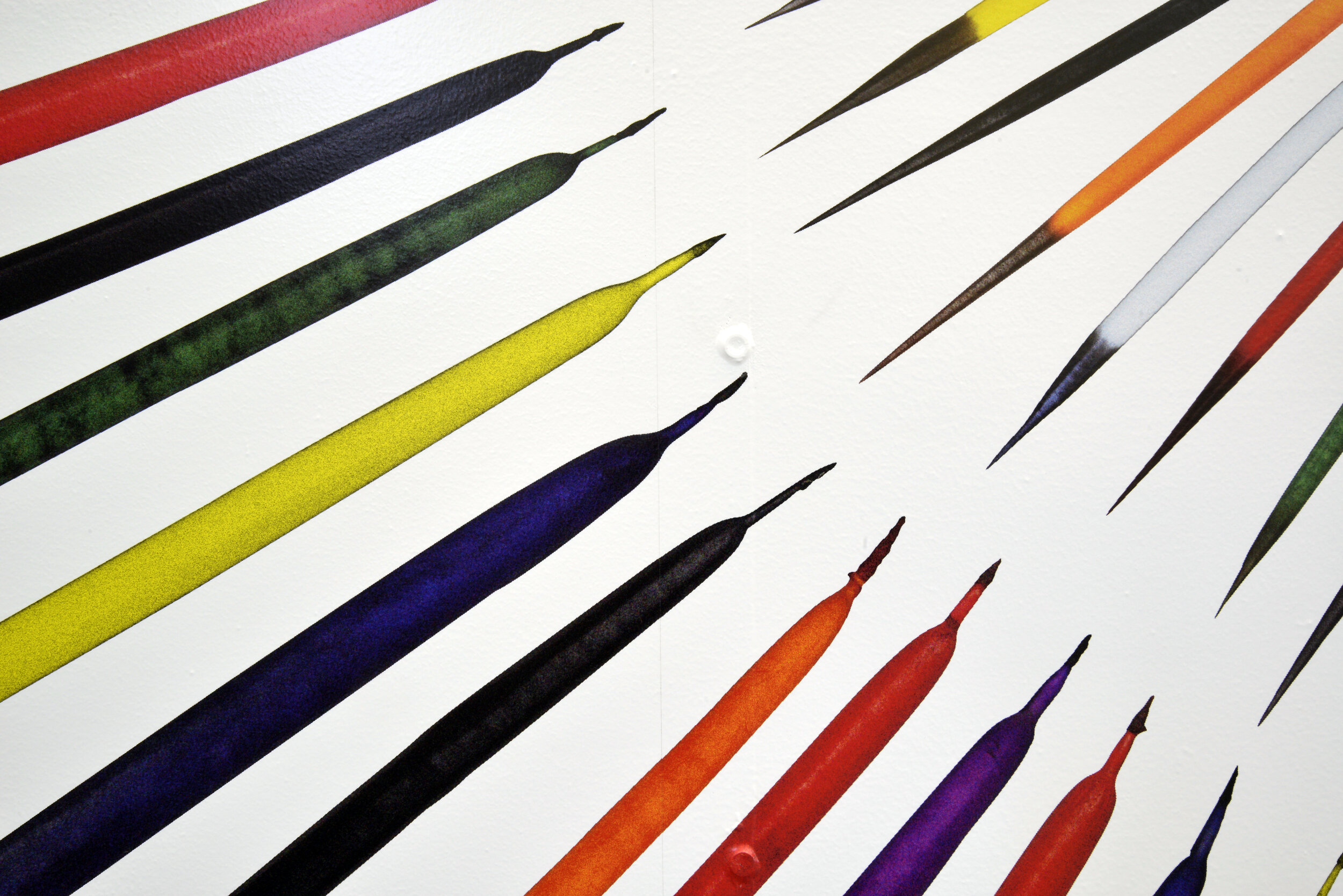
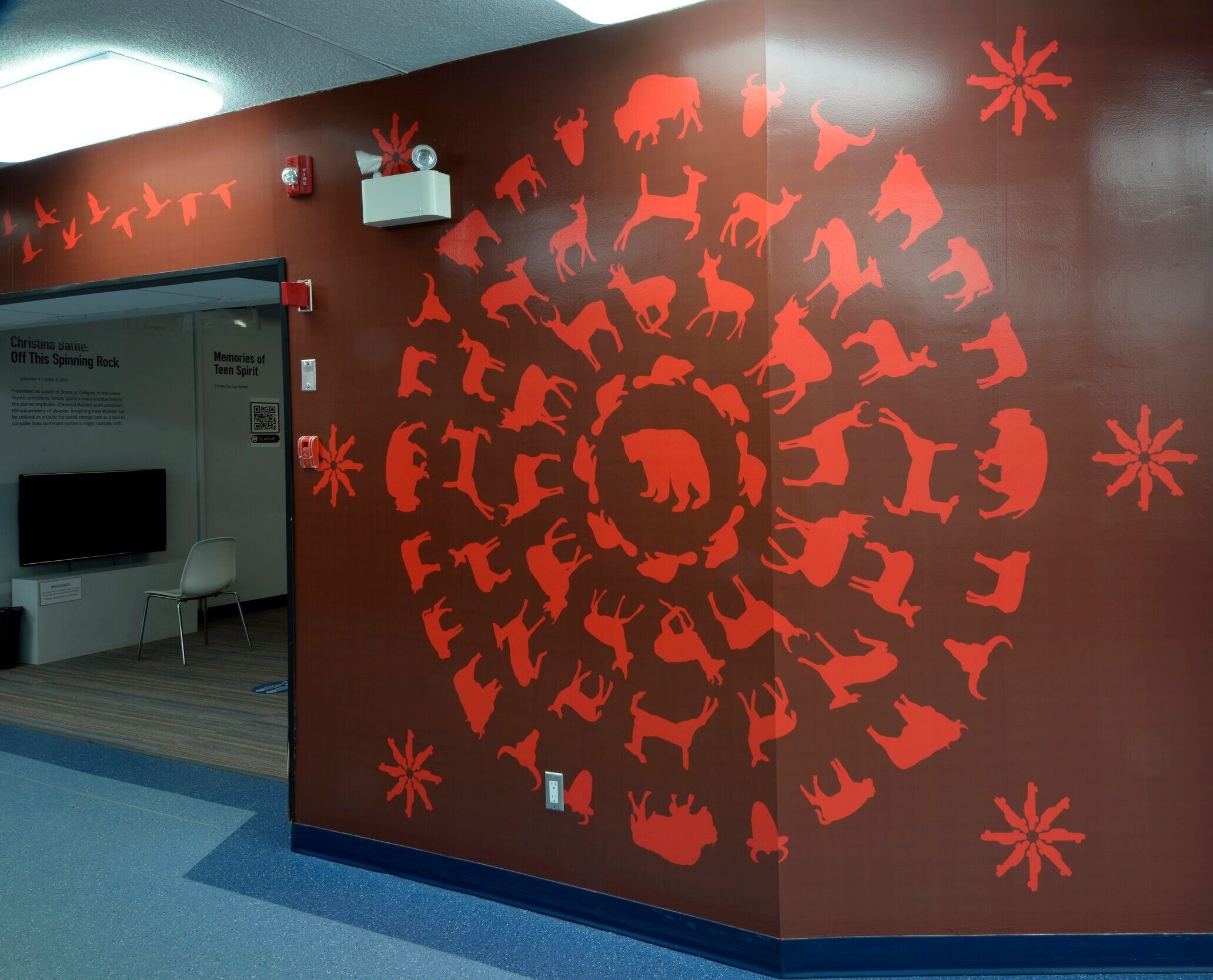
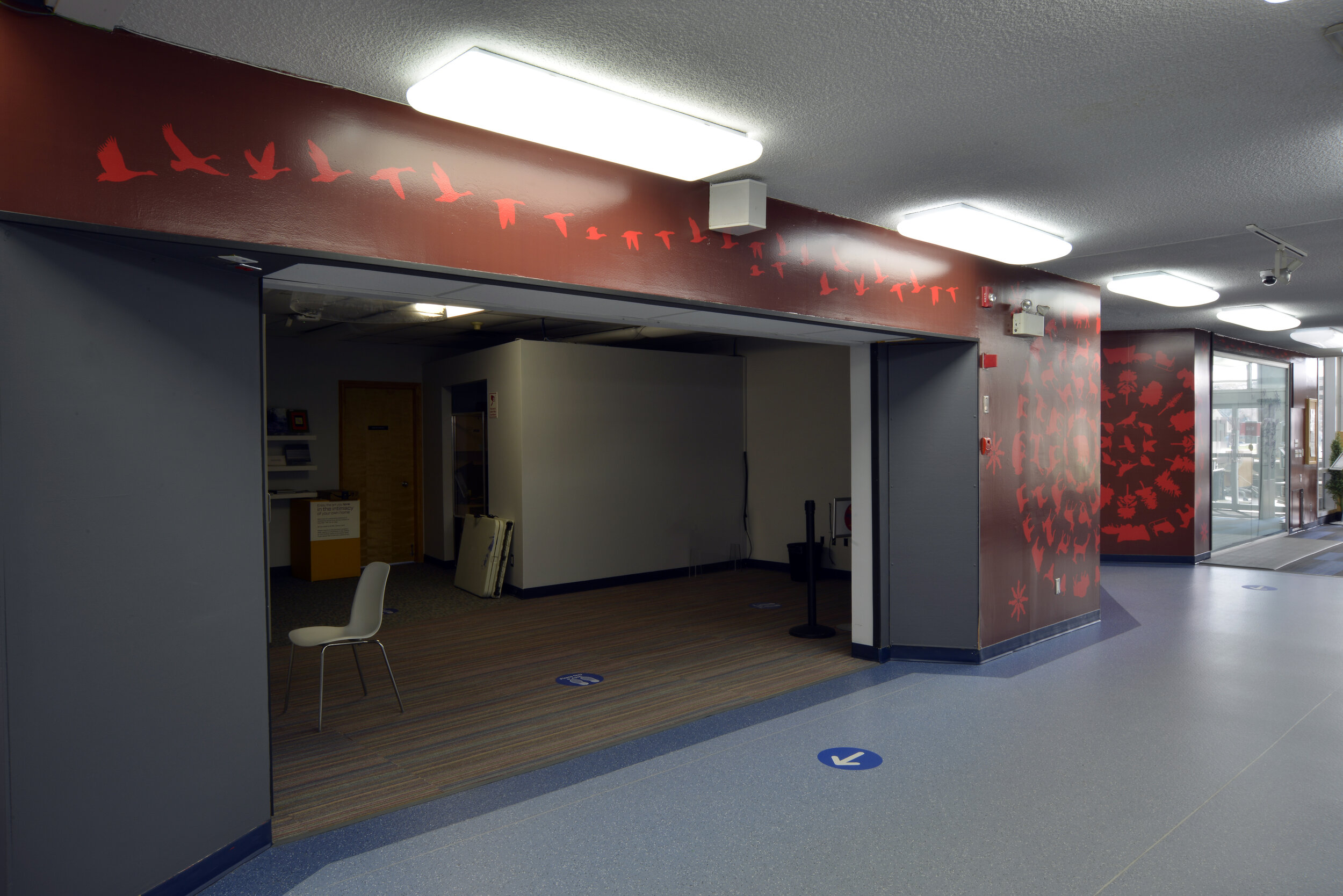
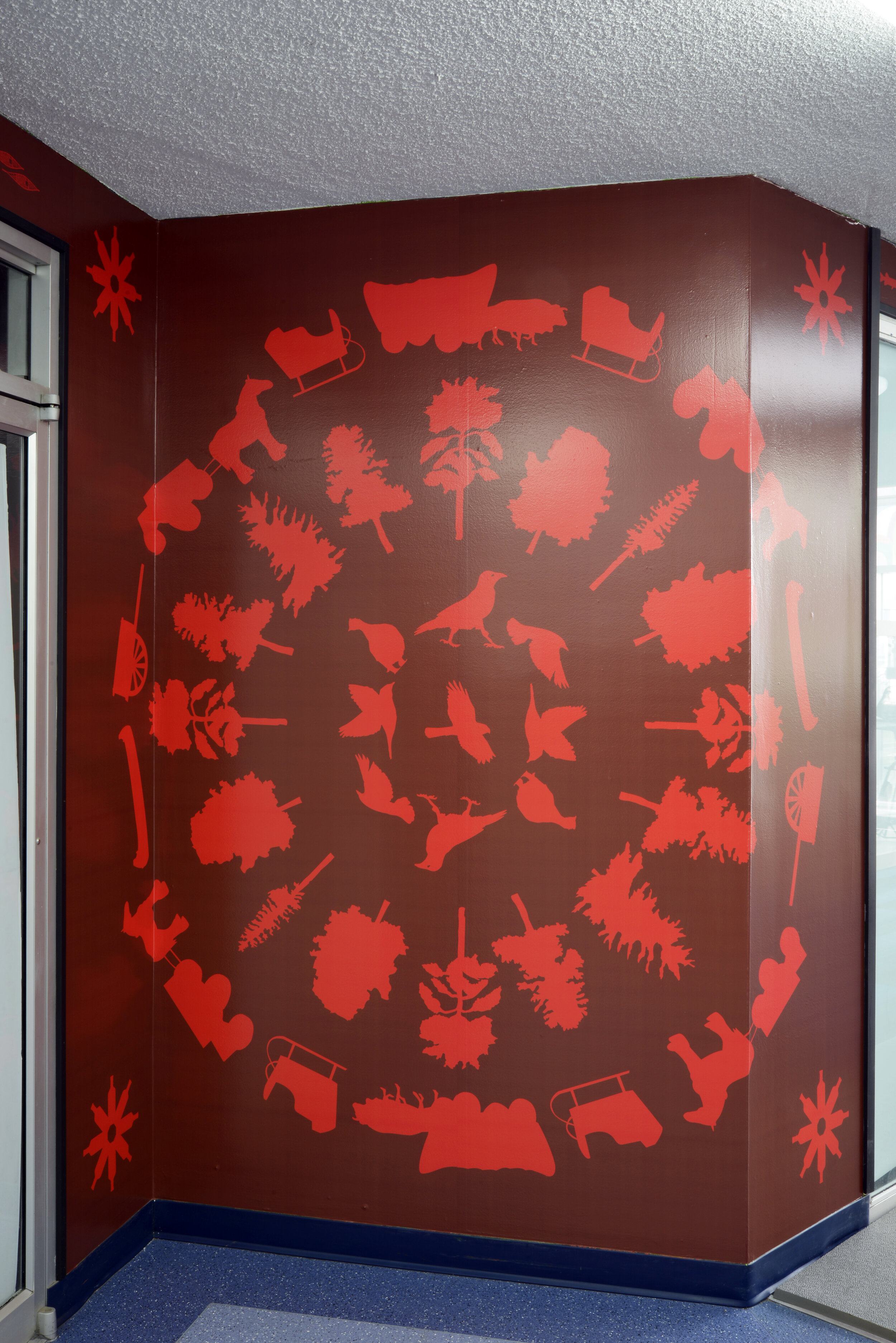
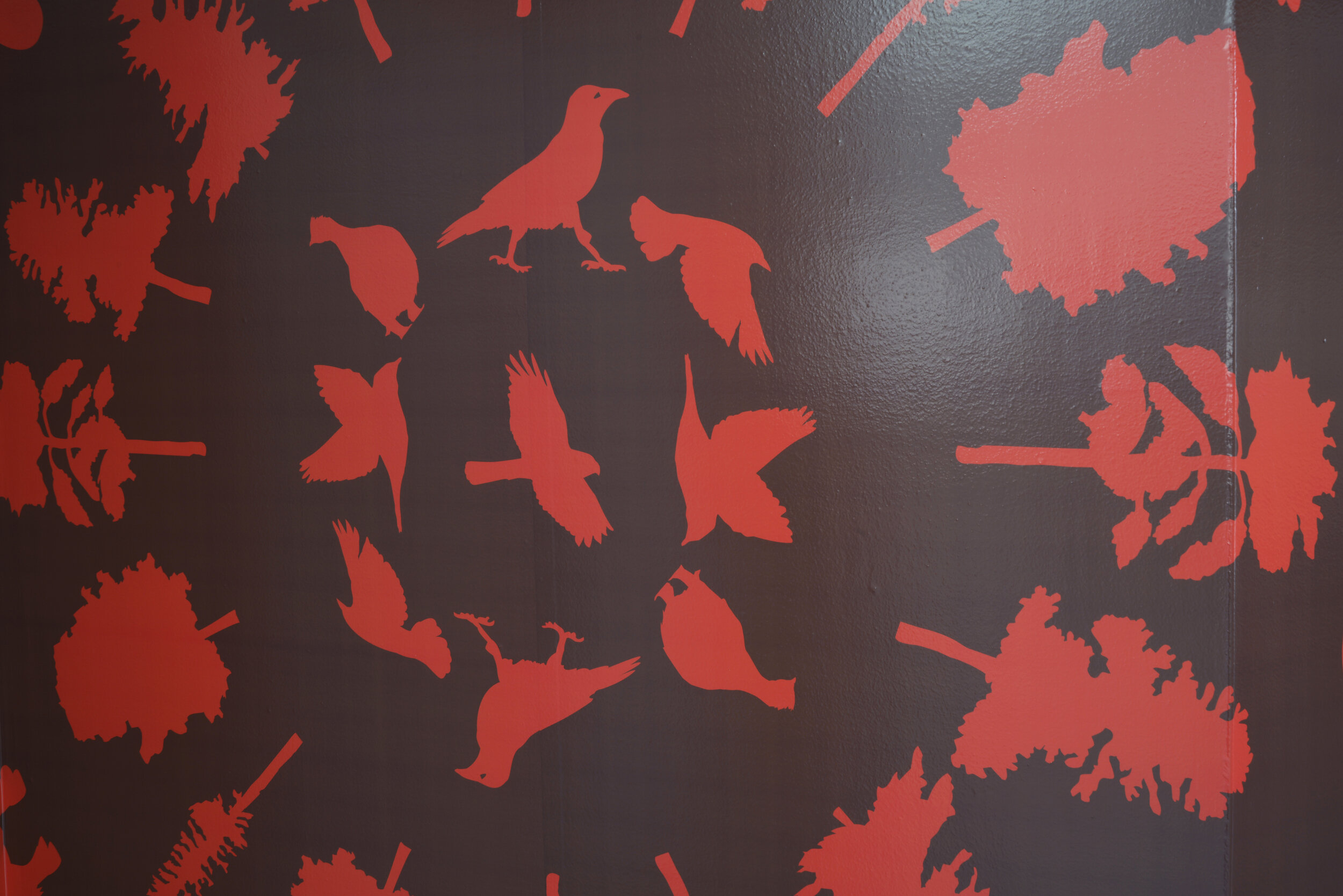
quinn hopkins, 2025, vinyl mural commission
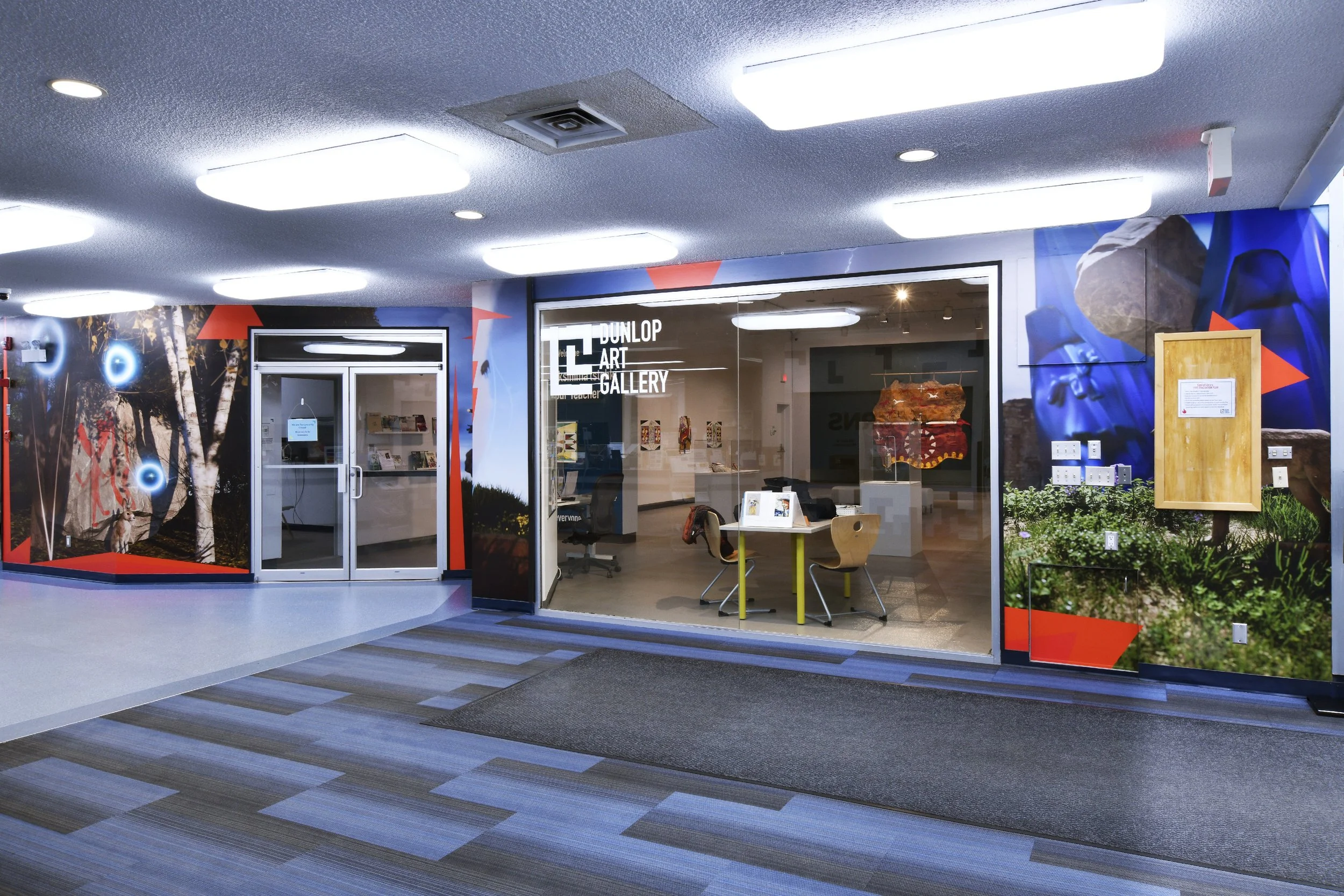
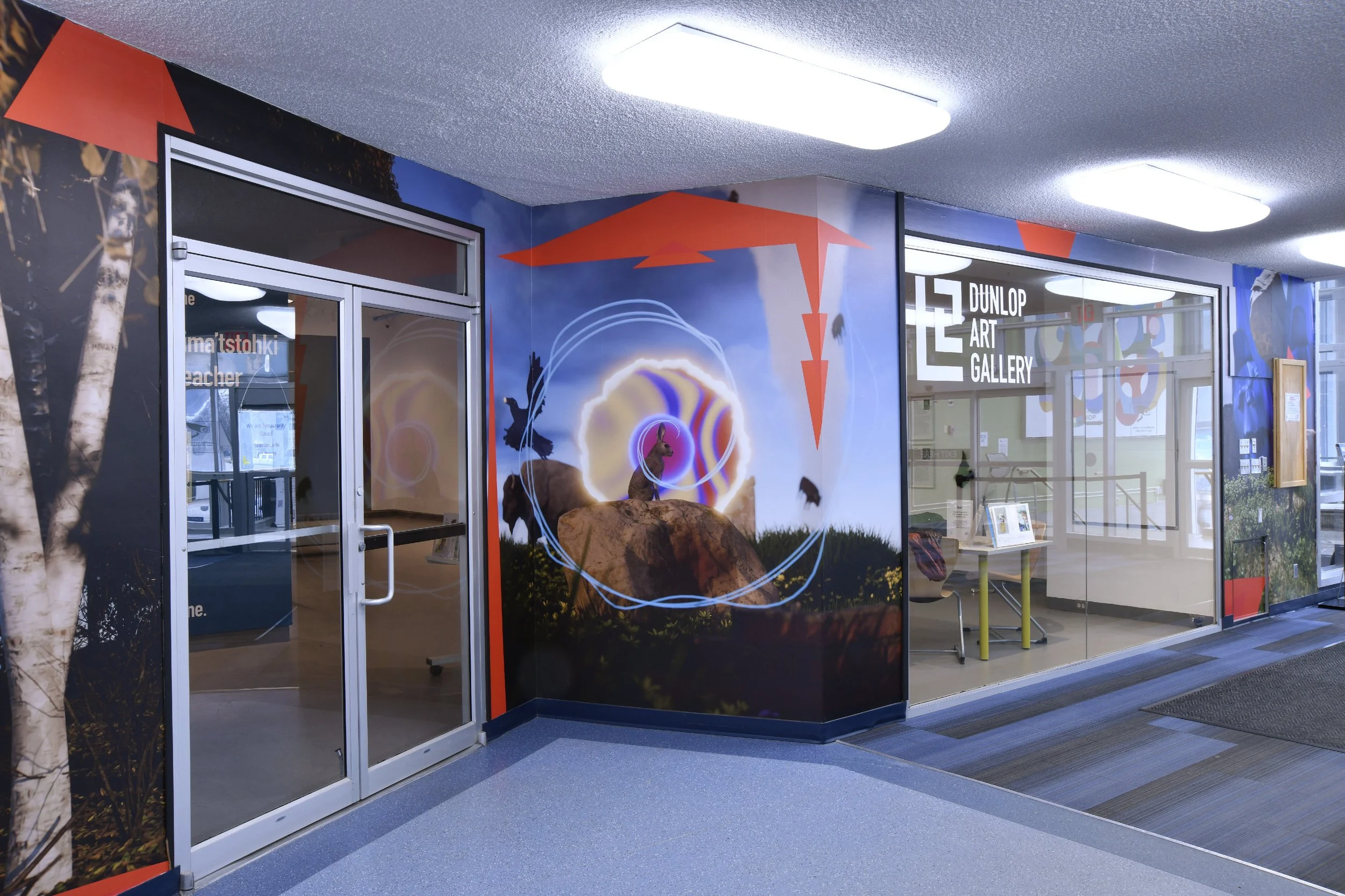
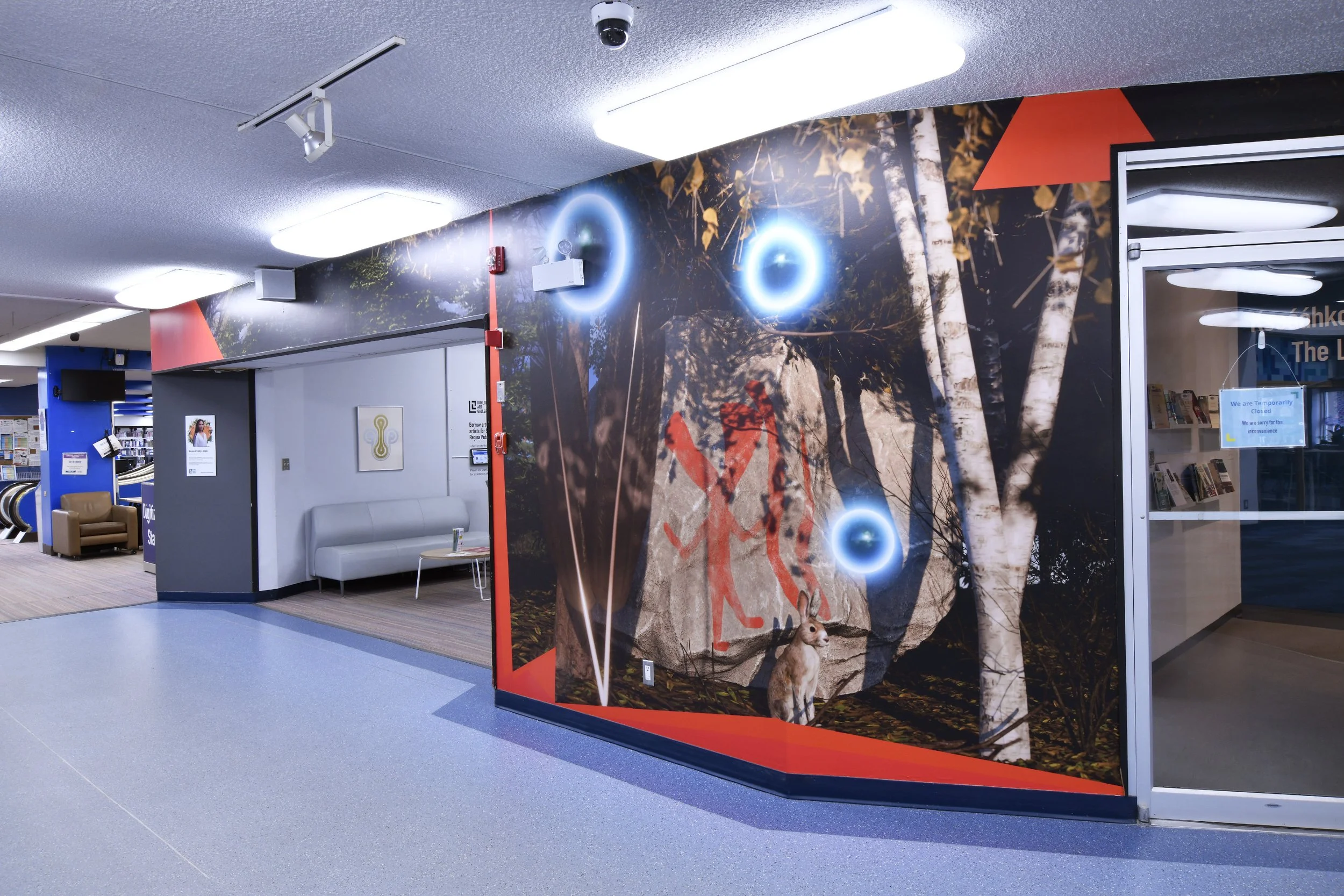
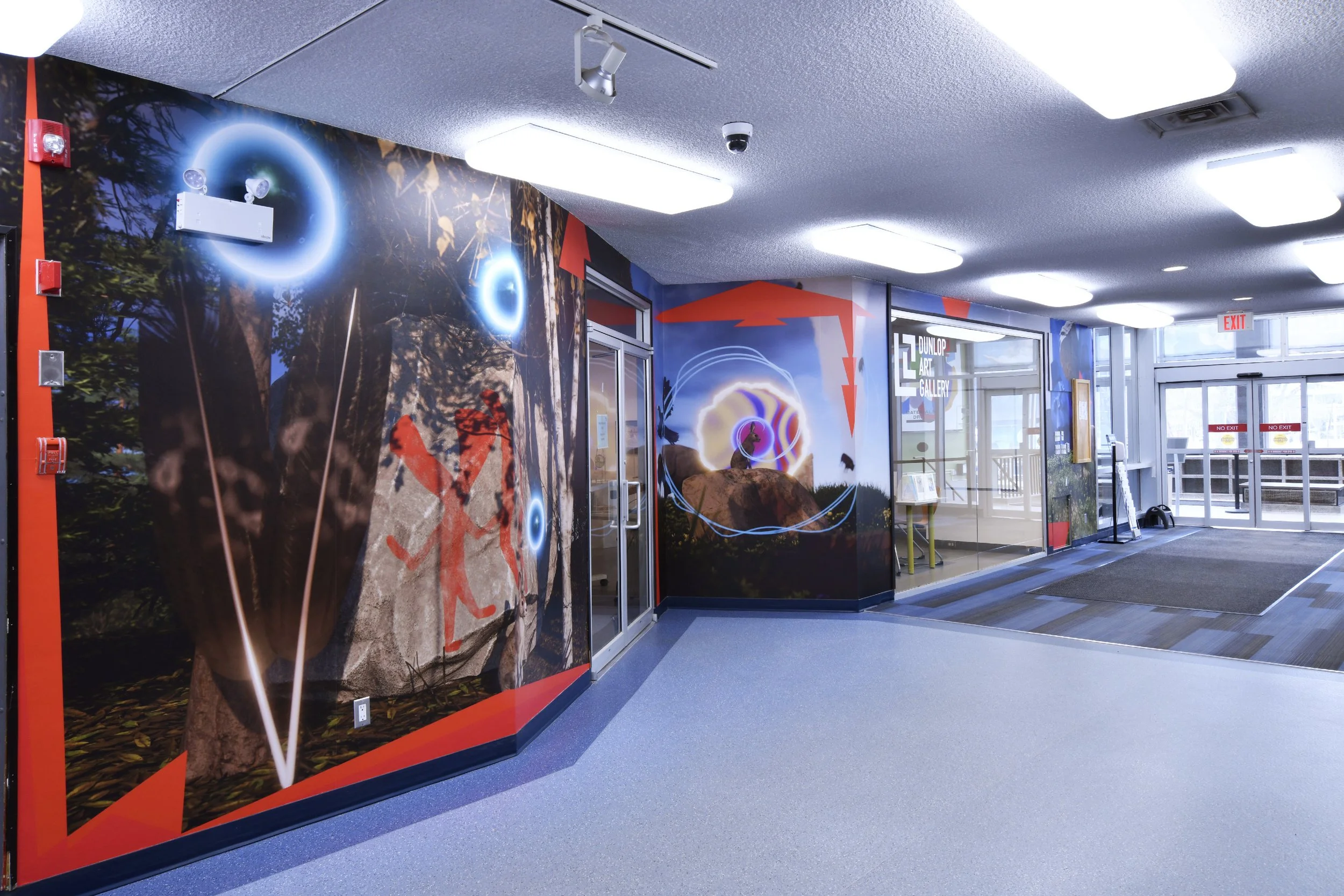
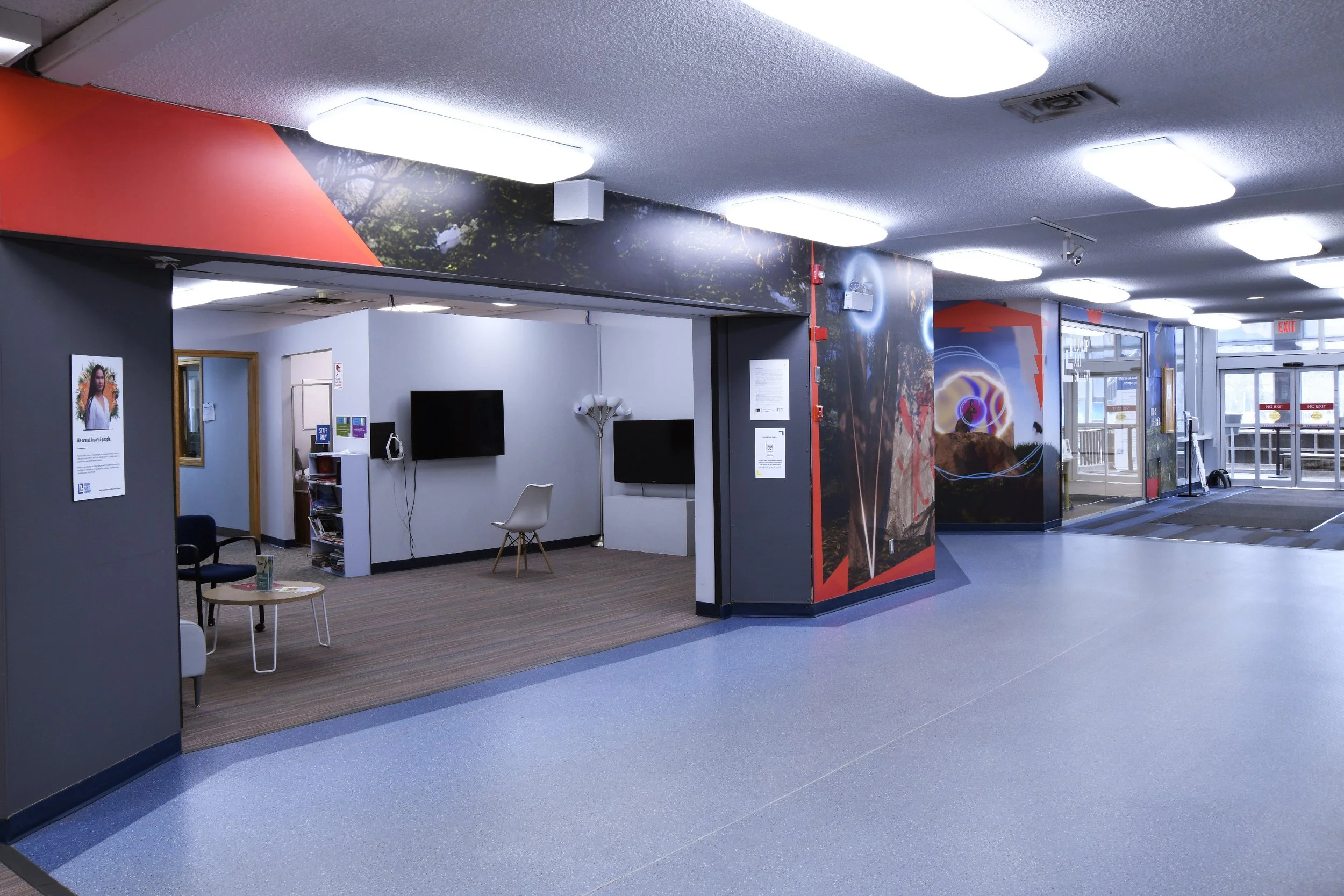
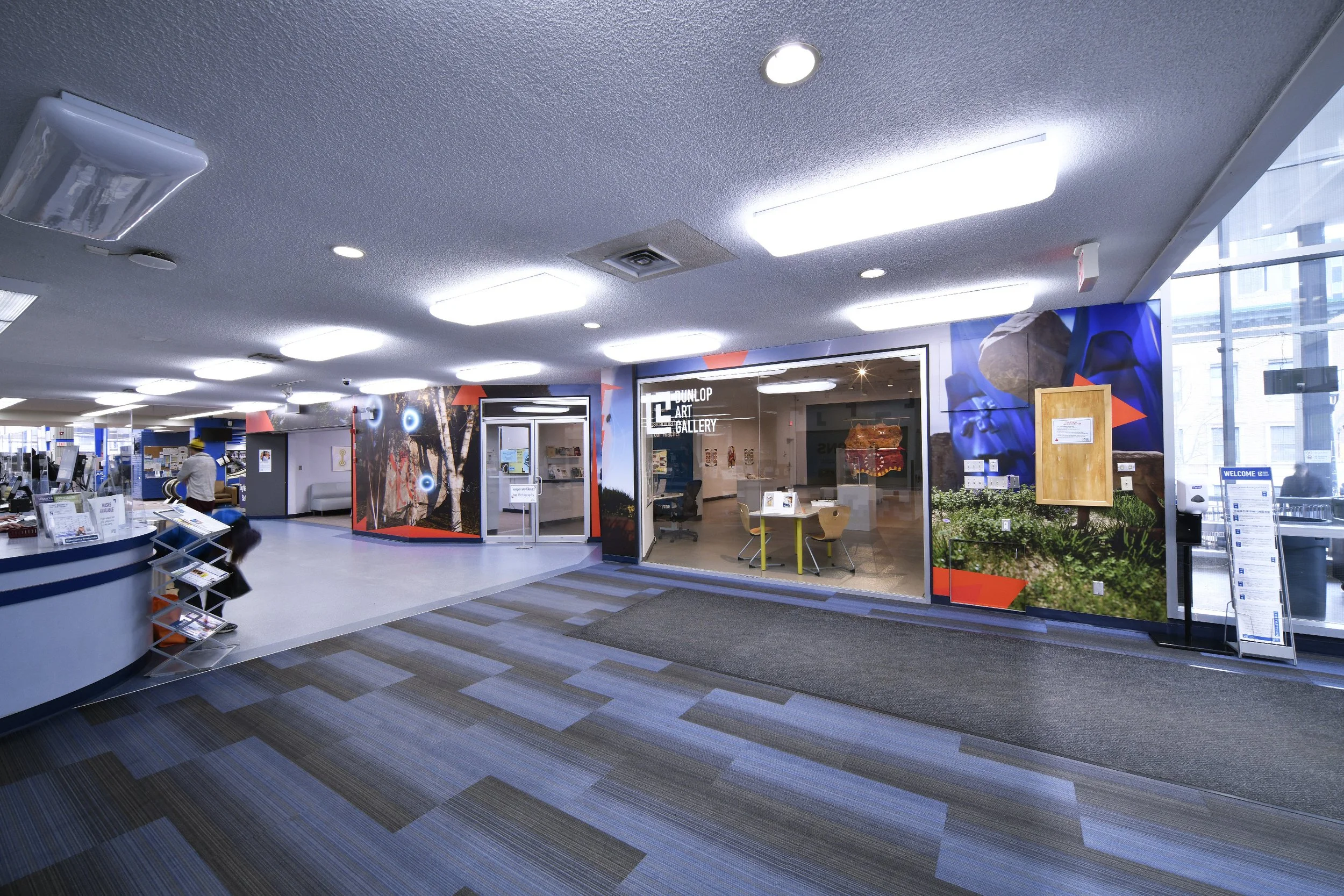
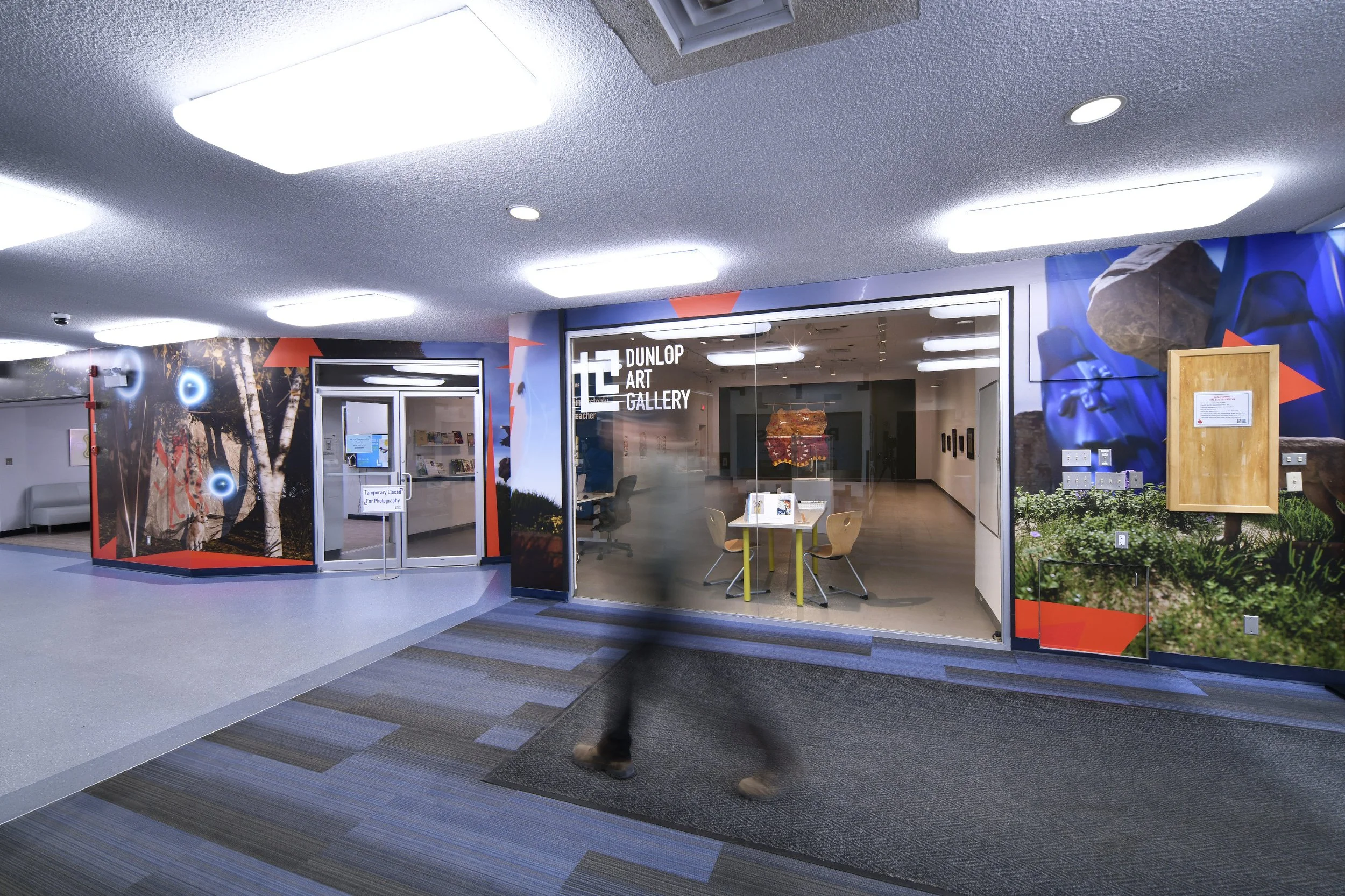
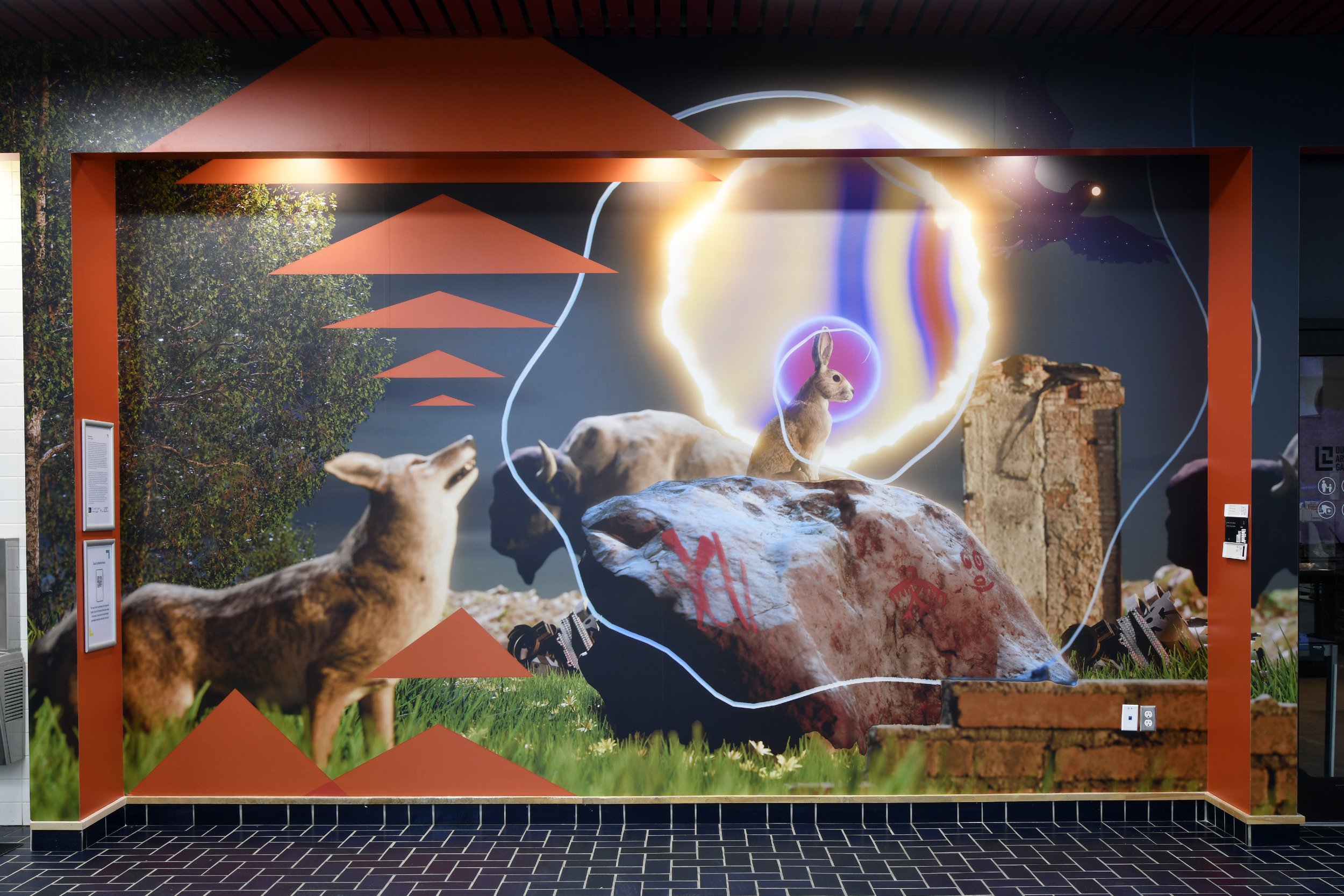
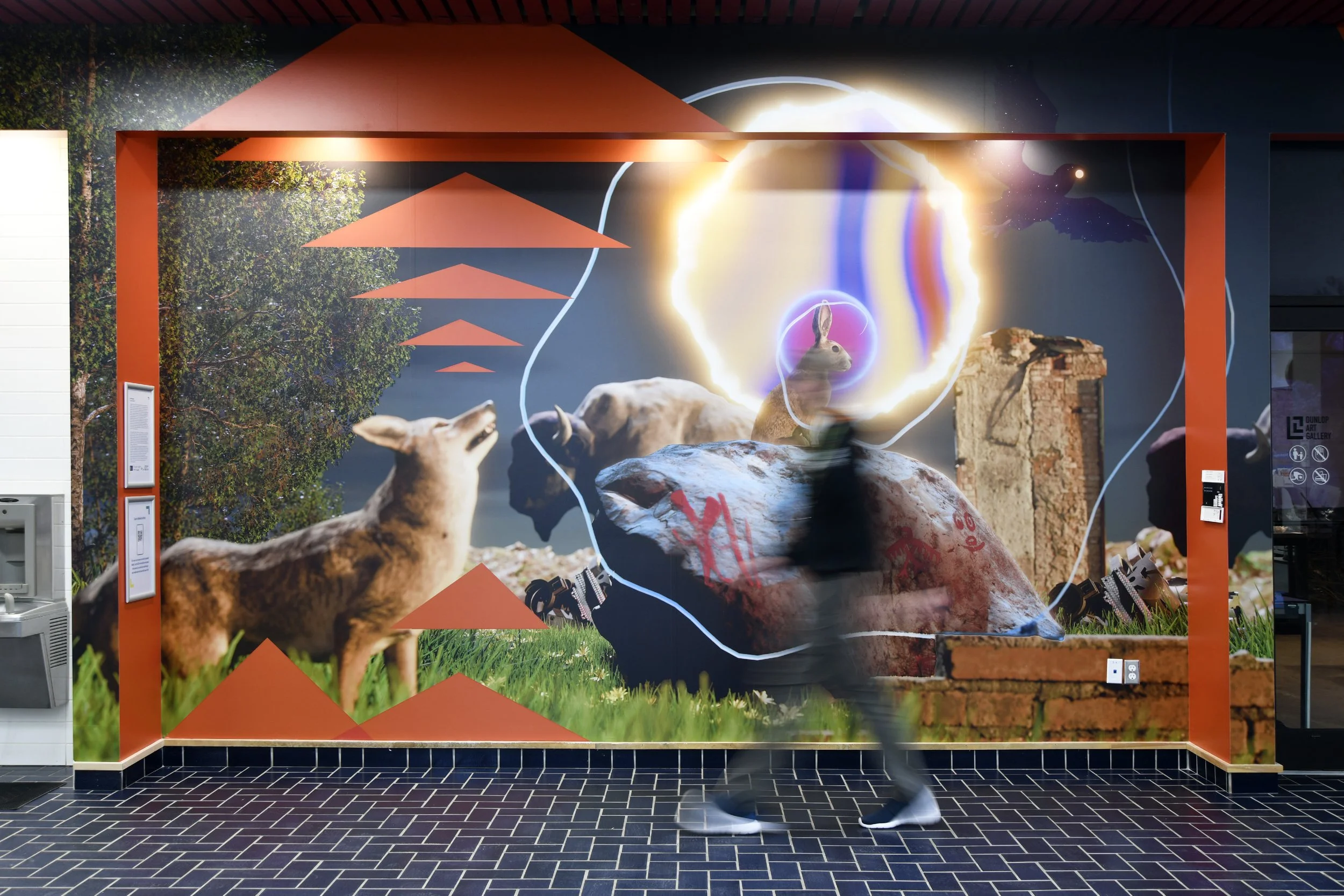
Curtia Wright, 2023, vinyl mural commission
RECENT COMMISSIONS


DAPHNE BOYER, 2021, vinyl mural commission
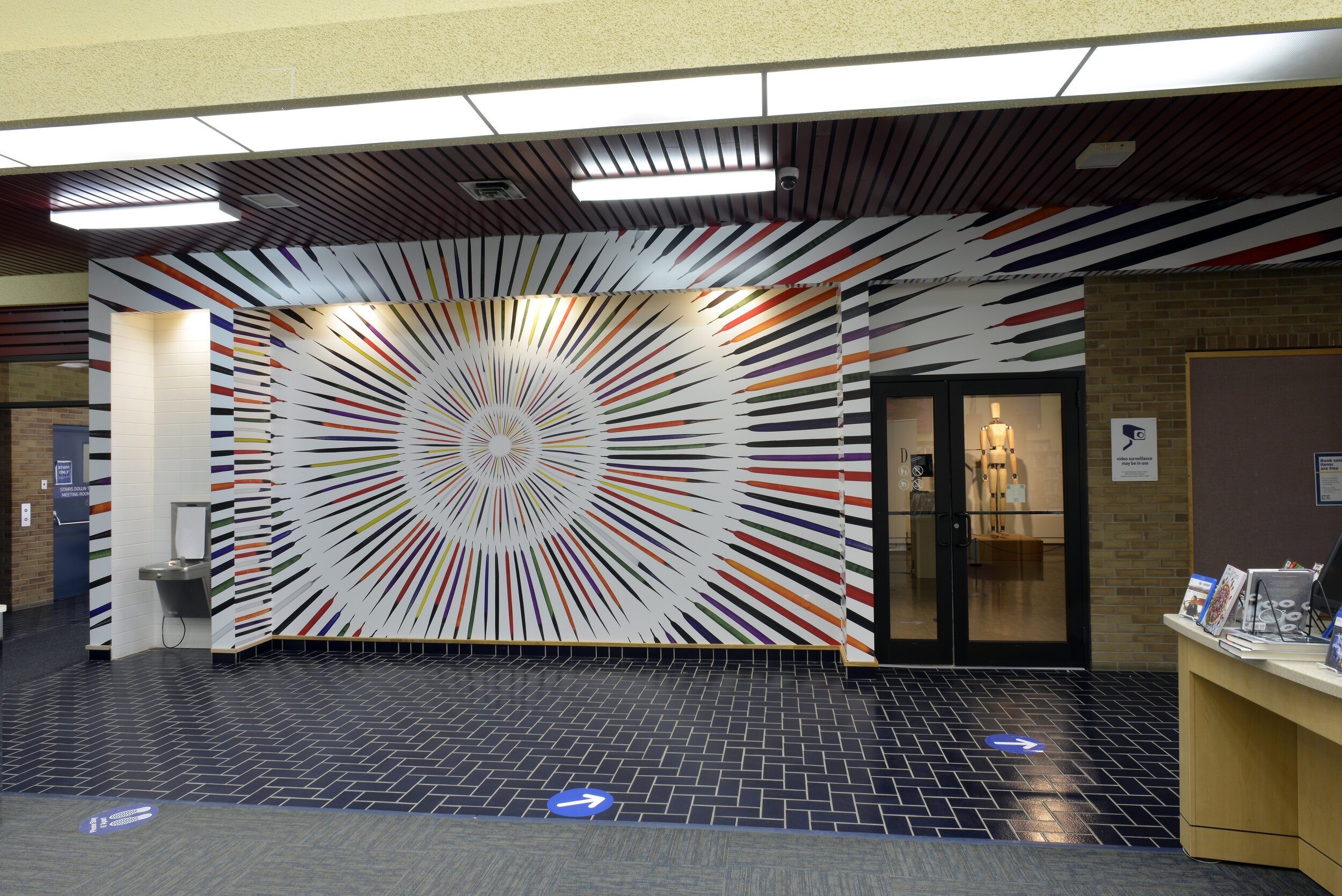
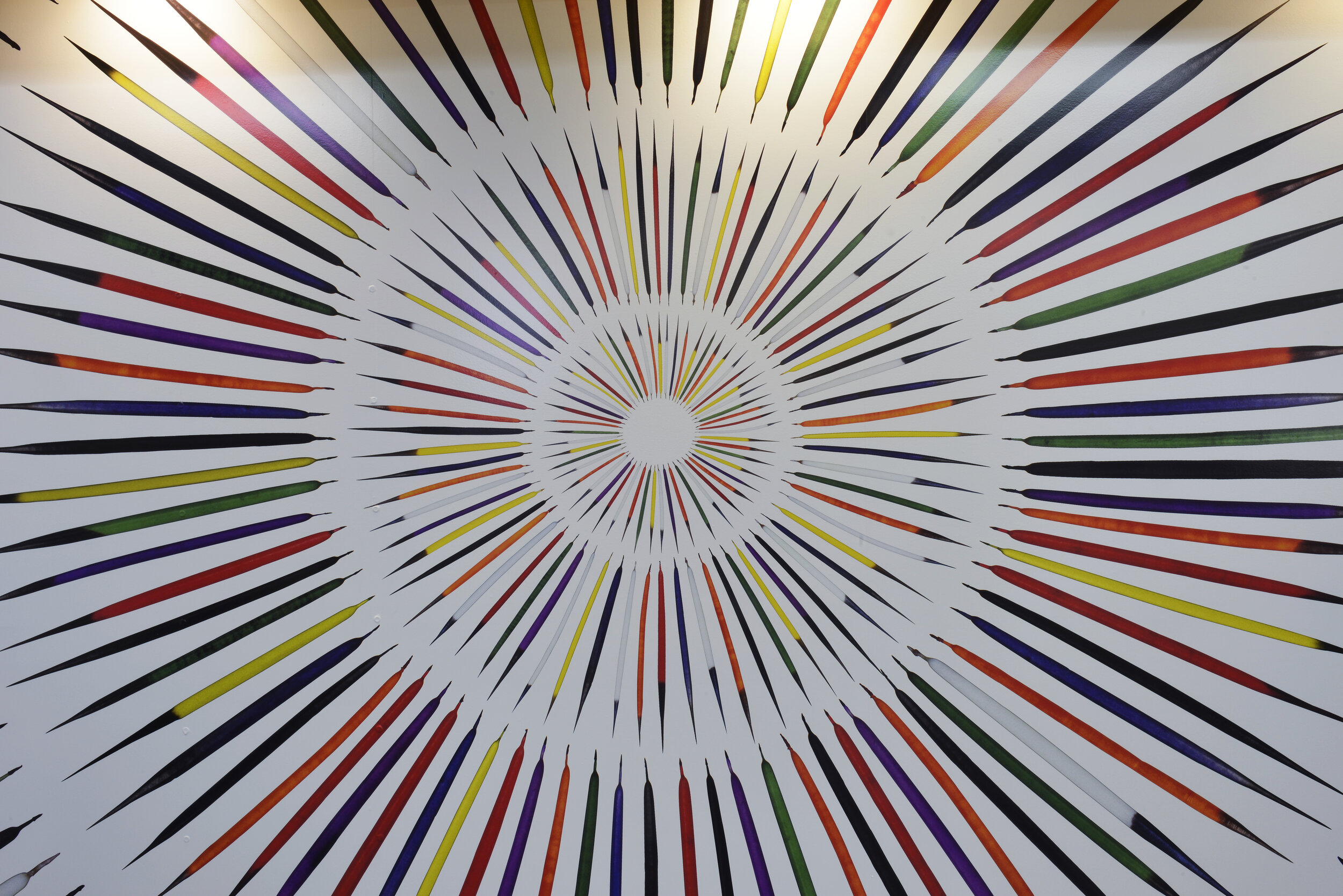
Back to Dunlop Art Gallery or Regina Public Library